CN
CN

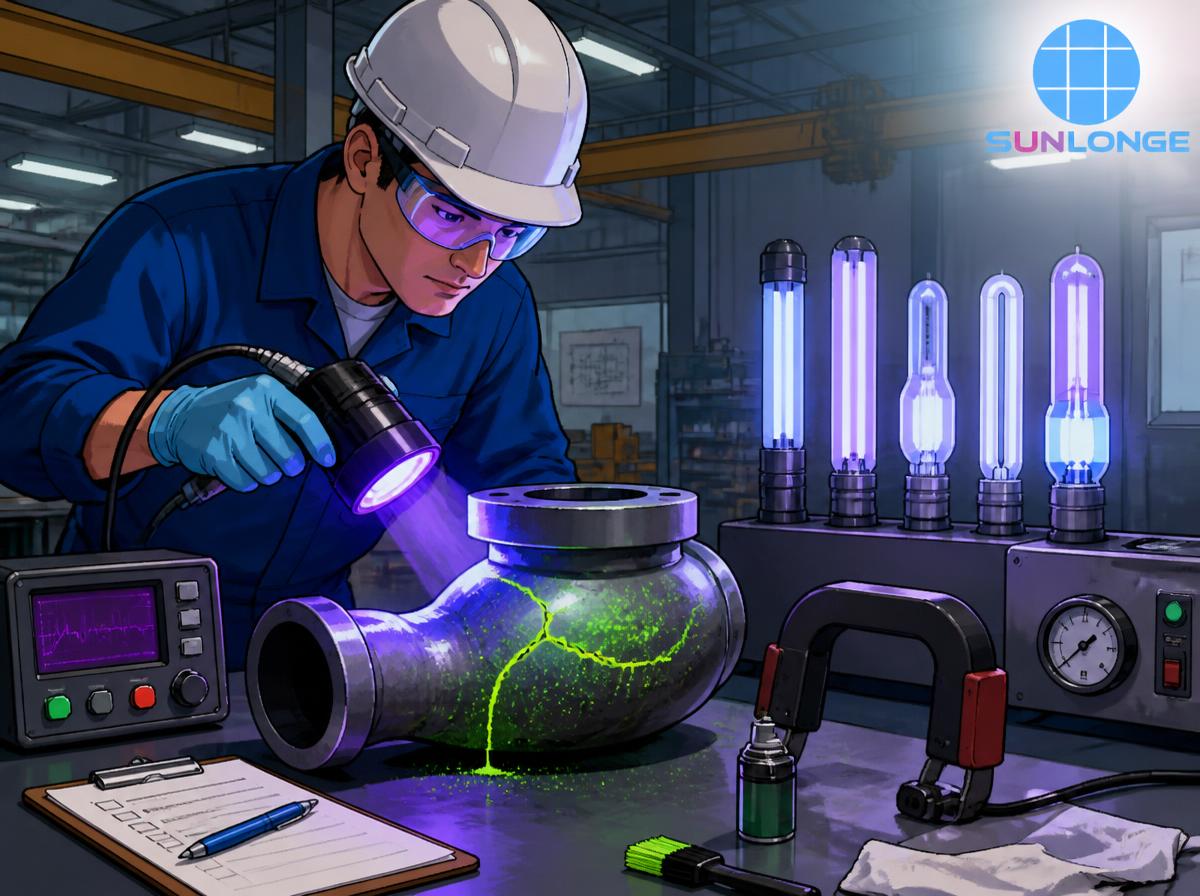
In industrial non-destructive testing (NDT), leak detection, fluorescent penetrant inspection, magnetic particle testing, and related applications, the reliability of the ultraviolet light source directly determines inspection accuracy, production uptime, and total cost of ownership. Traditional UV light sources—primarily medium-pressure and low-pressure mercury vapor lamps, along with certain fluorescent UV tubes—have long served these needs. However, they introduce inherent limitations in startup behavior, output stability over time, service life, and maintenance demands.
Modern UV LED LAMP technology addresses these shortcomings through solid-state design. A well-engineered UV LED lamp delivers instant full-intensity output, highly stable irradiance throughout its operating life, dramatically extended service hours, and near-minimal maintenance. When these advantages are combined with precise wavelength control (typically peaking at 365–370 nm for optimal fluorescence excitation), low visible-light emission, and mercury-free construction, the result is a more reliable, predictable, and cost-effective inspection tool.
This article examines the core reliability differences between UV LED lamps and conventional mercury/fluorescent UV sources, supported by industry data and operational comparisons. It also highlights why products from Sunlonge International Co., Limited—such as the SL6300 series adjustable-beam UV LED flashlight and related NDT lamps—stand out through premium components, rigorous certifications, and application-focused engineering.
Instant Startup: From Minutes of Delay to Milliseconds of Readiness
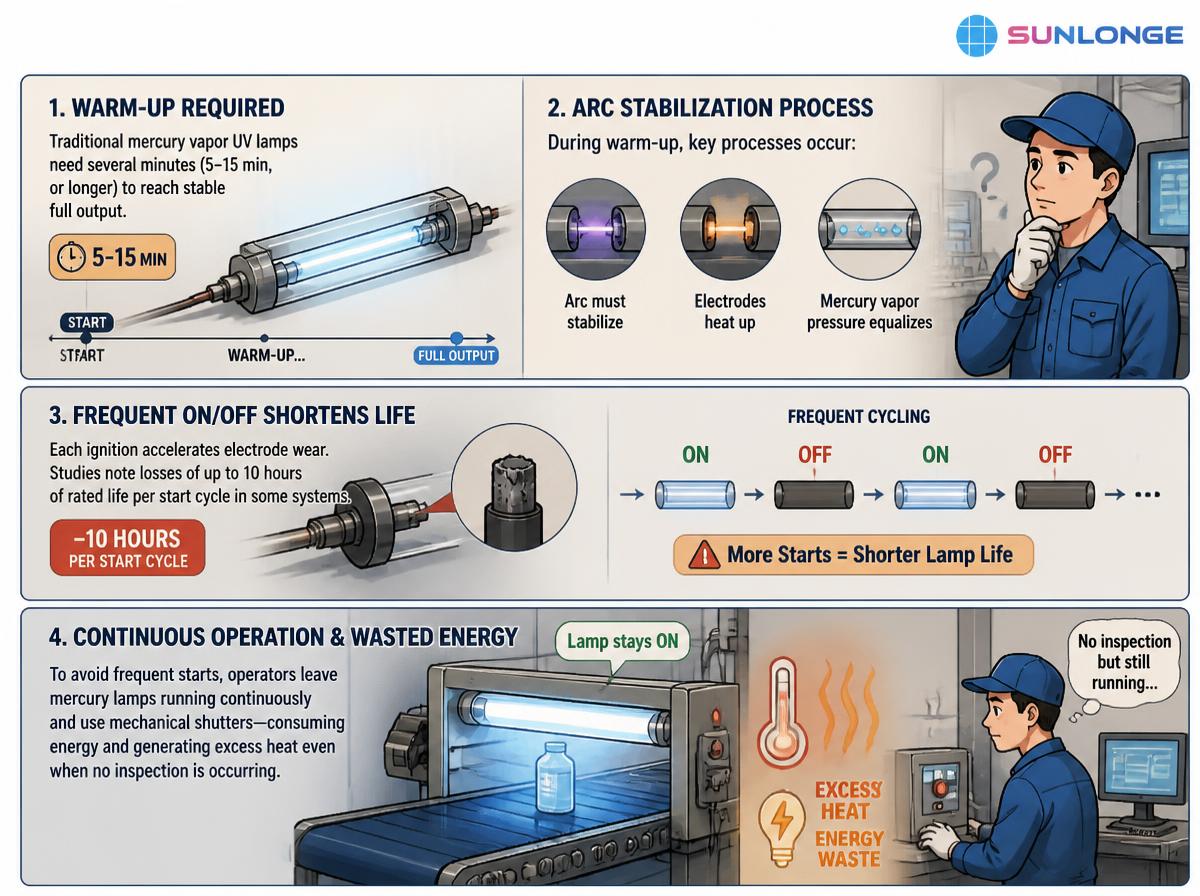
Traditional mercury vapor UV lamps require a warm-up period of several minutes (commonly 5–15 minutes, sometimes longer) to reach stable full output. During this time the arc must stabilize, electrodes heat, and the mercury vapor pressure equalizes. Frequent on/off cycling further shortens lamp life because each ignition accelerates electrode wear—studies note losses of up to 10 hours of rated life per start cycle in some systems. As a result, operators often leave mercury lamps running continuously and use mechanical shutters, consuming energy and generating excess heat even when no inspection is occurring.
In contrast, a UV LED lamp reaches rated output in milliseconds. Solid-state semiconductor junctions respond instantly to drive current. There is no arc to establish and no warm-up curve. This enables true “cure-on-demand” or “inspect-on-demand” operation: the lamp is powered only when needed. The practical benefits are immediate productivity gains, lower energy use (often 50–80% less than continuously running mercury systems), and elimination of shutter mechanisms that themselves become maintenance items.
Sunlonge UV LED lamps incorporate constant-current drivers and high-quality optics so that intensity is available at full specified levels the moment the switch is activated. For field technicians performing fluorescent penetrant or magnetic particle inspections, or for production-line stations requiring rapid cycling, this instant readiness removes a chronic source of process variability and downtime.
Stable Output: Predictable Performance Versus Gradual and Uneven Degradation
Mercury lamps suffer progressive and often non-uniform degradation. Electrode erosion changes arc characteristics, the quartz envelope solarizes (preferentially absorbing shorter wavelengths), and overall UV output declines. Spectral shifts can occur—shorter wavelengths may drop faster than longer ones—affecting fluorescence efficiency. After several hundred hours, intensity at critical wavelengths can fall 20% or more, requiring frequent recalibration or compensatory adjustments. Failure mode is frequently abrupt once electrodes or the envelope reach end-of-life thresholds.
UV LED lamps degrade far more gradually and predictably. Lifetime is typically specified to the L70 point (hours until output falls to 70% of initial calibrated value). High-quality industrial UV LEDs commonly achieve 10,000–25,000+ hours under proper thermal management; premium systems reach or exceed 30,000 hours. Output decline is continuous and trackable with a radiometer, allowing planned replacement rather than sudden process interruptions. Critically, the emission peak wavelength remains essentially constant because it is determined by the semiconductor bandgap rather than vapor pressure or envelope condition.
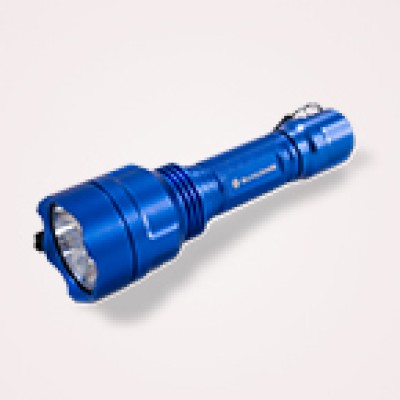
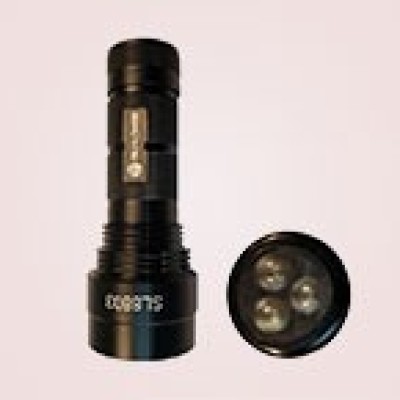
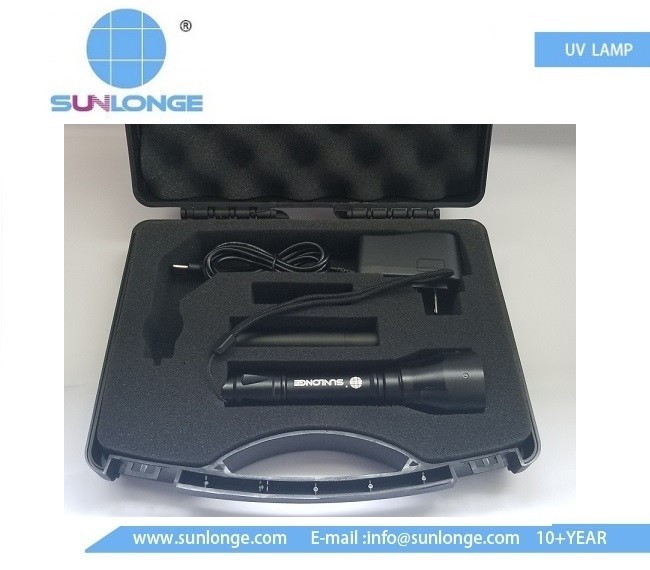
Sunlonge designs emphasize this stability. Models such as the SL6300 series use NICHIA 5 W 365 nm LEDs paired with constant-current drivers that maintain intensity even as battery voltage declines. Specified UV intensity stability exceeds 85% (and higher in multi-LED configurations). Low visible-light emission (<0.5–2 foot-candles depending on model and filters) further ensures high contrast for fluorescent indications without washout. These characteristics translate into consistent inspection sensitivity across long production runs or extended field campaigns.
Long Service Life: Years of Operation Versus Months of Replacement Cycles
Rated lifetimes illustrate the gap clearly. Medium-pressure mercury lamps used in many industrial UV applications are typically rated 500–2,000 hours (often around 1,000–1,500 hours to significant output loss or failure probability). Low-pressure germicidal or fluorescent UV sources may reach 8,000–10,000 hours under continuous operation, but performance still declines and cycling shortens life. In a two-shift production environment accumulating roughly 4,000 operating hours per year, a 1,500-hour mercury lamp requires replacement approximately every 4–5 months—2–3 times annually per station. Over five years this can mean 10–15 lamp changes, each involving procurement, handling of hazardous mercury waste, cleaning, realignment, and verification.
A UV LED lamp rated at 20,000–30,000 hours under the same schedule reaches its L70 point after several years of continuous use. Because LEDs tolerate unlimited on/off cycling without the electrode-wear penalty of mercury arcs, effective calendar life is often even longer when duty cycles are below 100%. Replacement becomes a planned, infrequent event rather than a recurring operational burden. Solid-state construction also eliminates glass envelope breakage risks and mercury contamination hazards.
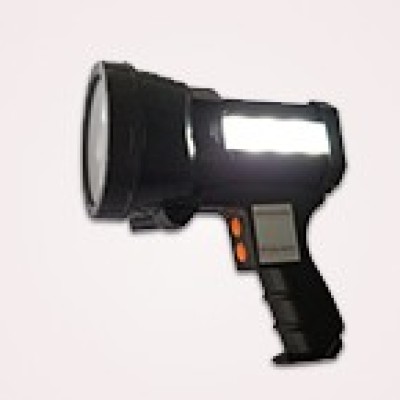
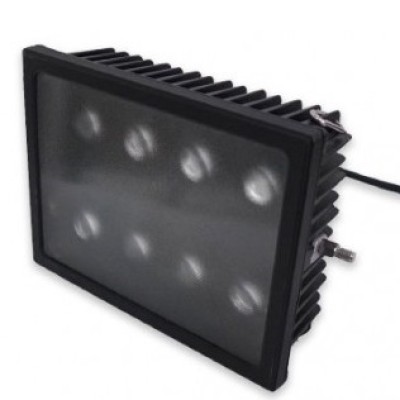
Sunlonge specifies an average LED life of 30,000 hours across its UV NDT lamp portfolio, including the SL6300 adjustable-beam flashlight, multi-LED handheld units (e.g., SL8803 and SL8104 series), and larger inspection lamps. This longevity, combined with robust thermal design and quality optics, supports multi-year service intervals in demanding environments such as aerospace NDT, pipeline inspection, automotive component testing, and industrial leak detection.
Reduced Maintenance Requirements and Lower Total Cost of Ownership
Maintenance differences compound the reliability advantage. Mercury systems demand regular lamp changes, disposal of hazardous waste, cleaning of reflectors and filters that accumulate deposits, verification of output after each change, and often cooling or ventilation systems to manage heat and ozone. Each intervention creates downtime and labor cost. In contrast, UV LED lamps have no consumable bulbs in the traditional sense, produce negligible ozone, generate far less heat, and require primarily occasional cleaning of external optics. Intensity monitoring with a radiometer enables predictive rather than reactive maintenance.
Industry analyses consistently show substantial reductions in after-sales costs, energy consumption, and unplanned stoppages when switching to UV LED technology. Energy savings of 50–80% are frequently cited, partly because LEDs operate only when needed and convert a higher fraction of input power into useful UV rather than infrared heat. Environmental benefits—elimination of mercury and reduced CO₂ footprint—align with tightening global regulations on mercury-containing products.
Sunlonge products further reduce ownership costs through practical features: portable battery-powered designs with multi-hour run times, dual AC/DC options on larger units, adjustable beam diameters (allowing one lamp to serve multiple inspection geometries), and modular construction. Aerospace-grade variants meet stringent visible-light and intensity criteria so that a single certified tool can cover both general industrial and specialized aeronautical NDT without additional equipment.
Why Sunlonge UV LED Lamps Deliver Superior Reliability
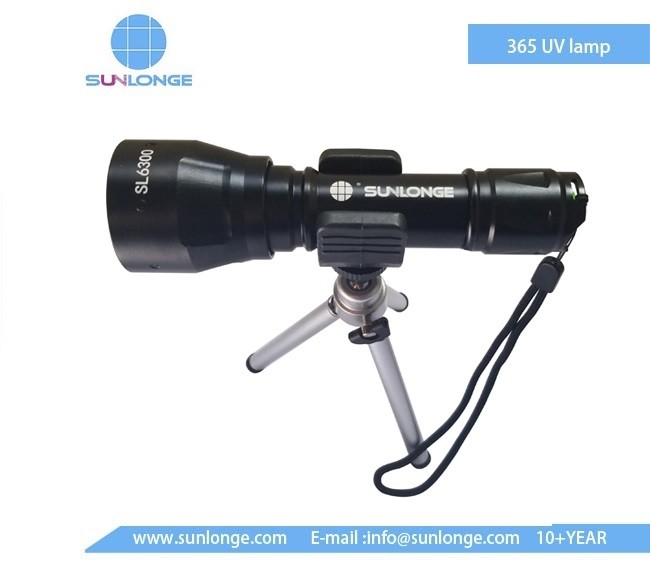
While the fundamental advantages of UV LED technology apply broadly, execution quality varies significantly across manufacturers. Sunlonge International Co., Limited (established 1999, Hong Kong headquarters with mainland China manufacturing and dedicated R&D) differentiates itself through several concrete factors:
- Premium LED sources and optical engineering: Integration of NICHIA 5 W 365 nm LEDs, multi-lens and filter systems, and adjustable-focus optics that deliver both high peak intensity (up to 35,000 µW/cm² at 15 inches / 380 mm on high-output variants) and controlled beam diameters (e.g., 20–100 mm adjustable on the SL6300 series). Intensity and wavelength can be customized to application needs.
- Documented stability and life: Average LED life of 30,000 hours with UV intensity stability >85% (higher on multi-LED models). Constant-current drivers maintain output as power sources age.
- Comprehensive certifications: Compliance with ASTM E3022 (and related standards ASTM E1417, E1444, E709, E2297) for UV-A lamps used in fluorescent penetrant and magnetic particle testing. Aerospace models meet Rolls-Royce RRES 90061 requirements, including strict limits on visible light emission (<0.5 FC / 5 lux on certain configurations). Certificates of compliance for output and wavelength are typically supplied.
- Application-proven designs: Handheld flashlights optimized for fluorescent magnetic particle and penetrant testing, mining inspection, aeronautics NDT, hydraulic and HVAC leak detection, and other industrial uses. Low-heat, solid-state operation functions reliably in strong magnetic fields. Portable form factors (e.g., SL6300 at approximately 160 g) reduce operator fatigue during extended inspections.
- Practical reliability features: Instant on/off, mercury-free construction, no ozone generation, and designs that minimize thermal stress on the LEDs. Multi-model portfolio allows selection of intensity, coverage area, and power configuration matched to the specific duty cycle and environment.
These attributes translate into fewer process interruptions, more consistent defect detection sensitivity, and lower long-term costs compared with both traditional mercury systems and lower-tier UV LED alternatives that may lack equivalent thermal management, spectral control, or certification rigor.
Comparison Table: Key Reliability and Performance Metrics
| Factor | Traditional Mercury / Fluorescent UV Lamps | High-Quality UV LED Lamps (e.g., Sunlonge) |
| Startup / Warm-up | 5–15+ minutes; cycling shortens life | Instant (milliseconds); unlimited cycling |
| Output Stability | Progressive decline + spectral shift; abrupt failure risk | Gradual, predictable L70 decline; wavelength stable |
| Typical Service Life | 500–2,000 h (medium-pressure); 8,000–10,000 h (some LP) | 10,000–30,000+ h (Sunlonge: 30,000 h average) |
| Replacement Frequency (2-shift) | Every 4–5 months (approx. 2–3×/year) | Every several years |
| Maintenance | Frequent bulb changes, hazardous disposal, cleaning | Minimal; primarily optics cleaning + radiometer checks |
| Heat / Ozone | High heat + ozone generation | Low heat, no ozone |
| Visible Light Emission | Variable; often higher | Tightly controlled (<0.5–2 FC depending on model) |
| Environmental / Safety | Contains mercury; breakage risk | Mercury-free; solid-state |
| Energy Use | High; often continuous operation | 50–80% lower; on-demand only |
| Example Intensity (15 in) | Application-dependent | Up to 35,000 µW/cm² (high-output models); stable |
Data synthesized from industry lifetime studies, manufacturer ratings, and operational comparisons. Actual results depend on thermal management, drive conditions, and duty cycle.
Real-World Implications for Industrial Users
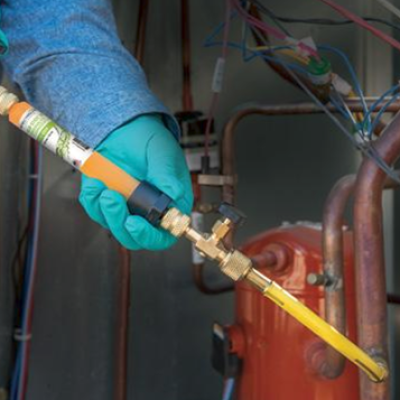
In aerospace NDT, where RRES 90061 and ASTM compliance are mandatory, a lamp that delivers stable, low-visible-light UV-A intensity without warm-up delays improves both throughput and auditability. In pipeline, hydraulic, and HVAC leak detection using fluorescent dyes, consistent high irradiance and long battery/runtime reduce the number of tools technicians must carry and the frequency of returns for maintenance. Production facilities running continuous fluorescent penetrant lines benefit from the elimination of unplanned lamp failures that stop entire inspection stations.
Market data reinforce the shift: the UV LED sector continues strong growth, driven by regulatory pressure on mercury, energy-efficiency mandates, and demand for process reliability in electronics, automotive, oil & gas, and precision manufacturing. Facilities that transition report measurable reductions in lamp-related downtime and consumable costs while maintaining or improving inspection quality.
Frequently Asked Questions
Q: How much longer do UV LED lamps typically last compared with mercury UV lamps? A: High-quality industrial UV LED lamps commonly deliver 10,000–30,000 hours to L70 versus 1,000–2,000 hours for many medium-pressure mercury lamps used in NDT and curing. Sunlonge rates its LEDs at an average 30,000 hours. In multi-shift use this often means years between replacements rather than months.
Q: Do UV LED lamps really turn on instantly with full intensity? A: Yes. There is no warm-up period. Full specified output is available within milliseconds, unlike mercury lamps that require minutes to stabilize and suffer life penalties from frequent starts.
Q: Is output stability better with UV LEDs? A: Yes. Degradation is gradual and trackable. Wavelength remains stable. Sunlonge designs with constant-current drivers maintain intensity stability >85% (and higher on multi-LED models) over the life of the lamp.
Q: What certifications should I look for in a UV LED lamp for NDT? A: ASTM E3022 is the key modern standard for measuring emission characteristics of UV-A lamps used in fluorescent penetrant and magnetic particle testing. Related ASTM standards (E1417, E1444, etc.) and aerospace specifications such as Rolls-Royce RRES 90061 are also critical. Sunlonge offers models compliant with these requirements, including low visible-light variants.
Q: Are there maintenance differences beyond lamp life? A: Significantly. Mercury systems involve hazardous-waste handling, frequent cleaning, and verification after each change. UV LED lamps are largely maintenance-free except for occasional optics cleaning and periodic intensity verification. No ozone extraction or high-heat cooling systems are typically required.
Q: Can one UV LED lamp replace multiple traditional lamps? A: Often yes. Adjustable-beam designs (such as the Sunlonge SL6300 series, which allows focal adjustment for different irradiated diameters) and models with selectable intensity or dual UV/white-light capability reduce the number of tools needed. Instant on/off and long life further increase utilization of each unit.
Q: Is the higher initial cost of UV LED lamps justified? A: In most industrial scenarios the total cost of ownership favors UV LED technology within 1–3 years through reduced energy, far fewer replacements, lower labor, eliminated hazardous disposal, and higher uptime. Premium certified products such as Sunlonge’s further protect process reliability and compliance.
Q: Where can I learn more about specific Sunlonge models? A: Detailed specifications for the SL6300 adjustable-light beam UV LED flashlight and the broader UV NDT lamp range are available at the manufacturer’s product pages. Models are offered in standard and aerospace configurations to match intensity, visible-light, and certification needs.
Conclusion
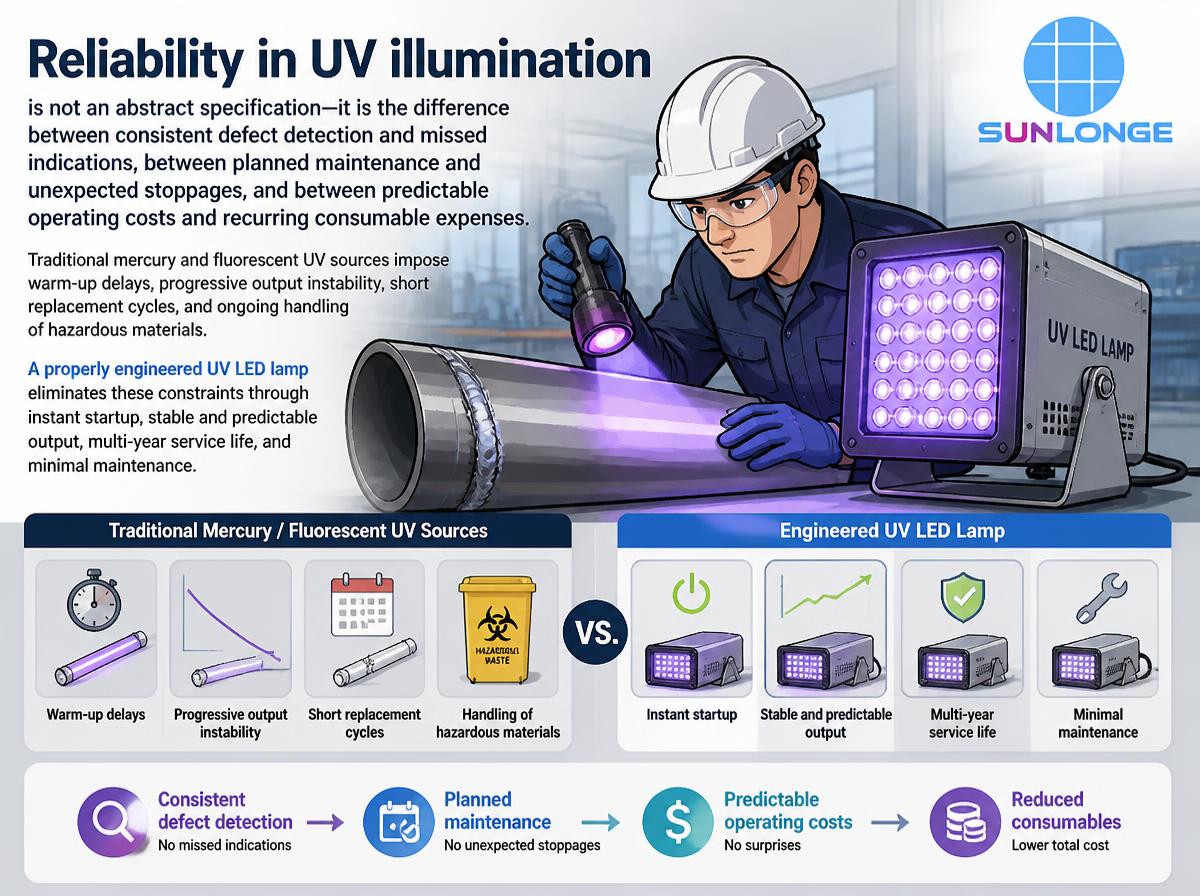
Reliability in UV illumination is not an abstract specification—it is the difference between consistent defect detection and missed indications, between planned maintenance and unexpected stoppages, and between predictable operating costs and recurring consumable expenses. Traditional mercury and fluorescent UV sources impose warm-up delays, progressive output instability, short replacement cycles, and ongoing handling of hazardous materials. A properly engineered UV LED lamp eliminates these constraints through instant startup, stable and predictable output, multi-year service life, and minimal maintenance.
Sunlonge’s UV LED lamps elevate these inherent technology advantages with NICHIA-sourced LEDs, constant-current stability, rigorous ASTM and aerospace certifications (including RRES 90061), adjustable optics, and application-specific designs for NDT, leak detection, and industrial inspection. The result is a more reliable light source that supports higher inspection quality, greater operational efficiency, and lower long-term cost.
For facilities still relying on mercury-based UV systems, evaluating a transition to certified UV LED lamps—beginning with portable, high-intensity tools such as the SL6300 series—offers a clear path to improved reliability. Review the technical specifications, request intensity and wavelength compliance documentation, and consider a side-by-side operational trial under your actual duty cycle and ambient conditions. The data on lifetime, stability, and maintenance consistently favor the modern solid-state approach.