CN
CN

What Are Fiber-Coupled Laser Sources?
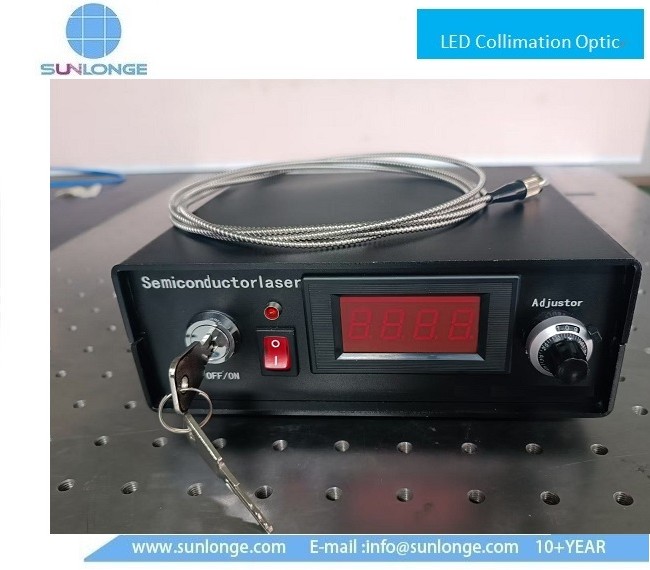
Fiber-Coupled Laser Sources are laser systems where the laser output is precisely coupled into an optical fiber—typically single-mode or polarization-maintaining—so that light is delivered through a flexible fiber rather than free-space optics. This architecture eliminates complex alignment, provides robust beam delivery, and allows the laser head to be located remotely from the imaging or inspection point.
In practice, a diode or DPSS laser is aligned into a fiber with core diameters from around 6–9 μm for single-mode fibers to 50–100 μm or more for multimode fibers, balancing beam quality and power handling. For fluorescence imaging and spectroscopy, single-mode or PM fibers are preferred because they preserve excellent beam quality (M² often < 1.2) and polarization control, which directly translates into tighter focusing and higher excitation efficiency.
How Fluorescence Excitation Works (And Why the Source Matters)
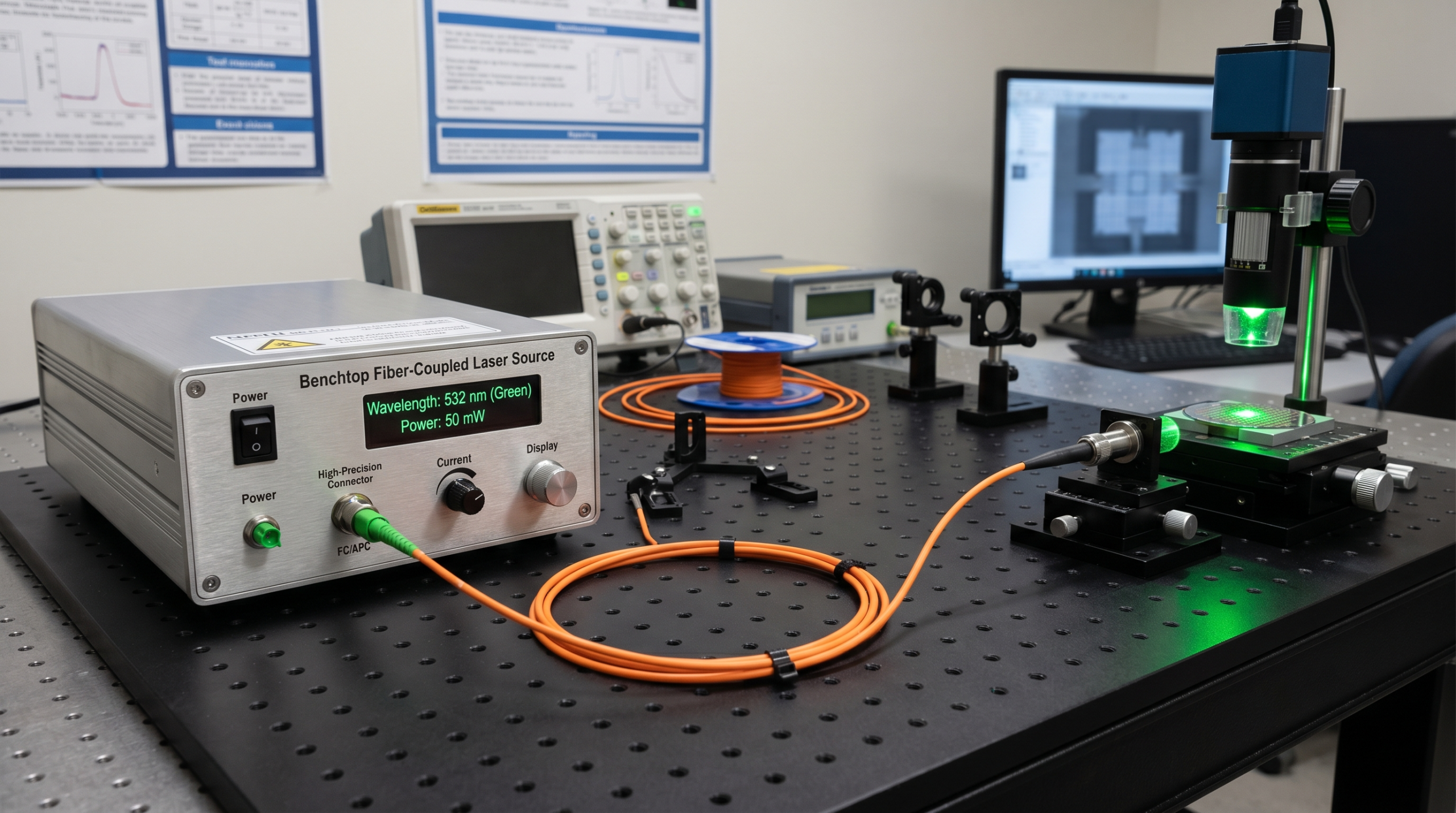
Fluorescence is a subtype of photoluminescence where molecules absorb photons at a specific excitation wavelength and then emit light at a longer wavelength as they relax back to the ground state. The intensity of fluorescence is strongly dependent on the absorption properties of the material—the more absorption at the excitation wavelength, the more fluorescence—making wavelength selection and spectral purity critical.
In fluorescence imaging, spectroscopy, and flow-based analytical instruments, the excitation source effectively sets your photon budget: it determines how many photons hit each fluorophore per second, how uniformly they are distributed, and how stable they are over time. Poor beam quality, intensity drift, or spectral mismatch immediately translate into lower signal, higher noise, and reduced quantitative reliability in your measurements.
Why Fiber-Coupled Laser Sources Boost Fluorescence Excitation Efficiency
-
Superior Beam Quality and Spot Control
Fiber-Coupled Laser Sources deliver well-defined, often near-Gaussian beams with M² values typically below 1.2 when coupled into single-mode or PM fibers, enabling diffraction-limited focusing at the sample plane. For confocal and super-resolution microscopy, this means:
- Smaller excitation spots
- Higher spatial resolution
- More efficient excitation per unit of laser power
Compared with LEDs or poorly conditioned laser beams, a fiber-delivered Gaussian profile concentrates more photons into the focal volume, improving excitation efficiency and contrast in fluorescence images and spectra.
-
Highly Stable Power for Reproducible Measurements
Modern fiber-coupled laser modules are engineered for low noise and high stability, with typical noise levels below 0.5% and temperature-stabilized operation to within a few hundredths of a degree Celsius. Thorlabs’ fiber-coupled sources, for example, specify noise under 0.5% and temperature control resolution as fine as 0.01 °C to maintain power and wavelength stability.
In fluorescence imaging, flow cytometry, and spectroscopy, this kind of stability directly translates into:
- Consistent fluorescence intensity from sample to sample
- Reliable longitudinal studies and time-lapse experiments
- Reduced need for frequent recalibration
Flow cytometry systems using fiber-coupled lasers benefit from this stability as cells pass the detection zone at high speed, ensuring each cell experiences nearly identical excitation conditions.
-
Wavelength Precision and Fluorophore Matching
Because Fluorescence intensity scales with how well the excitation wavelength overlaps the fluorophore’s absorption peak, precise selection of laser wavelength is essential. Fiber-coupled lasers for scientific use are offered at key lines such as 405, 450, 488, 520, 532, 638, 660, 785, and 830 nm specifically to match common fluorophores and Raman bands.
- 405–488 nm: Ideal for many GFP, FITC, and blue-excited dyes in fluorescence microscopy and confocal imaging.
- 638–660 nm: Optimized for red fluorescent proteins and far-red dyes.
- 785 nm: A workhorse for Raman spectroscopy, balancing Raman signal strength and suppression of background fluorescence.
Sunlonge’s SCL3000 series supports customizable wavelengths from 405 nm to 980 nm, letting users choose exact excitation lines rather than being constrained to fixed options—a decisive advantage when matching niche fluorophores or industrial dyes.
-
Flexible, Misalignment-Free Light Delivery
By moving the delicate laser head away from the sample and delivering light through a fiber, Fiber-Coupled Laser Sources decouple beam quality from mechanical vibrations and environmental disturbances. The result is:
- Misalignment-free operation in production environments
- Easier integration into compact instruments where space is limited
- Remote, sealed laser heads and electronics away from harsh industrial or biological conditions
For in-line fluorescence inspection on production lines—such as monitoring coatings, adhesives, or pipeline internals—this fiber delivery enables compact probes with stable excitation embedded directly into the process.
Sunlonge SCL3000: Fiber-Coupled Laser Sources Engineered for Fluorescence
Sunlonge’s SCL3000 Fiber-Coupled Laser Sources are designed to produce high power and high intensity illumination through an optical fiber patch cord for microscopy and analytical applications. They are specifically positioned to serve confocal microscopy, super-resolution microscopy, EPI/HILO/TIRF imaging, and flow cytometry—applications where fluorescence excitation efficiency is critical.
Key Technical Specifications (SCL3000)
| Parameter | Sunlonge SCL3000 Fiber-Coupled Laser Sources | Benefit for Fluorescence Excitation |
| Wavelength options | Customizable 405 / 488 / 520 / 638 / 660 / 785 / 850 / 980 nm | Precise matching to fluorophore absorption peaks for maximum excitation efficiency. |
| Output power per channel | 20–30 mW per wavelength | Optimized for confocal & spectroscopic applications without overheating sensitive samples. |
| Fiber type | Single-mode polarization-maintaining | High beam quality and stable polarization for confocal, STED, and polarization-sensitive measurements. |
| Power control | 10–100% via manual knob + remote control | Fine-tuning of excitation intensity to balance signal and photobleaching. |
| Integration | 186 × 160 × 63 mm integrated control + heat dissipation | Compact, turnkey module simplifies OEM and system integration. |
| Modulation capability | Up to ~100 kHz (per Sunlonge selection guide) | Supports time-resolved fluorescence and fast switching experiments. |
| Output stability | High stability (Sunlonge emphasizes stable output) | Reproducible fluorescence signals over long acquisition times. |
Unlike many generic modules that offer only a handful of fixed wavelengths and basic single-mode output, the SCL3000 family combines custom wavelength design, single-mode PM coupling, and integrated thermal and driver electronics into one compact unit. This combination is particularly valuable for OEM instrument builders who need drop-in sources that meet demanding fluorescence excitation specs without in-house laser engineering.
How SCL3000 Improves Fluorescence Imaging and Microscopy
Confocal and Super-Resolution Microscopy
Confocal and super-resolution systems demand:
- Tight, diffraction-limited spots
- Multi-wavelength excitation for multiplexed labeling
- Power stability well below 2% over long imaging sessions
Sunlonge explicitly positions the SCL3000 for confocal and super-resolution microscopy, providing 20–30 mW per channel with single-mode PM fiber, enabling excellent beam quality and polarization control for advanced imaging modes such as STED, PALM, and STORM.
Because the entire control and heat dissipation system is integrated into the laser head, the SCL3000 reduces thermal drift and power fluctuations that otherwise degrade fluorescence quantification in long time-lapse or 3D stack acquisitions. This stability directly supports consistent excitation and reduced photobleaching variability across the field of view.
Flow Cytometry and High-Speed Fluorescence Detection
In flow cytometry, cells pass through a focused laser spot at high speed, demanding high beam pointing stability and low noise to avoid measurement scatter. Sunlonge’s fiber-coupled architecture ensures:
- Stable illumination geometry at the interrogation point
- Flexible multi-wavelength configurations to excite multiple fluorophores per cell
- Clean, single-mode profiles for well-defined interrogation volumes
Compared with LED-based solutions, Fiber-Coupled Laser Sources in this class deliver narrower linewidths and higher spatial coherence, boosting spectral selectivity and sensitivity in multicolor flow panels.
Fiber-Coupled Laser Sources in Spectroscopy and Analytical Instruments
Raman and Advanced Spectroscopy
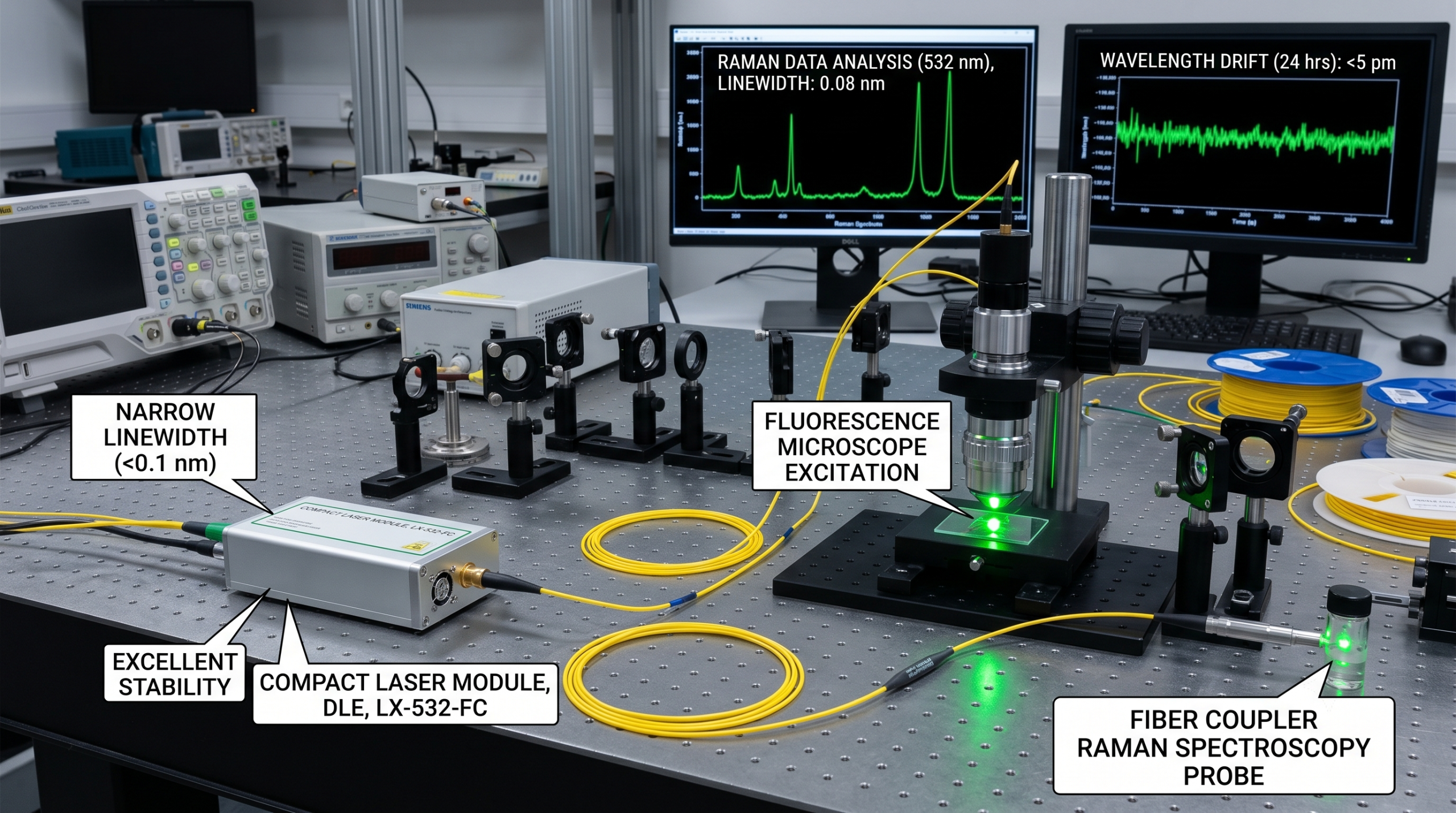
Fiber-coupled laser diode modules are now standard in Raman, fluorescence spectroscopy, and time-resolved techniques because they combine narrow linewidths (often <0.1 nm), excellent wavelength stability, and compact form factors. Common Raman wavelengths—532, 638, 785, and 830 nm—are widely available in fiber-coupled form and can be delivered through single-mode fibers to excitation probes or microscope objectives.
This approach allows:
- Remote placement of lasers away from vibration sources
- Easy swapping of probes and sampling heads via standard fiber connectors
- Integration with portable spectrometers and field instruments
Sunlonge’s customization capability from 405–980 nm means system designers can select wavelengths optimized not only for fluorophores but also for Raman scattering efficiency and minimal sample fluorescence background.
Spectroscopy in Industrial and Process Environments
In industrial spectroscopy—such as inline monitoring of chemical processes, coatings, or contaminants—Fiber-Coupled Laser Sources and UV/visible excitation modules are valued for their robustness and flexible routing to multiple measurement points via fiber splitters.
Sunlonge’s broader UV NDT and fluorescent leak detection portfolio, including high-intensity UV-A LEDs and excitation lamps, is already deployed in semiconductor inspection, pipeline and HVAC leak detection, and oil & gas infrastructure. The same design philosophy—industrial-grade stability, high intensity, and optimized wavelengths—flows into the SCL3000 series, making it a natural choice when building fluorescence-based inspection or analytical systems.
Quantitative Advantages: Efficiency, Lifetime, and Market Momentum
Market Growth: Fiber-Coupled Laser Sources Are the Future
According to Sunlonge’s market analysis, the global fiber-coupled laser source market is projected to grow from about 1.2 billion USD in 2024 to 12.8 billion USD by 2033, representing a compound annual growth rate (CAGR) of 10.8%. A dedicated segment—the fiber-coupled diode laser module market—is expected to reach 2.5 billion USD by 2033 with a CAGR of 9.1%, underlining the rapid adoption of these sources in industrial and scientific equipment.
For B2B buyers, this growth signals that Fiber-Coupled Laser Sources are becoming the standard in new-generation fluorescence imaging, spectroscopy, and inline inspection systems—not a niche technology.
Lifetime, Stability, and Cost Savings
Sunlonge’s LED-based excitation products (such as the SL8803 and SL8100 series) illustrate the company’s approach to durability and cost of ownership:
- LED lifetimes of around 30,000 hours, versus 6,000–9,000 hours for many traditional mercury lamps.
- Intensity stability >90%, meaning less than 10% variation over typical operating cycles.
- UV NDT and excitation lamps delivering 21,000 µW/cm² and tens of thousands of lux while maintaining that stability.
- System-level energy savings of 30–70% versus legacy lamps and UV curing sources.
These design principles carry into Sunlonge’s laser offerings: integrated thermal management, constant-current drivers, and robust housings designed for industrial environments. Combined with long-life solid-state emitters, Sunlonge reports up to 40% total cost savings in illumination and inspection applications compared with traditional high-intensity sources and more complex alternatives.
Although SCL3000 is a laser-based system rather than pure LED, the same cost-of-ownership logic applies: stable, efficient, and durable sources reduce downtime, recalibration cycles, and replacement costs in fluorescence-based instruments.
Why Sunlonge Beats Generic Fiber-Coupled Laser Suppliers
-
Application-Tuned Wavelengths and Customization
Sunlonge offers customizable wavelengths from 405–980 nm for the SCL3000, rather than forcing users into a handful of pre-defined lines. Combined with their experience in UV NDT and fluorescent leak detection, this means wavelengths are not only available—they are tuned to real-world fluorophores, industrial dyes, and material responses.
Generic laser manufacturers often provide catalog lines optimized for telecom or generic scientific use; by contrast, Sunlonge builds portfolios explicitly aligned with fluorescence, wafer inspection, leak detection, and microscopy workflows.
-
Single-Mode PM Fiber and Superior Beam Quality
While many low-cost fiber-coupled modules rely on multimode fiber to simplify coupling at the expense of beam quality, SCL3000 uses single-mode polarization-maintaining fiber to preserve a clean mode profile and stable polarization state. This is a concrete advantage in:
- Confocal and TIRF microscopy
- STED and other polarization-sensitive super-resolution techniques
- Polarization-resolved spectroscopy
Users gain higher excitation efficiency and more consistent image quality versus multimode-based systems where speckle and modal noise can undermine performance.
-
Integrated, Turnkey Design for OEMs
Sunlonge’s SCL3000 integrates the driver, TEC, and safety electronics into a compact 186 × 160 × 63 mm housing, ready for drop-in use. This stands in contrast to modular systems where integrators must source separate drivers, TEC controllers, and safety interlocks, increasing design complexity and risk.
For instrument builders in microscopy, spectroscopy, and analytical equipment, the integrated design shortens development time, reduces the risk of instability caused by poorly matched third-party components, and creates a cleaner, more maintainable system.
-
Industrial DNA and Compliance with NDT Standards
Sunlonge has been manufacturing UV NDT lamps, fluorescent leak detection systems, and specialized UV/blue excitation lamps since 1999, serving aerospace, automotive, semiconductor, pipeline, HVAC, and oil & gas industries. Many of its UV NDT products are designed around ASTM E3022, ISO 3059, and Rolls-Royce RRES 90061 requirements—some of the strictest standards in non-destructive testing.
This industrial DNA and standards-driven engineering culture directly benefit SCL3000 users: you are not buying a lab toy, but a laser source built to underpin critical inspections and process control in high-stakes environments.
-
Proven Use Cases Across Industrial and Scientific Domains
Sunlonge’s product lines are already deployed in:
- Semiconductor wafer inspection with UV-A illumination at up to 400,000 lux for sub-micron defect detection.
- Portable excitation sources for GFP/DsRed and UV fluorescence in agriculture, genetics, and in-field biology.
- Pipeline, HVAC, and oil & gas leak detection using fluorescent dyes and high-intensity UV lamps.
This breadth of use cases means Sunlonge understands both lab and field constraints—vibration, dust, operator variability, uptime demands—and designs Fiber-Coupled Laser Sources accordingly.
FAQ: Fiber-Coupled Laser Sources and Sunlonge’s Advantage
Q1. What makes Fiber-Coupled Laser Sources better than traditional free-space lasers for fluorescence?
Fiber-Coupled Laser Sources provide misalignment-free delivery, superior beam homogenization, and stable Gaussian beams through flexible fibers, making them more robust in real-world instruments and production environments. This translates into more uniform fluorescence excitation, easier integration, and higher uptime than fragile free-space optical paths.
Q2. How do Sunlonge’s SCL3000 Fiber-Coupled Laser Sources improve fluorescence excitation efficiency specifically?
SCL3000 units offer customizable excitation wavelengths (405–980 nm), 20–30 mW per channel, and single-mode PM fiber delivery, ensuring precise matching to fluorophore absorption spectra and high-quality, polarization-stable beams at the sample. Integrated control and thermal management keep output stable, maximizing photon budget and measurement repeatability.
Q3. Are Fiber-Coupled Laser Sources only for microscopes, or can they be used in industrial inspection?
They are ideal for both. In research, Fiber-Coupled Laser Sources drive confocal and super-resolution microscopes, Raman systems, and flow cytometers; in industry, they power inline inspection heads, fluorescence-based leak detection, and process spectroscopy where robust, remote light delivery is essential.
Q4. How does Sunlonge compare to generic fiber-coupled laser vendors on cost of ownership?
While upfront cost may be similar or slightly higher, Sunlonge’s focus on long-life solid-state emitters, high intensity, and stable drivers—proven in UV NDT and excitation systems—delivers up to 40% total cost savings over the system lifetime by reducing energy consumption, downtime, and replacement frequency.
Q5. What certifications or quality frameworks back Sunlonge’s optical products?
Sunlonge’s UV NDT and fluorescent inspection lamps are designed around ASTM E3022, ISO 3059, and Rolls-Royce RRES 90061 guidelines, reflecting aerospace-grade expectations for stability and performance. While SCL3000 is a laser product, it benefits from the same engineering practices and quality systems that support those certified NDT lines.
Q6. Can Sunlonge customize wavelengths or configurations for a specific fluorescence or spectroscopy workflow?
Yes. Sunlonge explicitly supports custom wavelength design within the 405–980 nm band for SCL3000 Fiber-Coupled Laser Sources and offers tailored configurations across its excitation and UV NDT platforms. This allows OEMs and end-users to align excitation perfectly with fluorophore, dye, or material absorption characteristics.
Q7. Is a Sunlonge LED excitation source enough, or do I really need SCL3000 for my application?
For wide-field imaging, macro fluorescence, or large-area NDT and leak detection, Sunlonge’s LED-based excitation sources (e.g., SL8803, SL8100) are often the better fit due to lifetime, field uniformity, and simplicity. For confocal/super-resolution microscopy, high-resolution Raman, or tightly focused analytical probes, the SCL3000 Fiber-Coupled Laser Sources provide superior spectral purity, beam quality, and modulation capability.