CN
CN

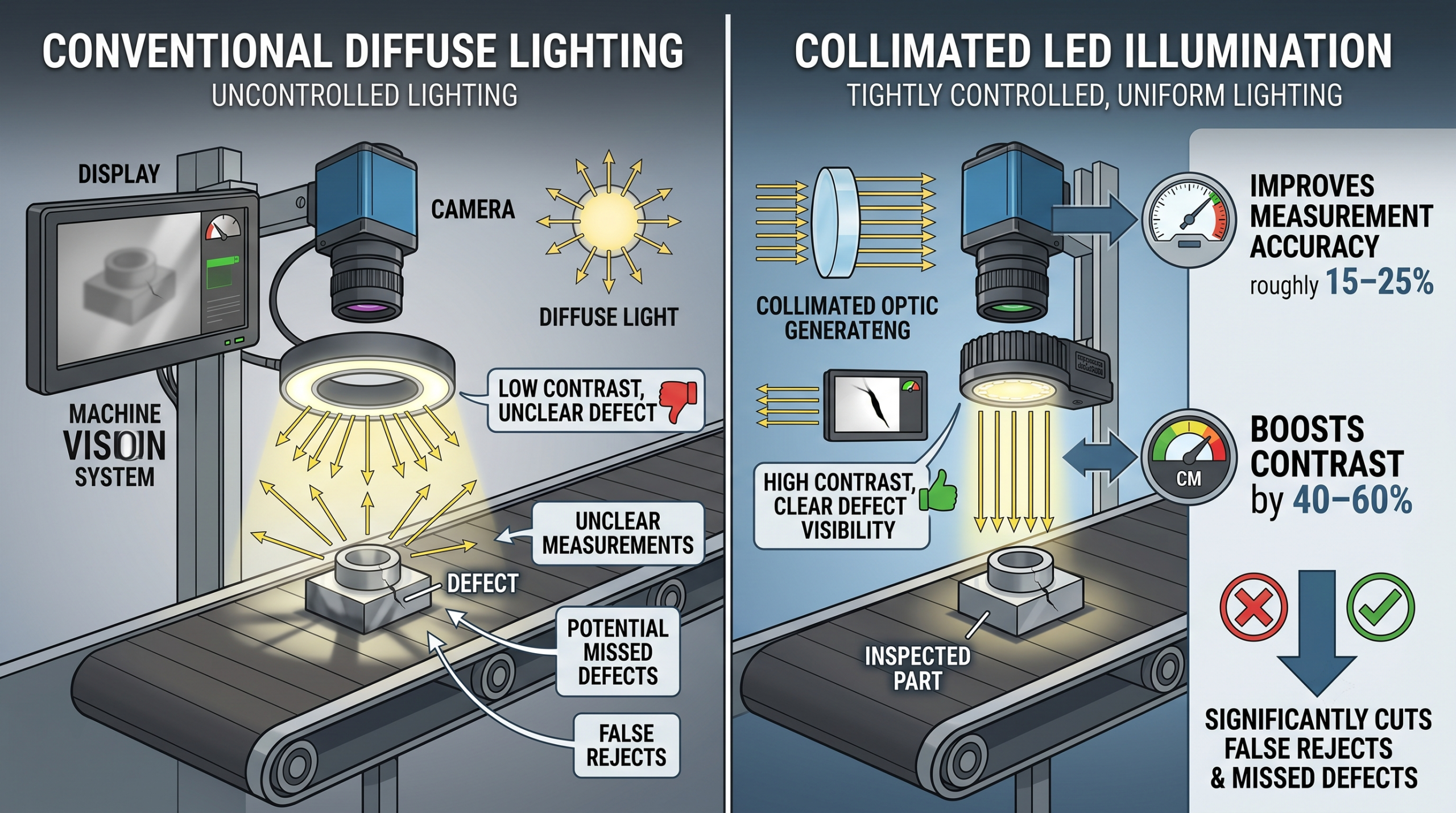
Collimated LED sources provide tightly controlled, uniform, shadow‑reduced illumination that can improve measurement accuracy in machine vision systems by roughly 15–25%, boost contrast by 40–60%, and significantly cut false rejects and missed defects when compared with conventional diffuse lighting. Sunlonge’s collimated LED sources combine this optical advantage with long lifetime, high UV performance at 365 nm, and substantial energy and maintenance savings, often delivering more than 40% (and up to 70%+) reduction in operating costs versus traditional lamps in industrial inspection environments.
Machine vision accuracy depends on illumination
Machine vision is now a core technology for automated inspection, guidance, and measurement, and its performance is tightly bounded by lighting quality rather than just camera resolution or algorithms. The global machine vision market was about 20.4 billion USD in 2024 and is projected to reach around 41.7 billion USD by 2030 at a 13% CAGR, driven mainly by quality assurance and inspection use cases where accuracy and repeatability are mission‑critical. The surface vision and inspection segment alone was roughly 4.19 billion USD in 2024 and is expected to double to 8.64 billion USD by 2033, underscoring how much value manufacturers place on reliable surface defect detection and dimensional control.
What is a collimated LED source?
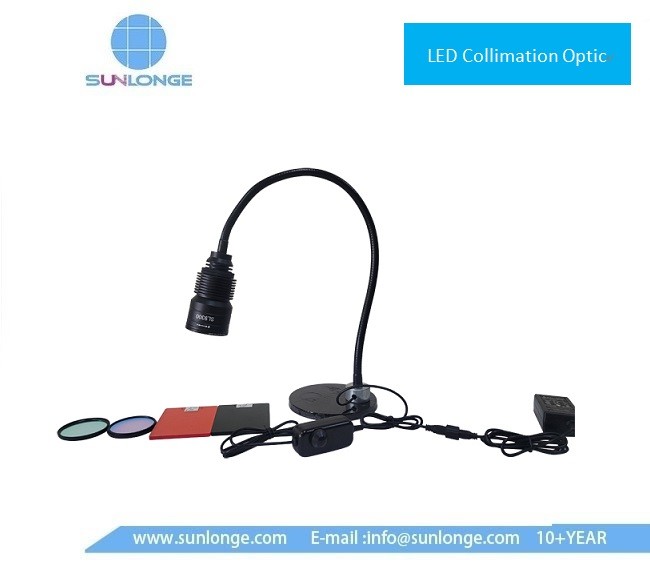
A collimated LED source is an LED illumination module whose optics convert the LED’s naturally divergent output into a beam of nearly parallel rays with very low divergence (typically well under 1–2 degrees). Instead of spreading light over a wide angle like a standard LED, a Collimated LED Source focuses its energy into a controlled, quasi‑parallel beam that maintains intensity and beam shape over distance, dramatically improving uniformity on the target plane. Sunlonge achieves this by placing premium UV or visible LEDs at the focal point of precision aspheric collimation optics, creating a highly directional, uniform beam tailored for inspection and metrology.
Why standard LEDs limit machine vision accuracy
Conventional diffuse LED panels and ring lights emit light across large angles (often 15–45 degrees or more), so intensity falls quickly with distance and varies significantly across the field of view. This non‑uniformity forces vision systems to work harder: algorithms must compensate for brightness gradients, edges become less crisp, and small defects can disappear in low‑contrast regions of the image. In addition, wide‑angle lighting creates more stray reflections and glare from shiny surfaces, degrading signal‑to‑noise ratio and making it difficult to hit tight tolerance bands in automated measurement.
How collimated LED sources boost accuracy
By delivering a well‑collimated beam with typically 85–98% uniformity across the target area, collimated LED sources remove brightness gradients that would otherwise introduce systematic measurement errors. Sunlonge reports that in real‑world industrial inspection, switching from diffuse to collimated lighting can improve dimensional measurement accuracy by around 15–25% and increase defect detection rates due to higher contrast and reduced noise. The same controlled beam geometry cuts stray light and can improve signal‑to‑noise ratio by roughly 30–50% in precision optical measurements, directly tightening gauge R&R and overall process capability.
Uniform illumination and reduced shadows
In backlit (silhouette) setups for gauging diameter, gaps, or profile, collimated backlights create very sharp transitions between light and dark because rays arrive at the object in parallel instead of many angles. This minimizes penumbra around edges—the “fuzzy” boundary region—so edge‑detection algorithms can trigger on a clean, high‑contrast gradient and repeat measurements within tighter tolerances. Even in front‑lighting geometries, collimated sources help suppress unwanted secondary shadows and uneven illumination, giving cameras a more consistent signal across the full region of interest.
Enhanced contrast and image quality
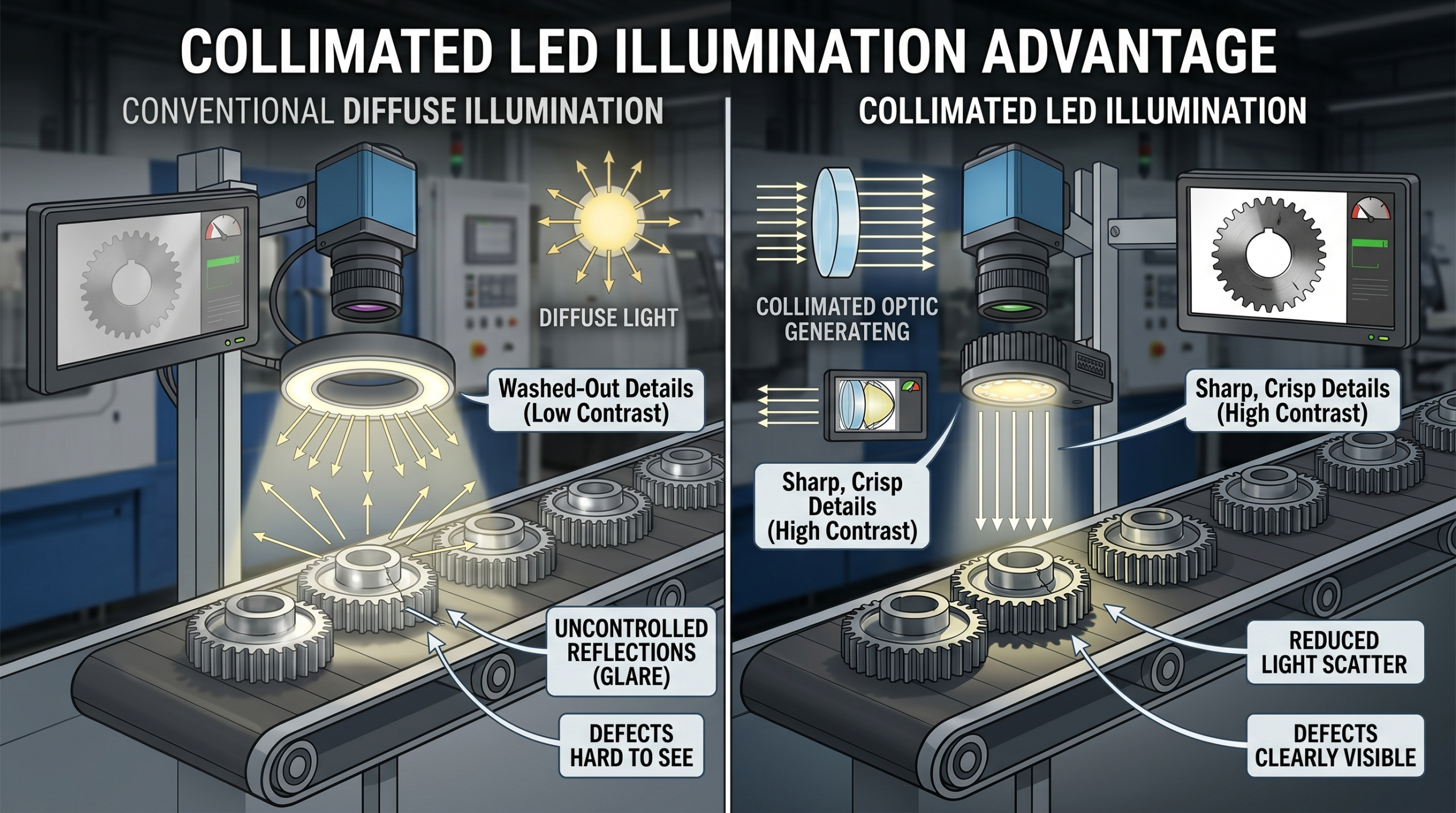
Collimated LED illumination produces more pronounced intensity differences between features and background because it reduces light scatter and uncontrolled reflections that tend to wash out images. Sunlonge’s internal data shows silhouette imaging of precision‑molded plastic components can gain approximately 40–60% contrast improvement when using collimated backlighting instead of conventional diffuse sources, leading to faster and more reliable automated defect detection. This contrast gain is especially valuable in challenging scenarios such as low‑albedo materials, shallow scratches, or tiny chips where baseline signal levels are inherently low.
Greater depth of field and working distance
When matched with telecentric lenses, collimated illumination can increase the effective depth of field of the imaging system—Opto Engineering notes that collimated light combined with telecentric optics can extend natural depth of field on the order of 20–30%. Because the collimated beam maintains intensity and angle over longer distances, it supports stable imaging at wider working distances, which is important when inspecting large components or integrating light outside confined process areas. Sunlonge’s optimized LED chip size and focal‑length design minimizes residual divergence, further extending usable working distance while keeping irradiance drop‑off over distance to typically only 10–15% in many setups.
Machine vision use cases improved by collimated LED sources
Collimated LED sources are especially effective in applications like:
- Dimensional gauging and metrology – telecentric lens systems paired with collimated backlights are the de‑facto standard for sub‑percent measurement uncertainty, supporting edge‑based measurements down to micrometer accuracy.
- Surface defect inspection – for flat reflective surfaces (metal, glass, coatings, PCBs), collimated front lighting reduces scattered light and enhances contrast for scratches, pits, and texture anomalies that diffuse lighting often misses.
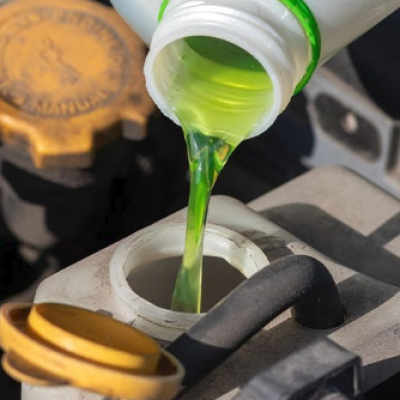
- Fluorescent and UV inspection – UV collimated LED sources at 365–405 nm deliver narrow‑band excitation with high spatial uniformity, which is ideal for fluorescent leak‑detection dyes, UV‑curable coatings, and contamination inspection in industrial environments.
Why Sunlonge’s collimated LED sources stand out
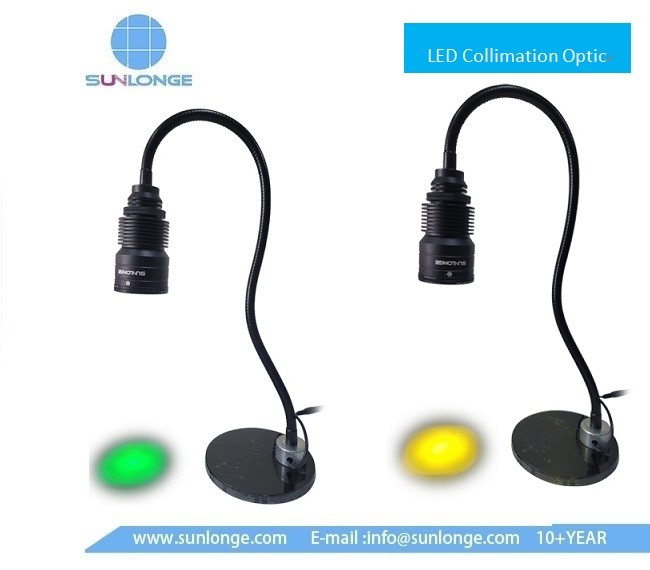
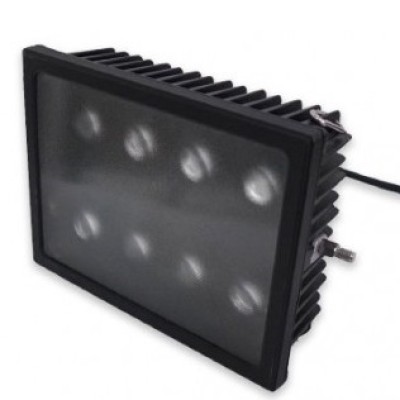
Sunlonge’s product line is built specifically for demanding optical inspection, with the SLC9300 collimated LED source plus SLC900 collimation optic providing high‑uniformity, low‑divergence beams optimized for machine vision, microscopes, and optical benches. The company offers premium UV LEDs at 365, 385, 395, and 405 nm alongside visible wavelengths, giving process engineers flexibility to match illumination to material absorption and camera sensitivity while keeping wavelength precision around ±5 nm. Sunlonge’s 365 nm technology is designed for high quantum efficiency and deep penetration, supporting both UV NDT and fluorescent leak detection while still achieving extremely high brightness levels on the order of hundreds of thousands of lux at the target for close‑range inspection.
Energy efficiency, lifetime, and cost savings
Traditional mercury and metal‑halide lamps typically have 5–15% wall‑plug efficiency, 1,000–2,000 hour lifetimes, and significant warm‑up times, which drive high energy and maintenance cost. In contrast, Sunlonge UV LED systems achieve wall‑plug efficiencies above 40%, 20,000–50,000+ hour lifetimes, and instant‑on operation, reducing energy consumption by roughly 65–75% and operating costs per curing or inspection cycle by about 70%. Over five years, Sunlonge estimates total cost of ownership around 8,000–12,000 USD versus 45,000–75,000 USD for mercury systems—equating to 73–82% savings and easily surpassing the 40% cost‑saving threshold many industrial buyers target.
Environmental and regulatory advantages
Mercury lamps contain hazardous materials and often require special disposal and compliance processes, while also generating ozone and high heat loads that complicate facility design. Sunlonge’s LED systems contain no mercury, generate no ozone, and are designed to comply with RoHS and support REACH requirements, helping manufacturers reduce environmental footprint and avoid regulatory headaches while upgrading illumination performance. Lower heat generation also makes integration easier in sensitive environments like electronics assembly, pharmaceutical packaging, and cleanrooms where thermal stability is critical.
Sunlonge vs other collimated LED vendors
A Sunlonge comparison against other collimated LED vendors such as Edmund Optics, Thorlabs, and Mightex shows that Sunlonge’s designs offer competitive or superior aperture sizes, divergence, and application focus for industrial imaging. For example, Sunlonge’s collimated LED modules feature an aperture around 22 mm with divergence under 1 degree, customizable wavelengths including UV, and high‑precision collimation optimized for machine vision, optical testing, and microscopy. By contrast, some research‑oriented systems emphasize narrower spectra or different mechanical formats, whereas Sunlonge balances optical performance with rugged industrial usability and ease of integration into production systems.
Key Sunlonge specs and their impact
The SLC9300 series with SLC900 collimation optics embodies Sunlonge’s approach to industrial‑grade collimated illumination. Some key specifications include beam divergence below 2 degrees, more than 90% beam uniformity, optical stability of about ±0.1% per °C, response time under 50 ms, and maximum irradiance up to roughly 2,000 mW/cm² depending on wavelength. These parameters translate into stable, high‑contrast images for fast‑moving production lines, with minimal warm‑up or drift and enough intensity headroom to support high‑speed cameras and short exposure times in machine vision.
Table: Key machine vision benefits of collimated LED versus conventional lighting
| Attribute | Sunlonge Collimated LED Source | Conventional Diffuse LED / Mercury Lamp | Machine Vision Impact |
| Beam divergence | < 1–2° | 15–45°+ typical | Better edge sharpness, lower shadow blur |
| Beam uniformity | 85–98% across field | Often <75%, strong gradients | Fewer systematic measurement errors |
| Warm‑up time | Instant‑on | 5–15 min for mercury | Higher uptime, simpler start/stop |
| Lifetime | 20,000–50,000+ hours | 1,000–2,000 hours | Less downtime, fewer lamp changes |
| Wall‑plug efficiency | >40% | 5–15% for mercury | 65–75% lower energy use |
| Measurement accuracy improvement | ~15–25% vs diffuse lighting | Baseline | More reliable gauging and SPC |
| Contrast improvement | ~40–60% in silhouette inspection | Baseline | Better detection of small defects |
| SNR improvement | ~30–50% vs uncollimated sources | Baseline | More robust algorithms, less false reject/accept |
| 5‑year total cost of ownership | 8k–12k USD | 45k–75k USD | 73–82% cost reduction |
Flexible mechanics and system integration
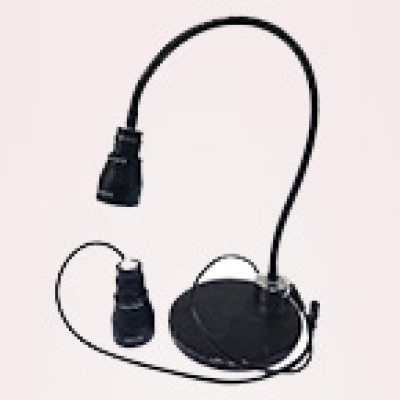
Sunlonge’s collimated LED sources use flexible gooseneck lamp holders and standard connector interfaces, allowing engineers to position illumination at optimized angles for complex geometries such as curved pipelines, HVAC coils, or irregular weld seams. Integrated dimmers support smooth 0–100% intensity control so you can tune exposure for different cameras, materials, or inspection recipes without swapping hardware. Optional fiber‑coupling adapters enable remote light delivery in confined or hazardous locations, particularly useful in oil and gas or chemical processing environments where the light source must remain outside hazardous zones.
Application examples in industrial inspection
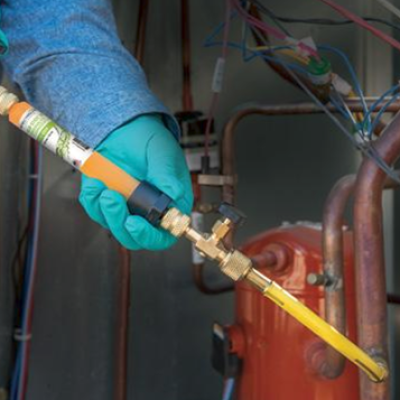
In pipeline and oil & gas maintenance, collimated UV LED sources combined with fluorescent leak‑detection dyes give high‑contrast images of micro‑leaks and cracks, allowing machine vision systems to spot early‑stage failures before they become catastrophic. HVAC coil and heat‑exchanger inspection benefits from the same 365 nm collimated illumination, as it highlights contaminants and fluid leaks that are otherwise invisible under white light. In industrial manufacturing—such as automotive, electronics, and metal fabrication—Sunlonge’s collimated LED sources support high‑speed line scan and area‑scan cameras for surface defect detection, PCB solder inspection, adhesive bead verification, and dimensional checks with improved accuracy and lower false‑reject rates.
Best practices for integrating collimated LED sources
To get the most from a Collimated LED Source, align the beam axis with your camera and lens optical axis as closely as possible—typically within a couple of degrees—to maximize uniformity and minimize unwanted reflections or gradients. Choose backlit collimated setups for silhouette gauging and front collimated illumination for surface defect detection, adjusting working distance to achieve the desired irradiance without saturating the sensor. Use Sunlonge’s electronic dimming and fast response (sub‑50 ms) to synchronize light pulses with camera exposure, reducing motion blur and further improving image sharpness in high‑speed inspection.
Q&A: Collimated LED sources in machine vision
Q1: How does a Collimated LED Source differ from a standard LED ring light in machine vision?
A standard LED ring or panel emits over a broad angle, so intensity falls quickly with distance and varies across the field, creating shadows and gradients for the vision system to manage. A Collimated LED Source uses lenses or reflectors to generate near‑parallel rays, so intensity and beam shape stay consistent over distance, yielding sharper edges, higher contrast, and more repeatable measurements.
Q2: How much accuracy gain can I expect by switching to collimated illumination?
Sunlonge reports typical improvements of about 15–25% in dimensional measurement accuracy when replacing diffuse lighting with collimated LED sources in industrial inspection, alongside 40–60% contrast gains in silhouette applications. In practical terms, this often means tighter Cpk values, fewer measurement outliers, and more confident go/no‑go decisions for automated inspection.
Q3: Will a collimated LED work with my existing telecentric lens?
Yes—telecentric lenses are actually designed to work best with collimated illumination, since both share a parallel‑ray geometry that minimizes perspective and magnification errors across the field. Using a collimated source with a telecentric lens can also extend effective depth of field by roughly 20–30%, helping you maintain accurate measurements over a wider range of part heights or positions.
Q4: Are Sunlonge’s collimated LED sources suitable for 24/7 production lines?
With lifetimes in the 20,000–50,000+ hour range and very stable output (around ±0.1% per °C), Sunlonge’s LEDs are engineered for continuous operation in industrial environments. Compared to mercury lamps that need frequent replacements and warm‑up, Sunlonge systems dramatically reduce unplanned downtime and maintenance interventions over multi‑year horizons.
Q5: How do Sunlonge collimated UV LEDs compare to mercury lamps for UV inspection or curing?
Mercury lamps provide broad‑spectrum UV but with low electrical efficiency (5–15%), short life (1,000–2,000 hours), and warm‑up delays, plus mercury handling and disposal requirements. Sunlonge UV LED systems deliver narrow‑band 365–405 nm light with >40% efficiency, 20,000–50,000+ hour lifetimes, instant‑on operation, and estimated 73–82% lower total cost of ownership over five years.
Q6: Can collimated LED sources be customized for my specific machine vision application?
Sunlonge offers customizable collimated LED modules with configurable beam sizes, wavelengths (including UV, visible, and IR), and mechanical interfaces to match different machine vision setups and host equipment. This allows you to optimize both optical performance and integration effort for pipeline inspection, HVAC coils, electronics, or any other specialized use case.
Q7: Are there environmental or safety benefits in switching to Sunlonge LEDs?
Sunlonge’s LED systems contain no mercury, generate no ozone, and are designed to meet RoHS and support REACH compliance, eliminating many environmental and safety concerns associated with legacy UV sources. They also produce significantly less heat, which improves operator safety and simplifies thermal management around sensitive products and equipment.
Next steps with Sunlonge collimated LED sources
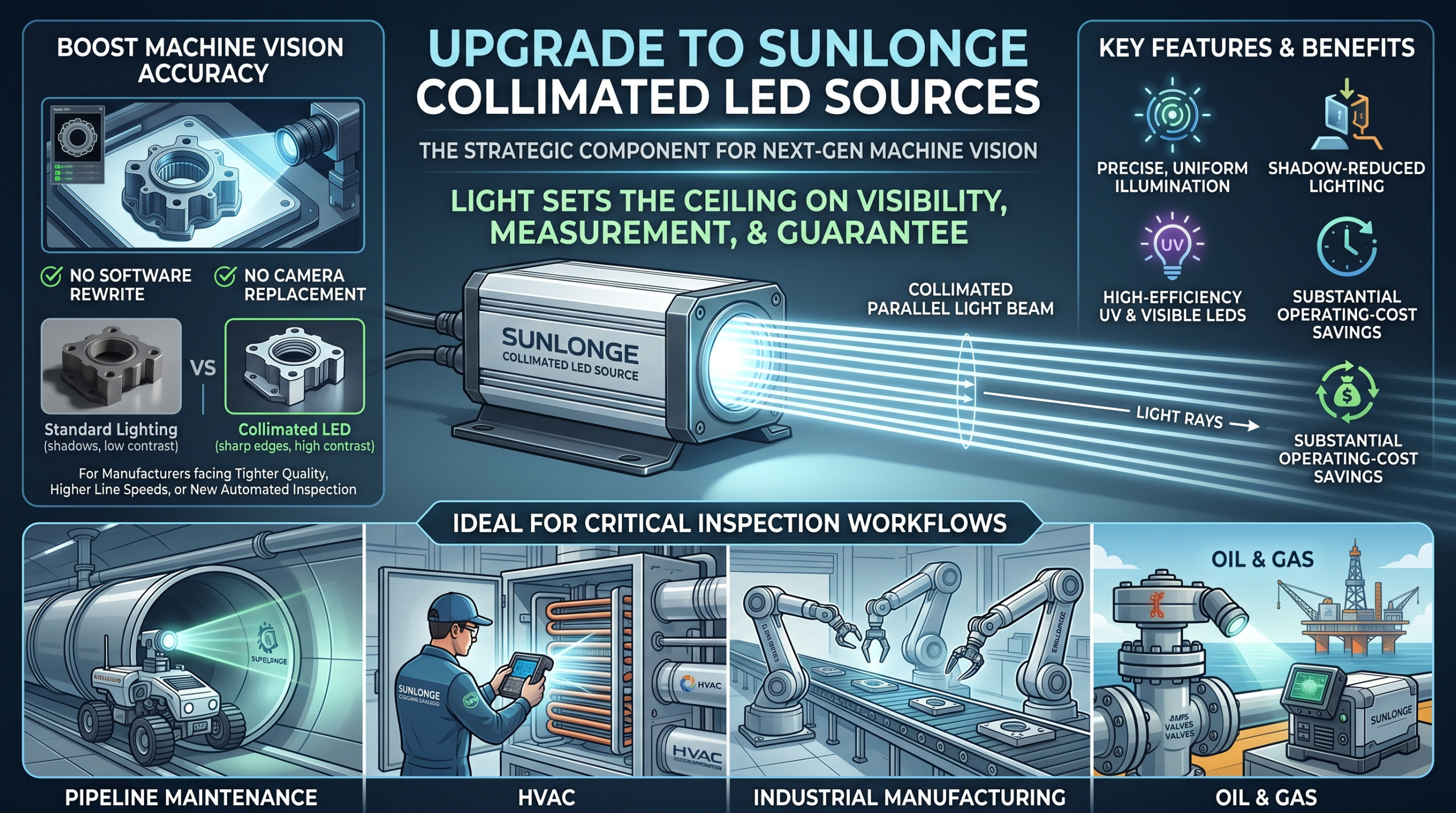
For manufacturers facing tighter quality requirements, higher line speeds, or new automated inspection projects, upgrading to Sunlonge collimated LED sources is one of the most impactful ways to boost machine vision accuracy without rewriting software or replacing cameras. By combining precise, uniform, shadow‑reduced illumination with high‑efficiency UV and visible LEDs, long lifetimes, and substantial operating‑cost savings, Sunlonge provides a compelling platform for pipeline maintenance, HVAC, industrial manufacturing, and oil & gas inspection workflows. When you evaluate your next machine vision or automated inspection project, treat the Collimated LED Source not as a commodity light, but as a strategic component that sets the ceiling on what your system can see, measure, and guarantee.