CN
CN

Introduction: Why the Excitation Light Source Matters
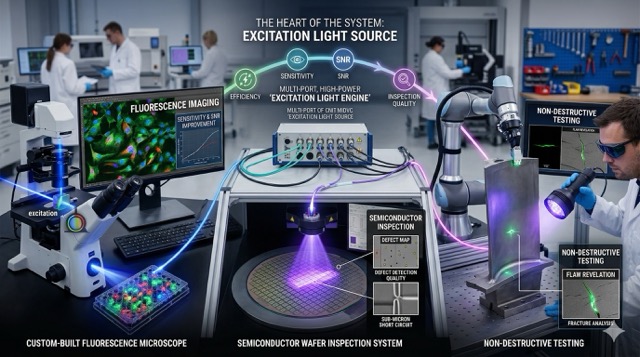
In fluorescence imaging, semiconductor inspection, and many non‑destructive testing workflows, the excitation light source is the heart of the system. It determines how efficiently fluorophores, fluorescent dyes, or surfaces are driven to emit detectable signals, which in turn controls sensitivity, signal‑to‑noise ratio, and overall inspection quality.
Today, two main technologies dominate: LED‑based excitation light sources and laser‑based excitation light sources. Lasers are associated with high precision and narrow spectra, while LEDs are known for robustness, lifetime, and cost efficiency. For many real‑world inspection and imaging tasks – especially in industrial environments – LED excitation sources now outperform lasers on total cost of ownership, uptime, and flexibility.
Sunlonge International leverages this trend with products like the SL8803 series portable excitation LED light source, designed as a powerful, field‑ready excitation light source for GFP, DsRed, UV, and multi‑wavelength applications.
What Is an Excitation Light Source?
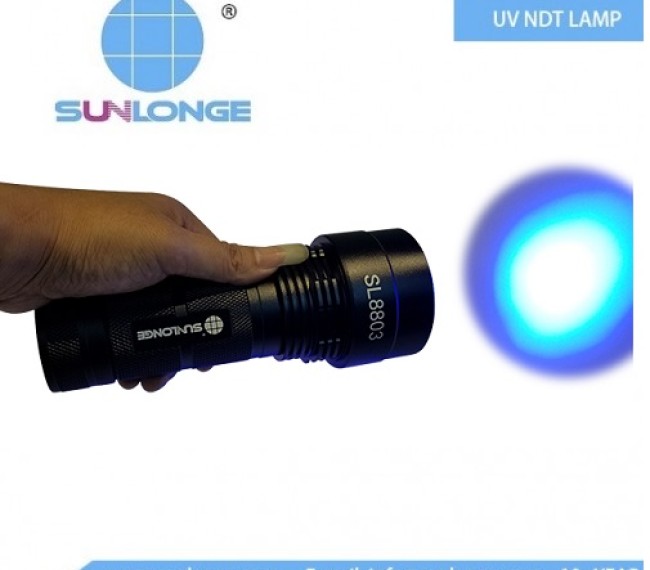
An excitation light source delivers light at specific wavelengths that excite fluorescent molecules or optical targets; when these relax, they emit longer‑wavelength light that is detected by cameras, sensors, or the human eye. Typical examples include:
- Blue excitation around 455 nm for GFP and many green fluorophores.
- Green excitation around 525 nm for DsRed and red fluorophores.
- UV excitation at 365–395 nm for fluorescent penetrant and leak detection dyes.
For industrial and lab users, an effective excitation light source must offer:
- Correct wavelengths matching fluorophore absorption peaks.
- Sufficient intensity across the field of view, without overheating the sample.
- High spatial uniformity for consistent imaging across the frame.
- Temporal stability over minutes to hours and over many on/off cycles.
- Long lifetime and low cost of operation.
LED vs Laser: Two Very Different Excitation Light Source Technologies
LED Excitation Light Sources
LED excitation light sources use high‑power LEDs that emit broadband, incoherent light, typically with a spectral width of 20–100 nm. Key attributes:
- Spectral coverage from 360–1700 nm depending on LED type, allowing UV, visible, and NIR excitation.
- Long lifetimes of 20,000–50,000 hours until output drops to around 70% of initial (L70).
- High energy efficiency compared to legacy lamps, with much lower heat load.
- Excellent mechanical robustness and vibration tolerance.
Studies on integrated LED excitation cubes show 1–2 orders of magnitude higher optical efficiency compared with mercury lamps in fluorescence microscopy, enabling equal or better image quality with far less power.
Laser Excitation Light Sources
Laser excitation light sources use laser diodes or other laser technologies that emit narrowband, coherent light with linewidths typically < 1 nm. Core characteristics:
- Extremely high radiance and spatial coherence; beams can be tightly focused or efficiently coupled into fibers.
- Wall‑plug efficiencies often exceed ~40% for many visible and NIR laser diodes.
- Very narrow spectral output for high spectral resolution and selective excitation.
However, laser diodes are more sensitive to temperature and drive conditions, so they require precise thermal control and constant‑current drivers to avoid performance drift and premature failure.
Comparison Table: LED vs Laser Excitation Light Sources
Below is a concise comparison of LED and laser‑based excitation light sources for imaging and inspection.
| Attribute | LED Excitation Light Source | Laser Excitation Light Source |
| Emission type | Broadband, incoherent; 20–100 nm spectral width. | Narrowband, coherent; often < 1 nm spectral width. |
| Beam profile | Divergent; easy to homogenize into wide, uniform fields. | Collimated; ideal for small spots and fiber coupling. |
| Spectral coverage | 360–1700 nm via different LEDs; flexible multi‑band designs. | Discrete laser lines; limited wavelengths per system. |
| Typical lifetime | 20,000–50,000 hours (L70). | 5,000–15,000 hours in many instruments. |
| Intensity stability | Very stable with constant‑current drivers; minimal warm‑up. | High stability possible, but strongly temperature‑dependent. |
| Spatial uniformity | Wide, homogeneous illumination achievable with diffusers/lenses. | Often Gaussian; uniform fields require extra optics. |
| Component cost | Low to moderate; simple drivers and optics. | Higher; additional optics, cooling and safety systems. |
| Safety | Lower eye hazard at typical intensities; simpler to manage. | Higher eye/skin hazard; strict safety protocols. |
| Best applications | Wide‑field fluorescence, routine imaging, NDT, leak detection, semiconductor surface inspection. | Raman spectroscopy, confocal/TIRF, advanced interferometry. |
In short: lasers win on beam quality and spectral purity, while LED excitation light sources win on lifetime, robustness, cost, and wide‑field uniformity.
Stability, Lifetime and Reliability: Why LEDs Are Favored for Industrial Excitation
LED Excitation: Long Life, Low Drift
High‑power LEDs are solid‑state devices with no filaments or gas discharges, so they rarely “burn out” suddenly; instead, their output slowly declines. Modern devices routinely offer 20,000–50,000 hours of usable life before reaching L70.
With a well‑designed constant‑current driver, LED excitation light sources demonstrate excellent intensity stability, with minimal flicker or drift over time. Sunlonge’s SL8803 series specifies >90% stability of intensity, meaning output varies by less than 10% over typical operating cycles – critical for quantitative fluorescence and consistent inspection.
Laser Excitation: High Performance, Higher Sensitivity
Laser diodes can also be long‑lived but are significantly more sensitive to temperature swings and over‑driving. Manufacturers stress the need for:
- Tight constant‑current control.
- Constant or actively stabilized operating temperature.
Without this, lasers can degrade quickly or fail catastrophically. Practical lifetimes in instruments are often 5,000–15,000 hours, depending heavily on system design.
For a B2B user in pipelines, HVAC, or oil & gas – where uptime and low maintenance are key – the LED‑based excitation light source is typically more attractive than a laser system that demands careful thermal and safety management.
Cost, Efficiency, and Total Cost of Ownership
Component Price vs System Cost
At component level, LEDs are far cheaper than lasers. Yet laser vendors correctly point out that system‑level cost (optics, drivers, thermal design, safety) is what really matters. In some high‑end life‑science instruments requiring very small, high‑brightness excitation spots, comprehensive analyses find lasers can yield lower total cost by simplifying the optical path.
However, for wide‑field illumination – especially in NDT, fluorescent leak detection, and macro fluorescence – LED excitation light sources almost always win:
- Cheaper components and drivers.
- No complex beam‑shaping optics.
- No laser‑class safety infrastructure.
Efficiency and Heat
Laser diodes routinely achieve >40% wall‑plug efficiency, converting a large fraction of electrical power into coherent light. High‑power LEDs used as excitation light sources are also highly efficient compared to legacy arc lamps and often require far less cooling, especially at moderate irradiance levels.
For industrial inspection over large areas – for example, illuminating 100–160 mm fields at tens of thousands of lux – LED excitation light sources provide a better overall efficiency and thermal profile than lasers.
Sunlonge’s 40% Cost‑Saving Advantage
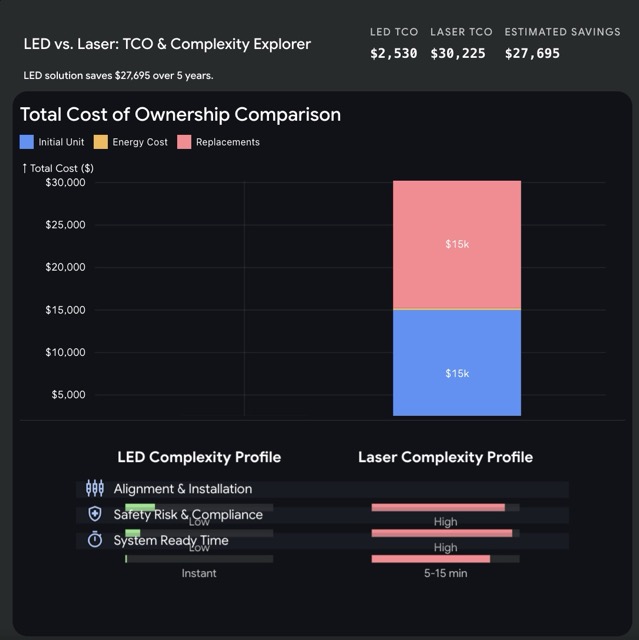
By combining high‑efficiency LEDs, smart driver design, and long lifetimes, Sunlonge reports up to 40% cost savings in illumination and inspection applications compared with traditional high‑intensity sources and more complex alternatives. Savings come from:
- Lower energy consumption.
- Far fewer replacements over the life of a system.
- Minimal downtime and reduced service complexity.
For customers in semiconductor, manufacturing, pipeline, and HVAC inspection, this translates directly into lower total cost of ownership and a faster payback period.
Application Fit: Where Each Excitation Light Source Type Makes Sense
LED Excitation Light Sources: Wide‑Field Workhorses
LED‑based excitation light sources dominate in:
- Wide‑field fluorescence imaging (stereo microscopes, macro imaging).
- In‑situ GFP/DsRed observation in gene‑modified plants, small animals, and microorganisms.
- Industrial surface inspection and NDT, including fluorescent penetrant and magnetic particle inspection.
- Fluorescent leak detection in pipelines, HVAC, and oil & gas systems.
These scenarios prioritize robustness, large and uniform illumination fields, long life, and reasonable intensity – all LED strengths.
Laser Excitation Light Sources: Precision Specialists
Laser‑based excitation sources are chosen when the physics demands coherence and narrow bandwidth:
- Raman and CARS spectroscopy.
- High‑end confocal and TIRF microscopy.
- Interferometry and holographic metrology.
In these domains, the extra cost and complexity is justified by performance requirements; in most industrial inspection and routine imaging, it is not.
Sunlonge’s SL8803 Excitation Light Source: Design Overview
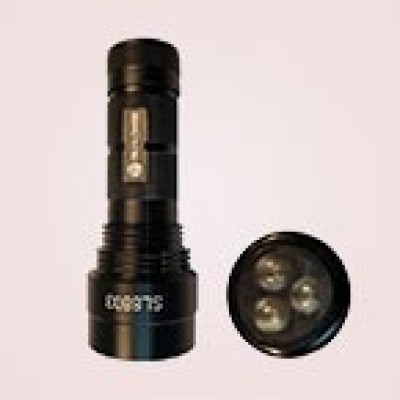
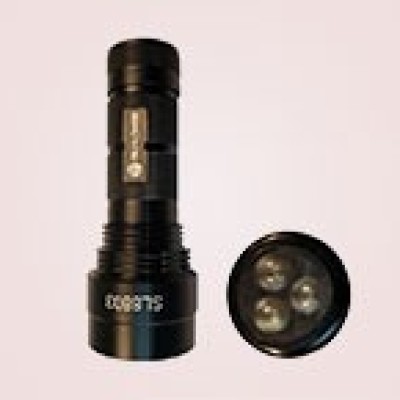
The SL8803 series portable excitation LED light source is Sunlonge’s flagship excitation light source for portable fluorescence work in laboratories and field environments.
Core Specifications
- Wavelength options:
- SL8803‑455 (blue, 455 nm) for GFP excitation.
- SL8803‑525 (green, 525 nm) for DsRed excitation.
- Multi‑wavelength configurations combining 365, 395, 455, 525, and 625 nm to match multiple fluorophores or dyes.
- LED engine: 3 × 5 W high‑power LEDs with lenses; average lifetime ≈30,000 hours.
- Illuminance: ~15,000 lux at 15 inches (455 nm version) and up to 40,000 lux for certain green excitation versions.
- Irradiated area: Approx. 160 mm diameter at 30 cm, giving a broad, uniform excitation field.
- Stability: Intensity stability >90%, even over extended operation.
- Form factor: Compact 73 × 193 mm aluminum body, approx. 0.4 kg, tail switch with battery status display.
- Power: Lithium battery pack with ~3 hours continuous excitation time and >8 hours side‑light runtime depending on configuration.
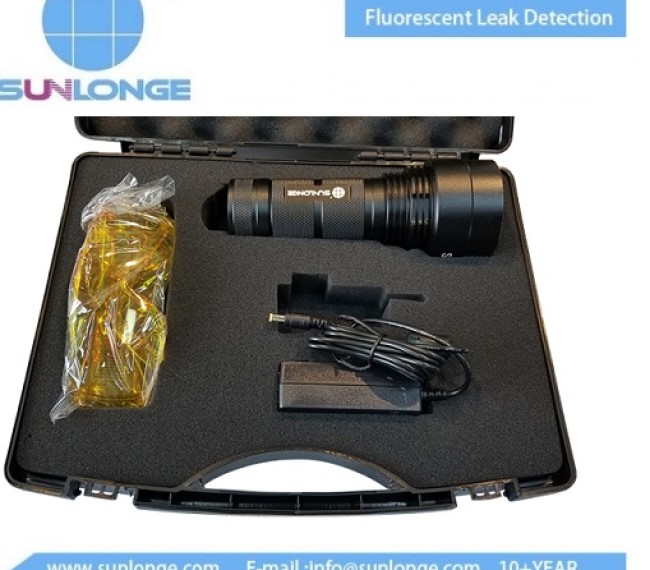
Standard kits include the excitation light source, wavelength‑matched observation glasses (e.g., orange filter for blue excitation), power adapter, tripod, toolbox, and certification documents.
Typical Use Cases
Sunlonge lists several biological use cases for SL8803:
- GFP/DsRed detection in gene‑modified crops (rice, wheat, corn, soy, cotton, Arabidopsis).
- Reporter visualization in genetic animal models (mice, monkeys).
- Fluorescence in bacteria, yeast, fungi, and other microorganisms.
- Gene‑specific expression studies in developmental and molecular biology.
Because it is portable and covers a large field, SL8803 enables researchers and engineers to observe fluorescence directly on plants, animals, wafers, or components without moving them to a dedicated microscope setup.
Why Sunlonge’s Excitation Light Source Is Better Than Generic Alternatives
- Spectrally Optimized Wavelengths for Real Fluorophores
Sunlonge’s excitation light source family provides discrete bands at 365, 395, 455, 525, 595, and 625 nm, explicitly aligned with the absorption peaks of common fluorophores, fluorescent dyes, and inspection materials. Generic “blue” or “purple” LEDs often have wider, less controlled spectra, wasting excitation power and creating more background noise.
- High Intensity and Wide, Uniform Fields
Products like SL8804‑H deliver 21,000 µW/cm² at 15 inches as a UV excitation light source, while SL8803 UV and visible variants achieve 21,000 µW/cm² at 30 cm and up to 40,000 luxfor visible excitation. Combined with ~160 mm diameter fields, this gives:
- Strong excitation across large samples or multiple specimens at once.
- Uniform brightness, reducing hotspot artifacts and missed defects.
- Stability >90% and Industrial‑Grade Drivers
Sunlonge emphasizes intensity stability above 90%, a direct result of well‑designed constant‑current driver circuits and thermal management. This stability is crucial when:
- Comparing fluorescence signals over time.
- Running long inspection shifts in industrial environments.
- Industrial DNA and High‑End Certifications
Unlike generic LED labs or torch brands, Sunlonge’s portfolio includes UV NDT lamps compliant with ASTM E3022, ISO 3059, and Rolls‑Royce RRES 90061, used in aerospace and critical infrastructure inspection. The same engineering and quality systems underpin its excitation light source products, making them more trustworthy for B2B buyers in:
- Semiconductor fabs.
- Oil & gas and pipeline inspection.
- Automotive and HVAC diagnostics.
- Customization and Multi‑Market Experience
Sunlonge openly offers customization – wavelength combinations, beam patterns, accessories – based on customer demand. Combined with decades of experience in UV NDT, fluorescent leak detection, wafer inspection, and lab imaging, this positions the company as a solution partner, not just a component vendor.
Statistics and Figures That Support LED Excitation
A few key data points underline why LED excitation light sources – especially Sunlonge’s – are winning:
- LED excitation cubes in microscopy provide 10–100× higher optical efficiency than mercury lamps, with better stability.
- Typical LED excitation lifetimes are 20,000–50,000 hours, far outlasting many arc lamps and laser modules (often 5,000–15,000 hours).
- Sunlonge excitation and NDT lamps reach 21,000 µW/cm² at 15–30 cm and tens of thousands of lux in visible bands, while maintaining >90% intensity stability.
- Sunlonge reports up to 40% total cost savings in industrial illumination and inspection applications versus traditional high‑intensity and more complex solutions.
These numbers add up to a clear narrative: for most inspection and imaging users, a high‑performance LED excitation light source provides better economics and simpler operations than lasers.
FAQ: Excitation Light Sources, LED vs Laser, and Sunlonge
Q1: What is an excitation light source in simple terms?
An excitation light source is the illumination system that delivers the right wavelengths to make fluorescent molecules or dyes glow; the emitted light is then captured by a detector or observed directly.
Q2: When should I choose an LED excitation light source over a laser?
Choose LEDs when you need wide‑field illumination, long life, lower cost, and robust operation – for example, routine fluorescence imaging, semiconductor surface checks, leak detection, or penetrant inspection.
Q3: When do I really need a laser excitation light source?
Lasers are necessary when you rely on coherence and very narrow bandwidths, such as Raman spectroscopy, advanced confocal/TIRF microscopy, or interferometric metrology.
Q4: How is Sunlonge’s SL8803 different from a generic LED flashlight?
SL8803 is engineered as an excitation light source: it has precise wavelengths for GFP/DsRed and other fluorophores, ~160 mm uniform fields, 30,000‑hour LED life, and >90% intensity stability. Generic flashlights lack this wavelength control, uniformity, and stability.
Q5: Is Sunlonge’s excitation light source compatible with microscopes?
Yes. Sunlonge offers dedicated microscope fluorescence adapters and dual‑wavelength excitation modules to integrate with stereo microscopes and optical systems.
Q6: Is there a risk of photobleaching with LED excitation?
Intense excitation always carries some photobleaching risk, but LEDs allow fine control of intensity and duty cycle, reducing bleaching compared to fixed‑output arc lamps.
Q7: How stable is Sunlonge’s excitation light source in real use?
SL8803 and related products specify >90% intensity stability, meaning little drift across operating cycles – critical for quantitative measurements and long inspections.
Q8: Is Sunlonge focused only on biology, or also on industrial use?
Sunlonge is a UV NDT and fluorescent leak detection specialist; its excitation light sources share technology with lamps used in aerospace NDT, wafer inspection, pipelines, HVAC, and oil & gas.
Q9: How does Sunlonge deliver up to 40% cost savings?
By exploiting LED longevity (~30,000 hours), high intensity (21,000 µW/cm², 40,000 lux class), and efficient drivers, Sunlonge reduces energy usage, replacement frequency, and downtime, yielding up to 40% lower total cost of ownership in many illumination and inspection setups.
Q10: Why is Sunlonge a better partner for excitation light sources than generic lighting brands?
Sunlonge combines:
- Deep specialization in UV NDT and fluorescent detection.
- Products designed around stringent standards like ASTM E3022 and RRES 90061.
- Customizable, multi‑wavelength LED excitation light source portfolios such as SL8803 and SL8804‑H.
This combination means your excitation light source is not just bright – it is engineered for reliability, stability, and industrial‑grade performance.