CN
CN

Introduction

Automotive air conditioning diagnostics is one of the most common – and most frustrating – tasks in modern workshops. When cooling performance drops, the underlying cause is almost always a refrigerant leak somewhere in the system, not “refrigerant running out” by itself. Simply topping up gas without finding the leak leads to repeat failures, customer dissatisfaction, and lost profit for the workshop.
A professional UV Leak Detection Flashlight paired with fluorescent AC dye transforms this process. Instead of guesswork and repeated parts replacement, technicians can visually pinpoint the exact leak location in minutes, even when the leak is microscopic and hidden deep in the engine bay. This article explains how UV leak detection works, why it dramatically improves accuracy in automotive AC diagnostics, and how Sunlonge’s 365 nm UV technology and high-intensity leak detection flashlights give workshops a decisive competitive advantage.
Why Traditional AC Leak Diagnosis Wastes Time and Money
In theory, an automotive AC system is a sealed circuit: if everything is intact, the refrigerant charge should remain stable over the lifetime of the vehicle. In practice, hoses age, seals harden, condensers get stone damage, and vibrations loosen fittings – leading to small but persistent leaks.
Common “traditional” diagnostic approaches include pressure testing with nitrogen, electronic sniffers, soap-bubble testing, or simple trial-and-error part replacement. Each has significant drawbacks:
- Electronic sniffers are extremely sensitive (often detecting a few grams of refrigerant per year) but can be slow to operate across an entire system and require careful technique to avoid false positives.
- Soap-bubble or foaming agents only reveal leaks that are easily accessible and actively bubbling; evaporator and hidden connections often remain undetected.
- Trial-and-error replacement of condensers, hoses, or compressors without pinpoint diagnosis can result in unnecessary parts costs and repeat comebacks when the real leak remains.
Studies of mobile air conditioning systems in Europe show typical annual refrigerant leakage rates of 6.5–7.7% of the total charge, even for relatively new cars. Without accurate leak location, workshops risk repeated refills instead of lasting repairs, which increases greenhouse gas emissions and undermines customer trust.
How UV Leak Detection Flashlights Work in Automotive AC Systems
The leak detection chemistry: fluorescent dye + 365 nm UV
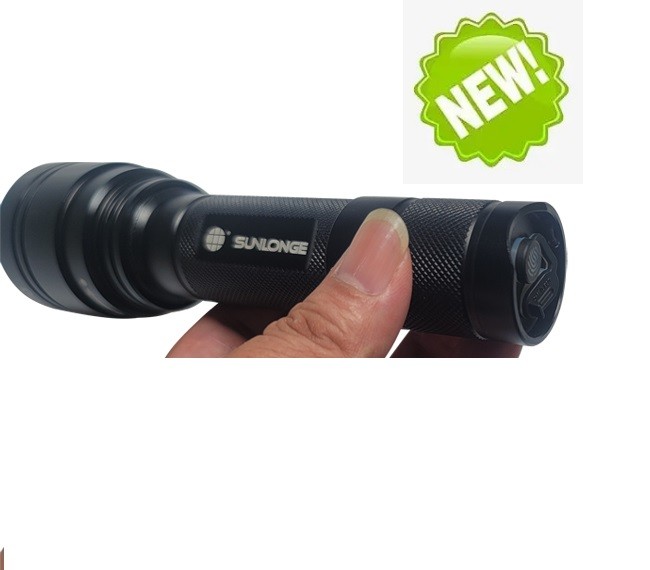
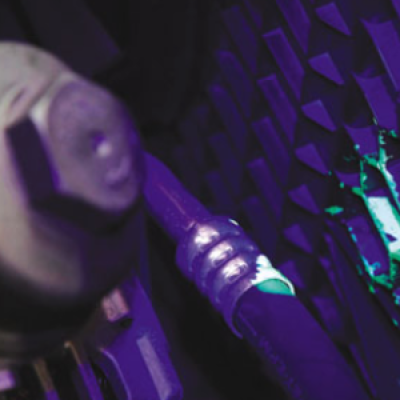
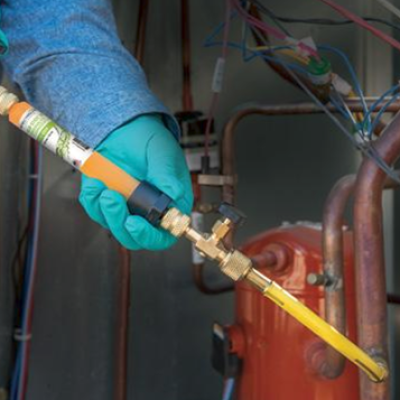
The UV leak detection method is elegantly simple. A specially formulated fluorescent dye is injected into the AC system, circulates with the refrigerant and lubricant, and escapes wherever a leak is present. When illuminated with a 365 nm UV Leak Detection Flashlight, the dye at the leak site fluoresces in a bright yellow-green color that is impossible to miss.
Sunlonge’s SL3200 fluorescent dye for oil-based systems and related formulations are designed specifically for automotive applications; they remain in the system indefinitely, do not affect seals or materials, and can be used for repeated inspections. The dyes are dosed in milliliter quantities and typically need 15–30 minutes of circulation before the system can be scanned, depending on system size.
The role of the UV Leak Detection Flashlight
The UV Leak Detection Flashlight supplies high-intensity ultraviolet radiation at the ideal wavelength of 365–370 nm, which is the “sweet spot” where fluorescent leak detection dyes absorb the most energy and emit the brightest light. Sunlonge’s UV flashlights keep the peak wavelength tightly in the 365–370 nm range so that fluorescent dyes glow strongly while visible violet light remains minimal, preserving contrast in low-light conditions.
With an appropriate UV leak detection lamp, technicians simply:
- Add the manufacturer-approved UV dye to the AC system.
- Run the engine and AC so dye circulates fully.
- Turn off ambient workshop lighting where possible.
- Scan lines, fittings, condenser, compressor, evaporator outlets, and drain points using the UV Leak Detection Flashlight.
Any leak – from an obvious condenser crack to a pinhole in a hose crimp – appears as a bright fluorescent glow at the exact failure point.
Quantified Benefits: Accuracy and Speed vs Traditional Methods
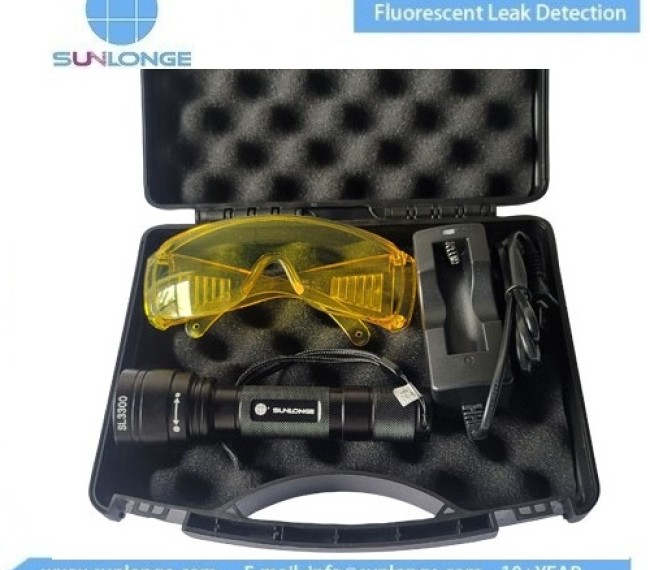
Recent Sunlonge content comparing UV leak detection flashlights with traditional techniques highlights the performance difference in measurable terms.
Key performance statistics
- 95%+ leak detection accuracy: UV flashlights can pinpoint leak locations down to holes as small as 0.007 inches (~0.18 mm) when paired with appropriate dye, outperforming many traditional visual and pressure-based methods.
- 60%+ faster leak isolation: Instead of slowly probing each joint or panel, technicians sweep the system with UV light and immediately see leaks where the dye glows, cutting diagnostic time significantly.
- Micro-leak sensitivity < 1 g/year: Proper dye and UV lamp combinations can reveal extremely small leaks, with documented sensitivity to leaks under 1 gram of refrigerant per year in favorable conditions.
This level of sensitivity is crucial, because gradual refrigerant emission can last for years before it causes a noticeable performance drop, meaning many “small” leaks are completely invisible without enhanced detection methods.
Reduced unnecessary component replacement
Because UV leak detection identifies the exact location of a leak, technicians no longer have to replace entire assemblies “just in case.”
- Condenser leaks become visibly clear at stone-damage points.
- Hose or O-ring leaks show glowing rings around fittings.
- Evaporator leaks manifest at the drain outlet or condensate drip areas.
A Sunlonge guide on fluorescent leak detection notes that, across industrial systems, early leak detection can prevent 40–60% of total maintenance costs compared to reactive repair, by catching issues before they cause larger failures and unplanned downtime. The same logic applies in automotive AC: accurate, early identification of refrigerant leaks avoids repeat service visits, unnecessary parts replacement, and customer dissatisfaction.
Sunlonge’s SL3300‑H: A Purpose-Built UV Leak Detection Flashlight
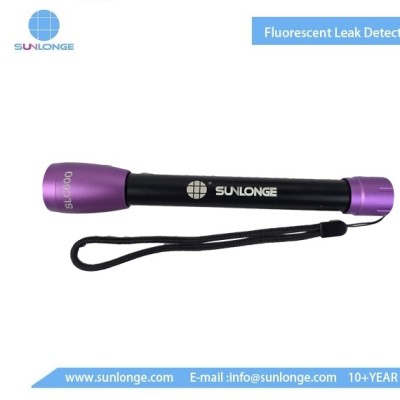
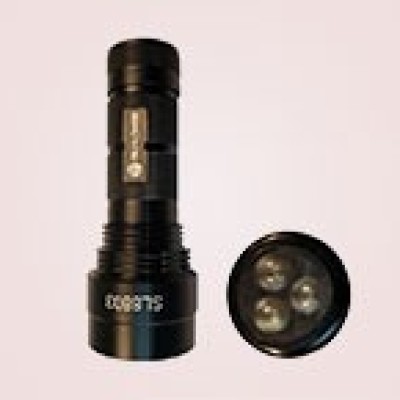
Sunlonge’s SL3300-H UV flashlight is specifically designed as a compact, high-output UV Leak Detection Flashlight optimized for automotive and HVAC leak detection.
Key specifications include:
- 365–370 nm UV LED source (3 W SVC LED with lens) – tuned for maximum fluorescent dye response.
- UV intensity up to 60,000 µW/cm² at 15 inches (38 cm) – significantly higher than many competing leak detection flashlights that operate around 25,000 µW/cm².
- Adjustable beam area of 50–80 mm at 38 cm – allowing technicians to switch between wide-area scanning and focused inspection.
- Constant current driver – maintains stable UV output (>80% stability) even as battery voltage drops, so leak visibility does not degrade over a shift.
- Flexible power options – runs on AAA batteries or a rechargeable 18650 lithium cell, in a compact 40 × 140 mm body weighing only 150 g without accessories.
Sunlonge states that its UV leak detection lamps are approved by customers in more than 30 countries, reflecting global adoption in automotive, HVAC, and industrial maintenance applications.
Table: UV Leak Detection Flashlight vs Traditional AC Leak Detection Methods
| Aspect | UV Leak Detection Flashlight (with dye) | Electronic Sniffer | Soap-Bubble / Visual Methods |
| Detection mechanism | Fluorescent dye glows bright yellow-green under 365 nm UV at leak sites. | Sensor detects refrigerant concentration in the air at probe tip. | Visual observation of bubbles foaming at leak location or oil traces. |
| Minimum leak size typically detectable | Micro-leaks down to 0.007 in holes and <1 g/year in favorable conditions. | Very small leaks (few grams/year) in accessible line sections; less effective in moving air or confined spaces. | Moderate to large leaks; small or shielded leaks often missed. |
| Diagnostic speed | 60%+ faster leak isolation than traditional scanning; rapid visual sweep of entire system. | Requires methodical scanning of all lines and components, often slower. | Time-consuming and limited to accessible joints; requires system pressurization. |
| Precision of leak location | Exact spot visible as localized fluorescence; ideal for targeted repair. | Indicates area where refrigerant concentration spikes but may not show exact hole. | Only reveals leaks where bubbles form or oil is clearly visible. |
| Reusability for future checks | Dye can remain in system for future inspections without performance impact. | Requires repeated setups and calibrations; no persistent marker. | Must be reapplied for each test; no cumulative effect. |
| Impact on customer satisfaction | Reduces comebacks and unnecessary part replacements through precise diagnostics. | Effective but harder to communicate visually to customers. | Least convincing for invisible or intermittent leaks. |
Why Sunlonge UV Leak Detection Flashlights Are Better Than Generic Alternatives
- True 365 nm UV for maximum dye response
Many low-cost “UV” flashlights sold online use 395 nm LEDs, which emit strong visible purple light but excite fluorescent dyes less efficiently. Sunlonge’s leak detection series maintains a precise peak wavelength of 365–370 nm, matching the absorption peak of professional fluorescent dye formulations and minimizing visible light interference. This results in brighter fluorescence and better contrast when scanning for small leaks in tight, dark engine compartments.
- Higher UV intensity for stronger fluorescence
Sunlonge’s leak detection portfolio includes models such as SL3300-H (60,000 µW/cm² at 15 inches) and other handheld lamps delivering 21,000–38,600 µW/cm² at 30 cm. By contrast, Sunlonge’s own application guides note that many competing flashlights in the same class offer around 25,000 µW/cm² at the standard working distance.
Higher intensity means:
- Micro-leaks and thin dye films fluoresce more clearly.
- Technicians can scan effectively even in partially lit environments.
- Faster scanning speed, because shorter exposure reveals the leak.
In related surface-inspection and wafer applications, Sunlonge’s technology delivers up to 280,000–400,000 lux at 30–40 cm, validating its ability to engineer extremely high, stable illuminance for demanding industrial tasks.
- Stable output with constant current driver
A common problem with basic UV flashlights is intensity drop as batteries discharge. Sunlonge’s leak detection lamps integrate constant current driver technology so that UV output stays within tight stability tolerances (>80–90%) over the discharge curve. This ensures leaks that were visible at the start of a shift remain equally visible later, which is critical for consistent diagnostics in a busy workshop.
- Integrated system: lamps + dyes + NDT expertise
Unlike general-purpose flashlight brands, Sunlonge is a specialized NDT and fluorescent leak detection manufacturer serving oil & gas, pipelines, HVAC, and industrial manufacturing in addition to automotive. The company offers a complete ecosystem:
- UV Leak Detection Flashlights (SL3300-H, SL1200, SL1000, SL8803 leak lamps, etc.) with various power and form factors.
- Fluorescent dyes for oil-based and water-based systems (SL3200, SL3100, SL3600, etc.) optimized to respond strongly at 365 nm.
- UV NDT lamps that comply with strict aerospace NDT standards such as ASTM E3022, ISO 3059, and Rolls‑Royce RRES 90061, demonstrating quality far above generic leak detection tools.
This integrated approach means the UV Leak Detection Flashlight you put in your technicians’ hands is backed by the same engineering that powers high-stakes aerospace and semiconductor inspection systems.
How UV Leak Detection Improves AC Repair Precision and Shop Profitability
Fewer comebacks and warranty reworks
Because UV leak detection provides visual proof of where the refrigerant escapes, technicians can repair exactly the failed connection, O‑ring, hose, or condenser section. This reduces the likelihood of:
- Recharging a system that still has an undetected secondary leak.
- Returning customer vehicles because cooling performance drops again within weeks.
Sunlonge highlights that accurate leak detection significantly reduces unnecessary labor and downtime, which is consistent with broader fluorescent leak detection data showing 40–60% maintenance cost savings in complex fluid systems when early leak detection is implemented.
More transparent customer communication
When a technician can show a customer a photo or live demonstration of fluorescent dye glowing at a condenser corner or hose fitting, it becomes far easier to justify the repair recommendation and parts cost. Customers feel they are paying for a clearly demonstrated defect rather than speculative part replacement, which supports higher acceptance rates and workshop reputation.
Faster diagnostics per vehicle
The speed benefits (over 60% faster leak isolation vs traditional methods in many use cases) mean workshops can process more vehicles per day or allocate more time to complex diagnostics. Over a year, even saving 20–30 minutes per AC diagnostic job can translate into dozens of additional billable hours or capacity to take on higher-value repairs.
Practical Workflow: Using a UV Leak Detection Flashlight in AC Diagnostics
Sunlonge’s own how‑to guides outline a straightforward, repeatable procedure for using UV dyes and UV Leak Detection Flashlights in automotive AC systems.
- Prepare the system
- Connect manifold gauges to the high and low service ports.
- Verify system pressure and confirm symptoms (poor cooling, low charge, etc.).
- Inject fluorescent dye
- Add the correct amount of UV dye through the service line as recommended by the dye manufacturer.
- Start the engine and run the AC at maximum to circulate dye throughout the system for 15–30 minutes.
- Create suitable lighting conditions
- Dim workshop lights or move the vehicle to a shaded area when possible.
- Put on UV‑blocking safety glasses to protect eyes and enhance contrast.
- Scan with the UV Leak Detection Flashlight
- Using a 365 nm Sunlonge flashlight (e.g., SL3300-H), inspect:
- Compressor body and shaft seal area.
- Hose crimps and O‑ring joints.
- Condenser face and side tanks.
- Service ports and Schrader valves.
- Evaporator outlets and drain tubes for dye in condensate.
- Using a 365 nm Sunlonge flashlight (e.g., SL3300-H), inspect:
- Document and repair
- Mark each glowing leak location with paint pen or tags.
- Perform targeted repair or component replacement.
- Re‑scan with the UV lamp after repair to verify all leaks are eliminated.
FAQ: UV Leak Detection Flashlights in Automotive AC Diagnostics
Q1. What exactly is a UV Leak Detection Flashlight?
A UV Leak Detection Flashlight is a high‑intensity UV LED lamp, typically emitting at 365–370 nm, used in combination with fluorescent dyes to reveal hidden fluid leaks in systems like automotive AC, engine oil circuits, and hydraulic lines. When the dye that has escaped at a leak site is illuminated, it glows brightly so technicians can see the precise failure point.
Q2. Why is 365 nm better than 395 nm for AC leak detection?
Most professional fluorescent dyes used in automotive and HVAC systems are engineered to absorb UV-A light most strongly around 365 nm, which produces the brightest fluorescence with minimal visible light contamination. Generic 395 nm flashlights emit more visible purple light but less effective UV energy in the dye’s optimal absorption band, resulting in weaker fluorescence and lower contrast.
Q3. Will adding fluorescent dye damage the AC system or void warranties?
Quality UV dyes such as Sunlonge’s SL3200 and SL3600 are formulated to be non-corrosive, material-compatible, and stable in oil and refrigerant circuits, and are widely used in OEM-level testing. When used at recommended dosages (usually fractions of a milliliter per system), they do not affect seal materials, compressors, or heat exchangers. Always follow OEM and dye manufacturer guidelines for warranty-sensitive vehicles.
Q4. How small a leak can a UV Leak Detection Flashlight find?
With appropriate dye and a high‑intensity 365 nm lamp like Sunlonge’s SL3300-H, technicians can detect micro-leaks as small as 0.007 inches in diameter and leakage rates below 1 gram of refrigerant per year under favorable conditions. This level of sensitivity is often beyond what visual inspection or soap-bubble methods can reliably achieve.
Q5. How does UV leak detection compare to an electronic sniffer?
Electronic sniffers remain excellent for detecting very small leaks in confined spaces but require slow, methodical probing and interpretation of sensor tones. A UV Leak Detection Flashlight, by contrast, provides an immediate visual confirmation of leak location once dye has circulated, and studies from Sunlonge show 60%+ faster leak isolation and 95%+ accuracy in many applications. Many professional shops use both methods: dye + UV for visual confirmation and sniffers for certain hard-to-access components.
Q6. Do I need to remove the dye after the repair?
In most cases, no. Sunlonge’s dyes are designed to remain in the system indefinitely without affecting performance, making them useful for future inspections if additional leaks develop later. The persistent marker reduces the need for repeated dye injections over the lifetime of the vehicle.
Q7. Why choose Sunlonge over generic UV flashlights?
Sunlonge is not a generic flashlight brand but a specialized industrial UV solutions providerwith products used in NDT, wafer inspection, and fluorescent leak detection in pipelines, HVAC, and oil & gas. Compared to generic tools, Sunlonge UV Leak Detection Flashlights offer:
- Precisely controlled 365–370 nm wavelength for maximum dye response.
- Significantly higher UV intensity (e.g., 60,000 µW/cm² for SL3300-H at 15 inches).
- Constant current drivers for stable output, and lifetimes of 30,000 hours or more.
- Design and manufacturing practices proven in aerospace-grade and semiconductor inspection environments.
Q8. Are there safety concerns with using UV Leak Detection Flashlights?
UV-A at 365 nm is considered relatively safe when used with standard precautions, but direct eye exposure should always be avoided. Sunlonge recommends UV-blocking safety glasses and limiting skin exposure during prolonged inspections. As with any diagnostic tool, following manufacturer safety instructions and industry best practices ensures safe and effective use.
Conclusion: Turning AC Diagnostics into a High-Confidence, High-Margin Service
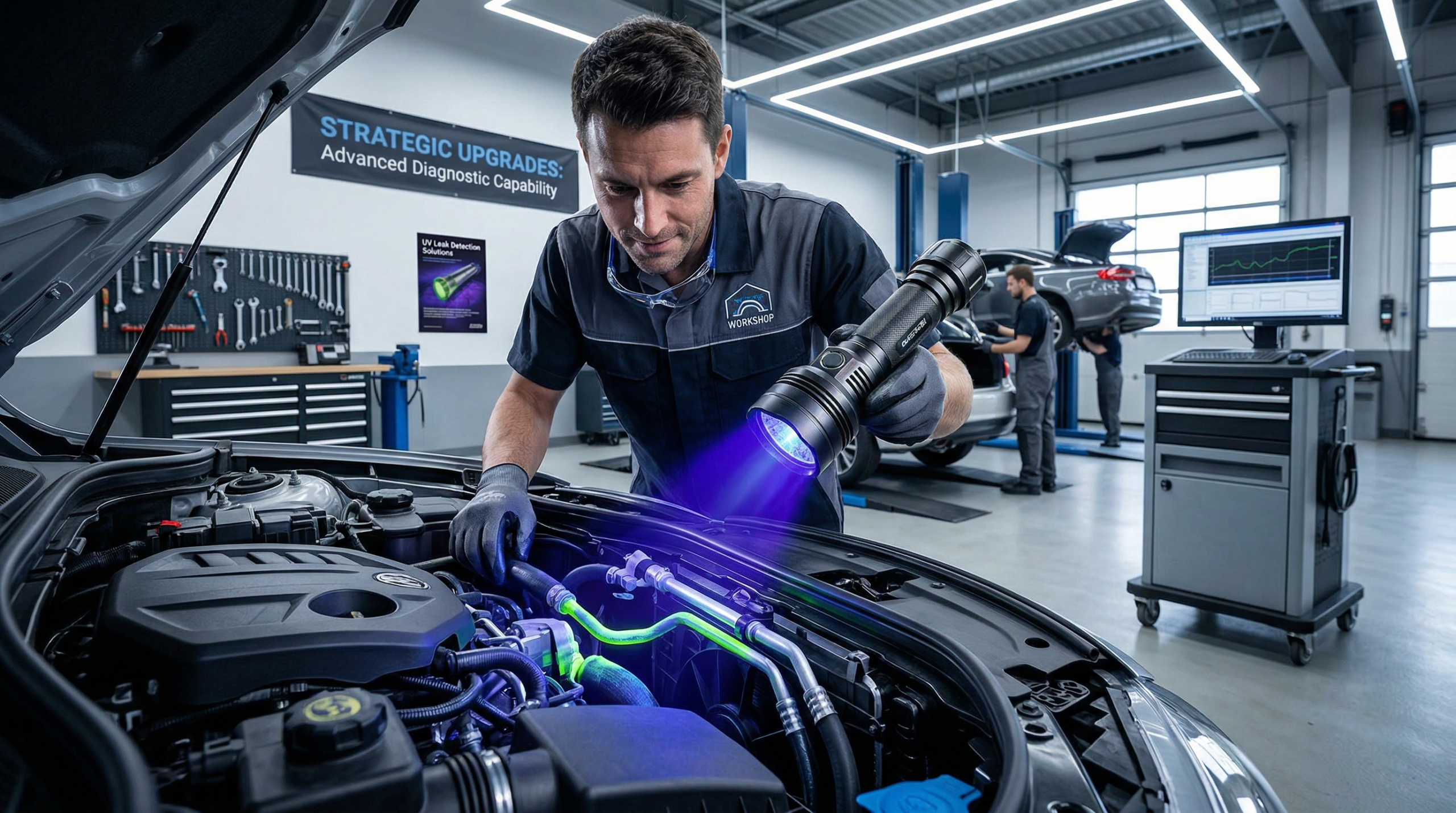
For modern workshops, an investment in a high-quality UV Leak Detection Flashlight is far more than a tool purchase; it is a strategic upgrade in diagnostic capability. By combining 365 nm UV technology, high-intensity output, and engineered fluorescent dyes, Sunlonge enables technicians to:
- Pinpoint micro leaks rapidly and visually, with 95%+ accuracy and 60%+ faster leak isolation than traditional methods.
- Reduce comebacks, unnecessary parts replacement, and refrigerant waste by fixing the real leak the first time.
- Communicate clearly with customers using visible, photographic evidence of leak locations.
- Align with increasingly strict environmental and efficiency expectations in automotive air conditioning service.
Sunlonge’s SL3300-H and its broader UV leak detection ecosystem reflect more than two decades of specialization in UV NDT and fluorescence-based inspection across pipelines, HVAC, manufacturing, and oil & gas, translated into a compact, workshop-ready tool. For any garage serious about professional AC diagnostics, a Sunlonge UV Leak Detection Flashlight is not just an accessory – it is a core diagnostic instrument that turns guesswork into measurable precision.