CN
CN

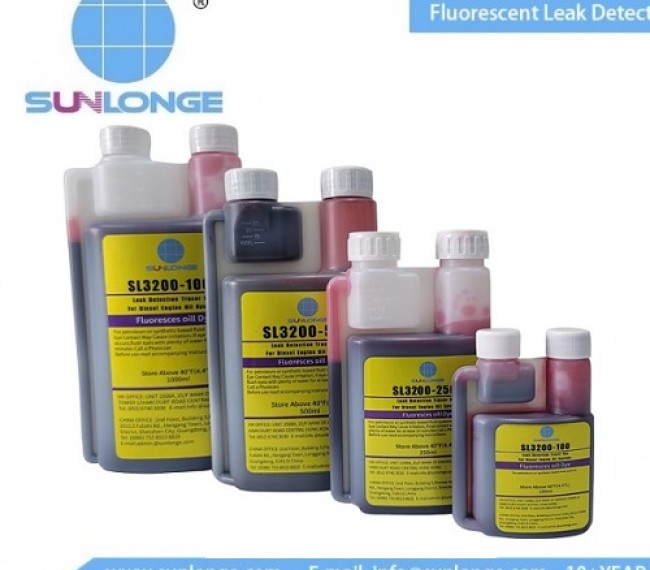
Fluorescent Leak Detection Dye is a highly sensitive tracer that circulates with oils, coolants, refrigerants, or other working fluids and glows brightly under UV light wherever a leak occurs. When combined with a 365 nm UV inspection lamp, it turns even microscopic leaks into obvious, visible “hot spots,” allowing technicians to pinpoint faults quickly without dismantling equipment.
Sunlonge International has built a complete ecosystem around this principle: high‑performance Fluorescent Leak Detection Dye (for oil, refrigerant, water‑based systems) plus engineered 365 nm UV NDT Lamps, giving industrial users a modern, non‑destructive diagnostics toolkit that is faster, more sensitive, and up to around 40% more cost‑effective than traditional methods.
What Is Fluorescent Leak Detection Dye?
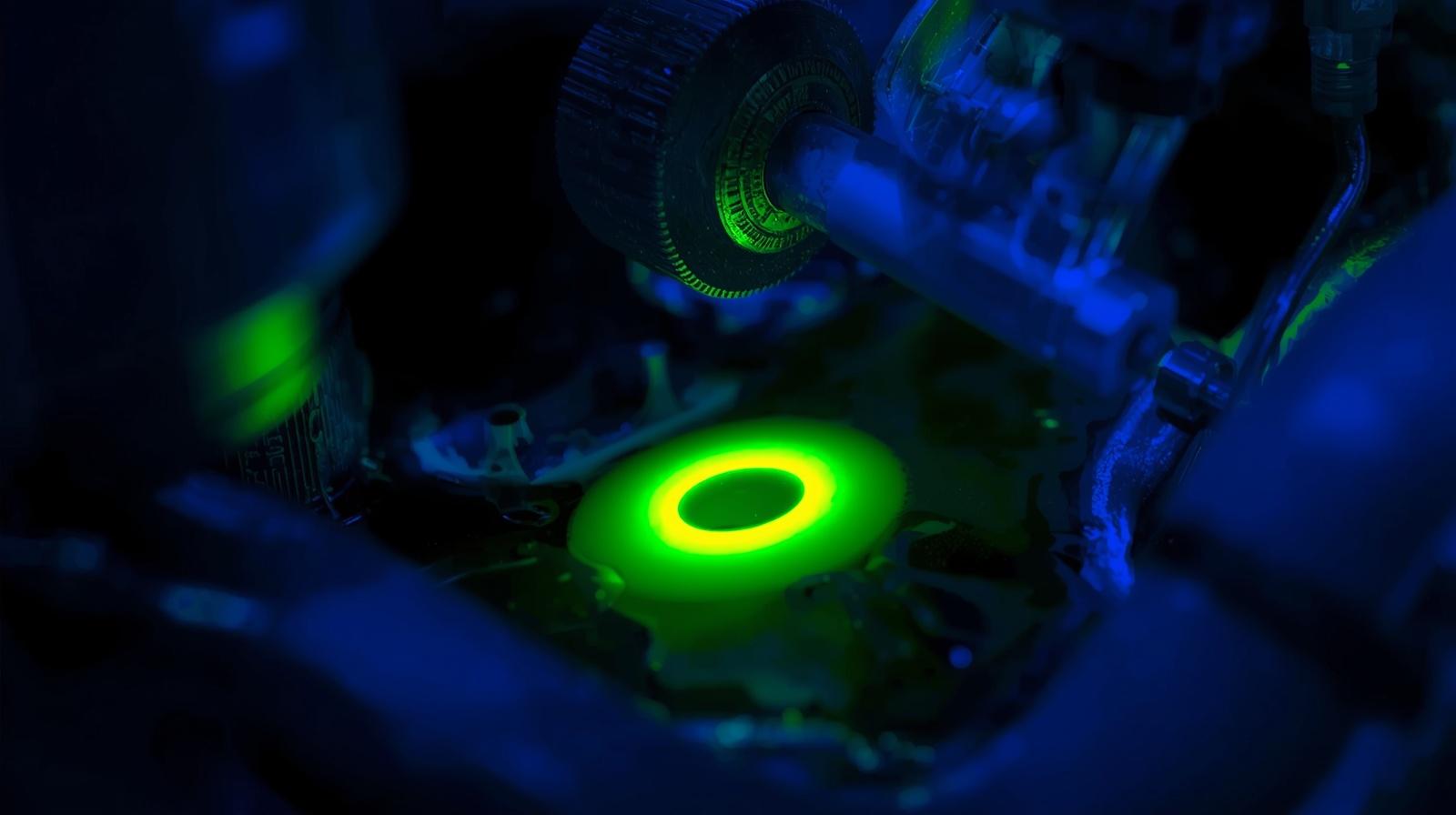
Fluorescent Leak Detection Dye is a specially formulated liquid additive that mixes with the host fluid in a closed system (refrigerant, compressor oil, hydraulic oil, engine coolant, etc.). The dye molecules remain fully miscible with the fluid during normal operation but have strong fluorescence under UV‑A or violet light, typically around 365 nm.
When the system leaks, the fluid escapes—and with it, the dissolved fluorescent dye. As the fluid evaporates or spreads, dye molecules remain behind and accumulate around the leak exit point, forming a concentrated fluorescent “halo” that is easy to see with a UV inspection lamp.
Fluorescent Leak Detection Dye is used today as a “gold standard” leak‑finding method across:
- HVAC/R and refrigeration systems (residential, commercial, industrial).
- Automotive A/C, engine oil, power steering, cooling systems, and transmission.
- Industrial hydraulics, lubrication circuits, and process equipment.
- Pipeline and fluid handling systems in oil & gas and manufacturing.
In some markets, more than 95% of professional HVAC technicians now rely on UV dye for refrigerant leak detection because of its speed, reliability, and clear visual proof.
How Fluorescent Leak Detection Dye Works – Step by Step
Although the underlying physics is complex, the practical workflow is straightforward.
-
Dye Injection and Mixing
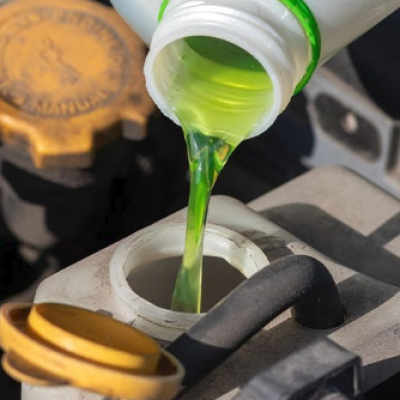
A small, measured amount of Fluorescent Leak Detection Dye is injected into the system, either premixed with compressor oil/refrigerant or through a dedicated injector.
- Typical usage ratio for Sunlonge’s SL3600 fluorescent oil dye is about 0.3–1.0 mL per system, depending on fluid volume.
- Dyes like Sunlonge SL3100 (water‑soluble) and SL3200 (oil‑soluble) are formulated to mix completely with common industrial fluids including POE, PAG, mineral oils, and many water‑based coolants.
Once added, the dye circulates with the fluid as the system operates, reaching every hose, joint, valve, weld, and component that the fluid touches.
-
Leak Occurs and Dye Accumulates
At leak sites—such as micro‑cracks in welds, worn seal edges, degraded gaskets, or pinholes in tubing—pressurized fluid slowly escapes. As the fluid exits, lighter fractions evaporate or disperse, but the larger dye molecules tend to adhere to the surrounding surface.
Over time, even at very low leak rates, this process builds up a local concentration of dye around the defect. Well‑designed systems with high‑performance dye can reveal leaks as small as under 1 gram per year, far below what traditional methods can reliably detect.
-
UV Illumination and Fluorescence
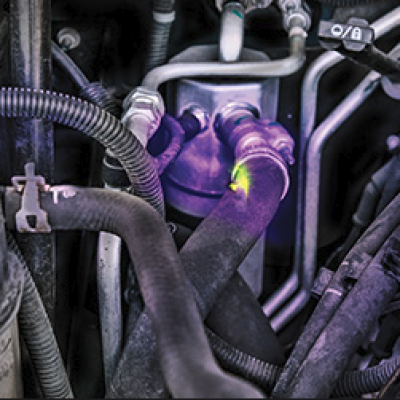
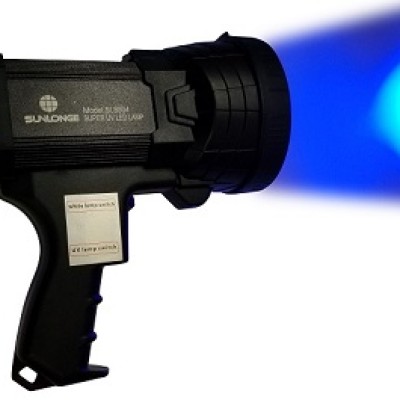
After a circulation period—often 15–30 minutes for typical HVAC or automotive systems—technicians scan the equipment with a 365 nm UV‑A inspection lamp in a dim or darkened environment.
Under UV light:
- Dye molecules absorb high‑energy UV photons and jump to an excited state.
- As they relax back to their ground state, they emit visible light, typically bright yellow‑green.
- Every leak site with accumulated dye glows intensely, creating a sharp visual contrast against non‑fluorescent backgrounds.
Sunlonge’s dyes are optimized for 365 nm UV‑A, which is also the standard wavelength for its UV NDT Lamps, ensuring maximum brightness and minimal background noise.
-
Diagnosis, Documentation and Repair
Once glowing leak points are identified, technicians:
- Mark and photograph the fluorescent spots for documentation and compliance reporting (e.g., EPA Section 608 leak‑repair records in HVAC).
- Categorize leaks by brightness, dye spread, and location to estimate severity and root cause.
- Perform targeted repair—tightening fittings, replacing seals or hoses, re‑welding, or swapping faulty components—without unnecessary teardown or guesswork.
Industrial plants using UV dye report 30–50% reductions in diagnostic downtime compared with traditional trial‑and‑error troubleshooting, because technicians can see exactly where the leak is.
Why Fluorescent Leak Detection Dye Outperforms Traditional Methods
Higher Sensitivity – Down to Micro‑Leaks
Visual inspection and soap‑bubble testing depend on visible fluid pooling or bubbling, so they only show leaks once fluid loss is significant. In contrast, high‑quality Fluorescent Leak Detection Dye can reveal:
- Micro‑leaks below 1 g/year in favorable conditions.
- Early‑stage seal degradation before performance complaints or system alarms appear.
- Slow, internal leaks that pressure‑decay tests cannot easily distinguish from external loss.
Sunlonge reports that its UV dye approach can be up to 100× more sensitive than simple bubble testing when paired with true 365 nm UV‑A lamps.
Simultaneous Multi‑Leak Detection
Pressure‑decay and electronic sniffers tend to focus on the largest or fastest leak first, allowing smaller leaks to go undetected. With Fluorescent Leak Detection Dye, every leak site that has accumulated dye glows independently, so multiple leaks are visible in a single scan.
This is crucial in complex HVAC manifolds, multi‑valve hydraulic blocks, or long pipeline sections where several small leaks can add up to major performance and compliance issues.
Faster, More Visual Diagnostics
UV dye turns leak detection into a visual process: bright glowing spots on a dark background are easy to see, photograph, and explain to maintenance managers or clients. For automotive technicians, for example, typical detection involves adding dye, running the system for about 15 minutes, and then scanning for fluorescing points—often faster and more reliable than repeated soap‑bubble or sniffer passes.
The same principle applies to industrial and HVAC diagnostics, where plants have reported 30–50% reductions in troubleshooting downtime after adopting fluorescent dye methods.
Sunlonge’s Fluorescent Leak Detection Dye Portfolio
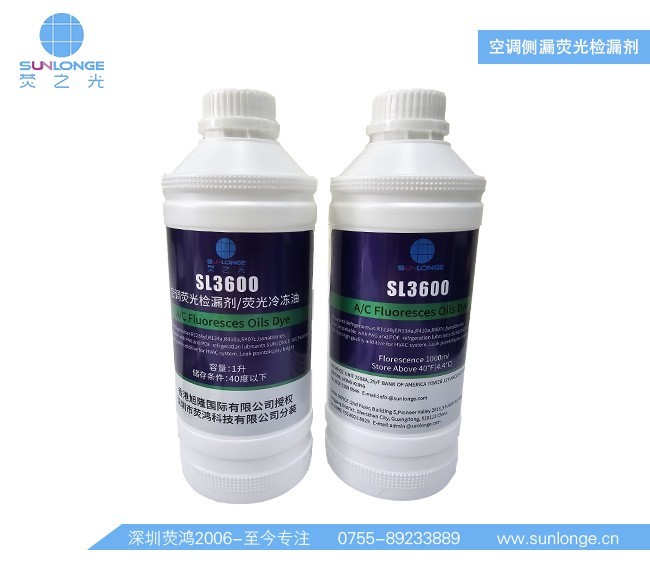
Sunlonge integrates its Fluorescent Leak Detection Dye range with its UV NDT Lamp platform, providing matched chemistry and optics for best‑in‑class performance.
SL3600 – Fluorescent Oils Dye 3600
Sunlonge Fluorescent Oils dye 3600 (often referred to as SL3600) is a concentrated solvent‑soluble dye in a polyol ester oil system, designed for petroleum‑ and synthetic oil‑based fluids.
Key technical properties:
- Suitable wavelength for inspection: 365 nm UV‑A.
- Typical dosage: 0.3–1.0 mL per system.
- Solubility: fully dissolved in POE/PAG and other compressor oils; compatible with many petroleum‑based lubricants.
- Seal material compatibility: formulated to be compatible with common rubber, plastic, and metal components.
- Flash point: above 85 °C, supporting safe handling in typical HVAC/automotive environments.
Typical uses include leak detection in HVAC/R and automotive A/C systems, where SL3600 is added to compressor oil or refrigerant and then inspected with a high‑intensity UV lamp. Leaks show up as bright yellow fluorescence clearly distinguishable from any faint natural blue fluorescence in some oils.
SL3100 and SL3200 – Water‑ and Oil‑Soluble Tracer Dyes
Sunlonge also offers SL3100 (water‑soluble) and SL3200 (oil‑soluble) fluorescent tracer dyes, giving users flexibility across water‑based cooling systems, lubricating oils, and industrial fluids.
These dyes are used in:
- Automotive cooling circuits (radiators, water pumps, hoses).
- Industrial cooling loops and heat‑exchanger circuits.
- Process fluids where water or oil is the primary carrier.
They are optimized to fluoresce intensely under Sunlonge’s 365 nm UV NDT Lamps, ensuring consistent detection performance.
Key Technical Data at a Glance
You can reuse the table below directly in your marketing or technical content.
| Aspect | Sunlonge Fluorescent Leak Detection Dye (example: SL3600 & SL3100/SL3200) | Why It Matters |
| Target wavelength | Peak fluorescence at 365 nm UV‑A. | Matches industry‑standard UV NDT Lamps; delivers high contrast with minimal visible light interference. |
| Typical dosage | 0.3–1.0 mL per system, depending on volume and fluid type. | Very low treatment cost; avoids changing fluid properties or viscosity. |
| Fluid compatibility | SL3600: POE, PAG, mineral oils, PVE lubricants; SL3100: water‑based systems; SL3200: oil‑based systems. | Enables unified leak detection strategy across HVAC, automotive, hydraulics, and process equipment. |
| Micro‑leak sensitivity | Detects leaks <1 g/year in suitable conditions. | Far more sensitive than visual or bubble testing; supports early‑stage fault detection. |
| Detection time | Circulation: 15–30 minutes for typical systems; fluorescent indications visible immediately after circulation. | Fits into normal maintenance windows; reduces system downtime. |
| Multi‑leak capability | Every leak site with dye accumulation fluoresces separately under UV. | Supports identification of multiple faults in a single inspection pass. |
| Downtime reduction | Plants report 30–50% shorter diagnostic timeversus traditional methods. | Direct OPEX savings in industrial environments; higher system availability. |
| Adoption in HVAC | >95% of technicians in some surveys use UV dye for refrigerant leak detection. | Confirms Fluorescent Leak Detection Dye as a mainstream, trusted diagnostic standard. |
Why Sunlonge’s Fluorescent Leak Detection Dye Is Better
-
Matched Chemistry + Optics (Dye + 365 nm Lamps)
Sunlonge doesn’t just sell dye; it provides a complete leak detection system:
- High‑performance Fluorescent Leak Detection Dye (SL3600, SL3100, SL3200).
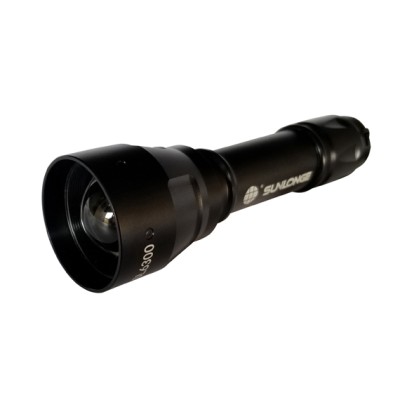
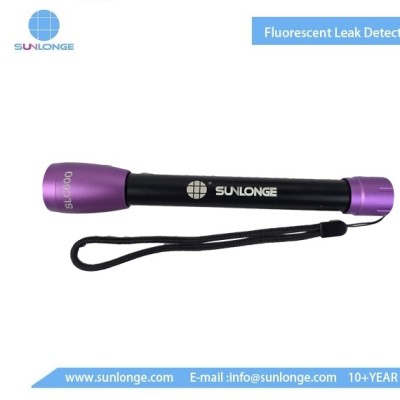
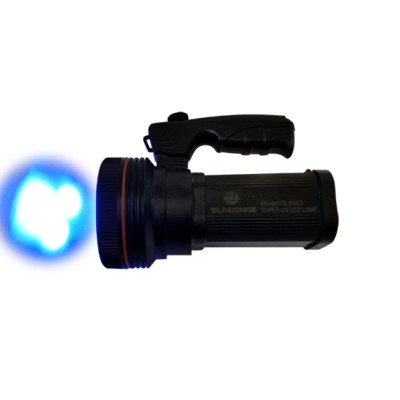
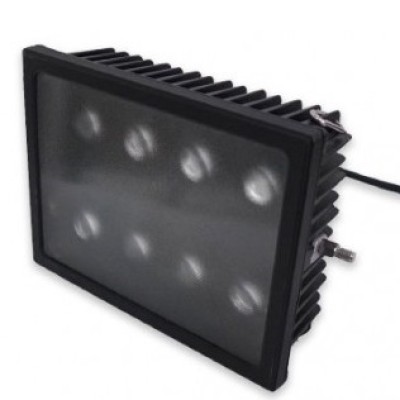
- Dedicated 365 nm UV NDT Lamps and leak detection flashlights with high intensity, low visible light, and homogeneous beams.
This tight integration ensures that dye excitation, lamp wavelength, beam profile, and lux level are all optimized to deliver intense, clear fluorescence in real‑world conditions.
-
Industrial‑Grade Sensitivity and Reliability
Sunlonge’s technical content highlights:
- Micro‑leak detection below 1 g/year, thanks to dye accumulation and high‑intensity UV illumination.
- Up to 100× higher sensitivity than soap‑bubble methods for small leaks.
- Significant reductions in troubleshooting time and diagnostic downtime (30–50% in some industrial plants).
These metrics align well with industrial maintenance KPIs, making Sunlonge a compelling choice for B2B buyers in pipeline maintenance, HVAC, manufacturing, and oil & gas.
-
Application Flexibility Across Fluids and Systems
Because Sunlonge offers both water‑soluble and oil‑soluble dyes along with UV A/C oils and tracer dyes, their solutions cover:
- Refrigeration and A/C systems (HVAC/R and automotive).
- Engine, gearbox, and power steering leaks in vehicles.
- Industrial hydraulic and lubrication systems.
- Cooling water loops, heat exchangers, and process lines.
Technicians can standardize on a single vendor without juggling incompatible dyes or worrying about material compatibility across different systems.
-
Compatibility and Safety
Sunlonge’s SL3600 Fluorescent Leak Detection Dye is designed to be:
- Fully soluble in typical compressor and refrigeration oils, avoiding phase separation.
- Compatible with commonly used rubber, plastic, and metal components, helping to avoid swelling or degradation.
- Used at very low treat rates to avoid meaningful changes in fluid viscosity or performance.
This makes it suitable for long‑term monitoring; in many applications, dye can remain in the system indefinitely to support future inspections.
-
Cost Saving and Total Cost of Ownership
When you factor in early leak detection, reduced diagnostic time, and fewer unplanned outages, Fluorescent Leak Detection Dye can significantly lower lifetime operating costs.
Sunlonge’s broader UV technology portfolio (dyes + 365 nm UV LED lamps) is engineered around energy‑efficient, long‑life LEDs and high‑concentration dyes, enabling up to about 40% total cost saving compared with legacy leak detection approaches that rely on repeated manual tests, slow diagnostics, and frequent component failures from undetected leaks.
Real‑World Use Cases for Sunlonge Fluorescent Leak Detection Dye
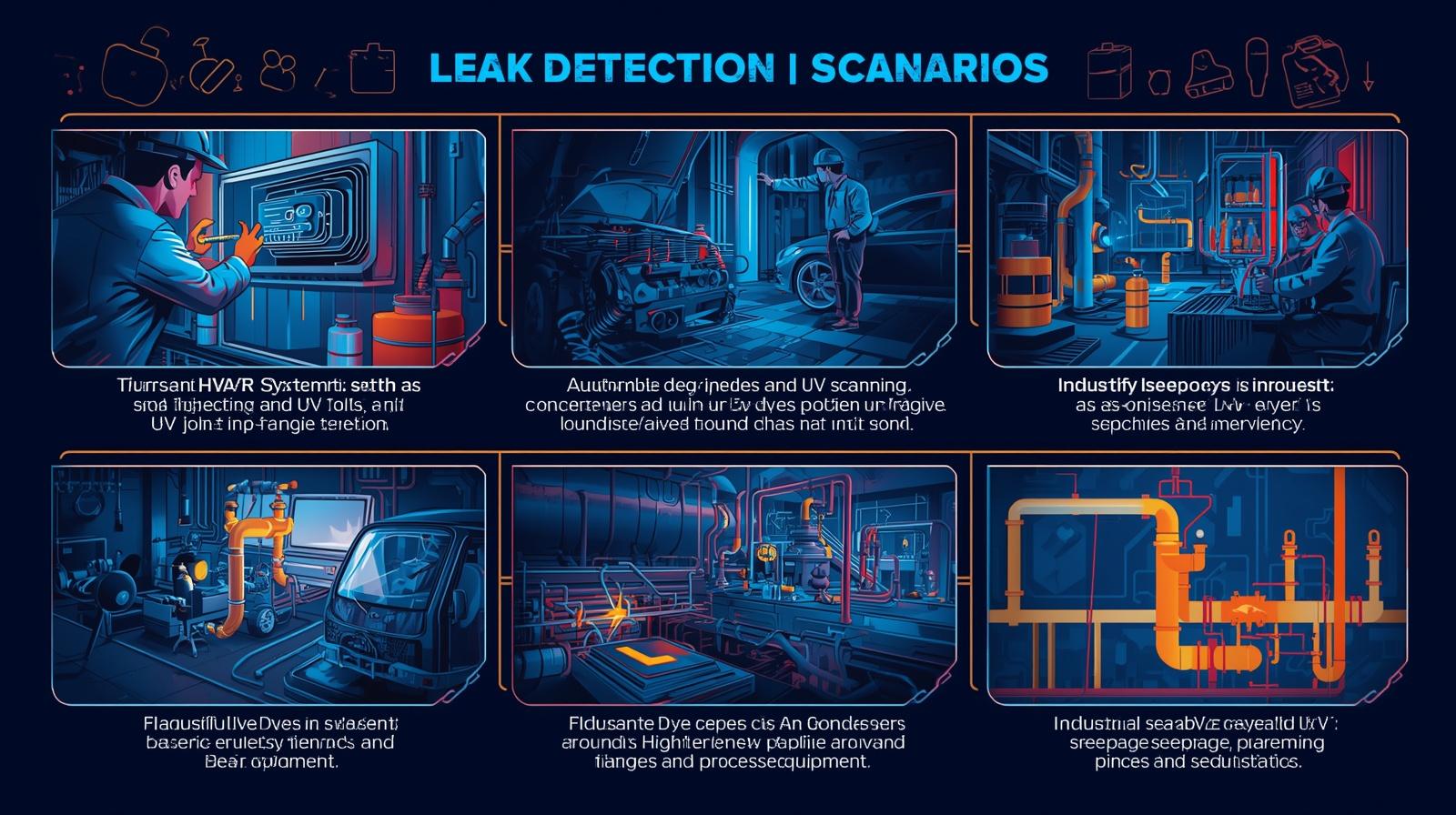
- HVAC/R Refrigerant Leaks – Technicians inject dye (e.g., SL3600), run the system, and scan coils, compressors, and joints. Tiny leaks fluoresce, allowing targeted repair and documentation for regulatory compliance.
- Automotive A/C and Engine Systems – Sunlonge UV dyes help locate leaks in condensers, evaporators, hoses, head gaskets, and oil seals, often in a single inspection session.
- Industrial Hydraulics and Lubrication – Plants use fluorescent dye to distinguish between internal leakage (inside valves or cylinders) and external leaks, reducing unnecessary teardown and improving reliability metrics.
- Pipeline and Process Equipment – UV dye can reveal seepage around flanges, threaded connections, and welds in pipelines or process vessels without shutting down whole sections for invasive testing.
In each case, Sunlonge’s matched 365 nm UV NDT Lamps dramatically enhance the visibility of its dyes, even in harsh field environments.
FAQ: Fluorescent Leak Detection Dye in Modern Diagnostics
Q1: What is Fluorescent Leak Detection Dye in simple terms?
It is a concentrated tracer that mixes with the working fluid in a system and glows brightly under UV light wherever the fluid escapes. This fluorescence allows technicians to visually pinpoint leak locations quickly and non‑destructively.
Q2: How is Fluorescent Leak Detection Dye added to a system?
Typically, a small volume of dye (for example, 0.3–1.0 mL for Sunlonge SL3600) is injected via service ports, oil fill points, or specialized injectors, then circulated as the system runs. After 15–30 minutes, a 365 nm UV lamp is used to scan for glowing leak sites.
Q3: Will the dye affect system performance or damage components?
High‑quality dyes like Sunlonge SL3600 are engineered to be fully soluble in target fluids and compatible with common seal, plastic, and metal materials at recommended treat rates. When dosed correctly, they are not known to significantly change viscosity or performance of lubricants, refrigerants, or coolants.
Q4: How small a leak can Fluorescent Leak Detection Dye find?
Under proper conditions (correct dosage, adequate circulation, and 365 nm UV inspection), fluorescent dyes can detect leaks below 1 g/year, far beyond the sensitivity of visual inspections or bubble tests. This makes them ideal for modern compliance and energy‑efficiency requirements.
Q5: Why combine Sunlonge Fluorescent Leak Detection Dye with Sunlonge UV NDT Lamps?
Dye sensitivity depends heavily on UV wavelength, beam intensity, and visible light suppression. Sunlonge’s dyes are tuned for 365 nm, and its UV NDT Lamps are designed to deliver strong, homogeneous 365 nm beams with low visible light, complying with NDT illumination best practices. Using both together maximizes defect visibility, reduces false negatives, and shortens diagnostics.
Q6: Can the dye stay in the system permanently?
In many automotive, HVAC/R, and industrial applications, fluorescent dye can remain in the system as a long‑term tracer, simplifying future leak checks. For critical or highly regulated systems, technicians may choose to flush and refill after repairs; Sunlonge provides usage guidelines to support both strategies.
Q7: In which industries is Sunlonge Fluorescent Leak Detection Dye used today?
Sunlonge dyes and UV NDT Lamps are used across HVAC/R, automotive, industrial manufacturing, pipeline maintenance, hydraulics, and other sectors where fluid integrity and uptime are critical. Their combination of sensitivity, speed, and compatibility makes them an attractive choice for OEMs, service providers, and plant operators worldwide.