CN
CN

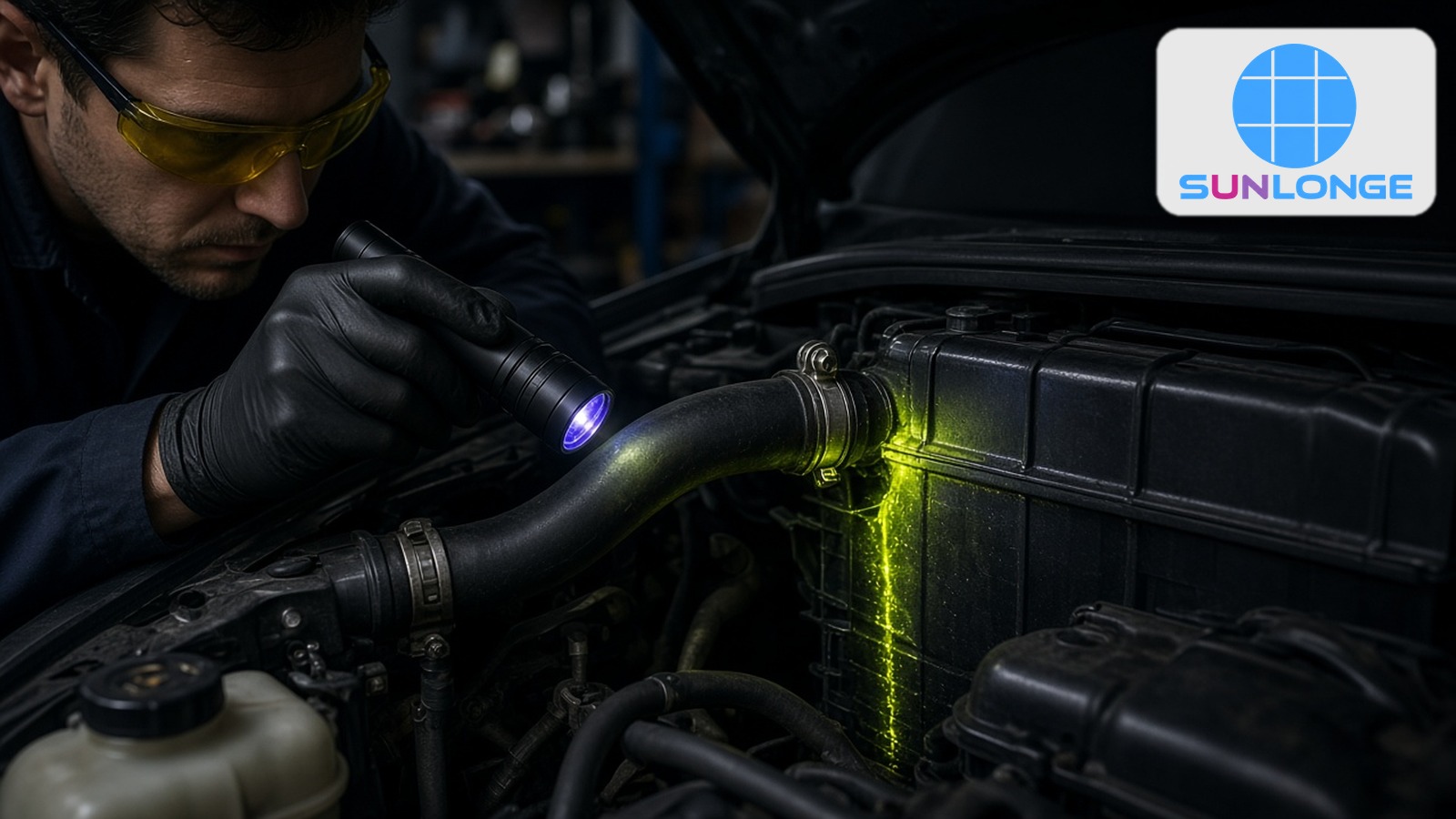
A fluorescent leak detection dye changes coolant diagnosis from guesswork into something you can see. When a cooling system loses fluid, the leak is often slow, intermittent, or hidden behind shrouds and underbody panels. Coolant can drip onto a hot surface, spread in the airflow, or show up only under pressure at full operating temperature. Add a small amount of UV-reactive dye to the coolant, run the system, and scan it with a UV lamp, and the leak point glows bright yellow-green right where it starts.
This matters because cooling problems are common and costly. In AAA’s analysis of more than 32 million roadside assistance requests in 2017, engine cooling system failures accounted for 11% of serious breakdowns that needed a tow. At Car Care Council community inspection events in 2014, 17% of vehicles checked had low, leaky or dirty coolant. In this guide we cover how dye works in a cooling system, where it reveals leaks component by component, how to run a clean diagnostic, and why Sunlonge dyes and UV lamps offer technicians a more complete system than typical generic products.
Why Coolant Leaks Are Hard to Find Without Dye
Visual checks and pressure testing are still essential, but they have limits:
- Leaks may only appear hot and pressurized. A seep at a hose clamp or gasket can close up when the engine is cold.
- The evidence moves. Airflow from the fan and road spreads drips away from the source, so the puddle under the car seldom marks the real leak point.
- Coolant is hard to see in a dark engine bay, especially on dirty or coolant-stained parts where old residue hides a new leak.
- Several leaks can exist at once. Fixing the obvious one and missing a second leads to comebacks.
A fluorescent dye travels with the coolant to every point it escapes, then marks each site so it can be seen clearly under UV light.
How Fluorescent Leak Detection Dye Works in a Cooling System
Most water-based coolant dyes use fluorescein or a similar compound. Fluorescein absorbs most strongly around 490 nm and emits around 514 nm, which the eye sees as an intense yellow-green. It also fluoresces when excited by 365 nm UV-A, the wavelength used by professional leak detection lamps. In a dim bay that gives a high-contrast glow, and yellow fluorescence-enhancing glasses make it stand out even more by cutting the lamp’s violet-blue glare.
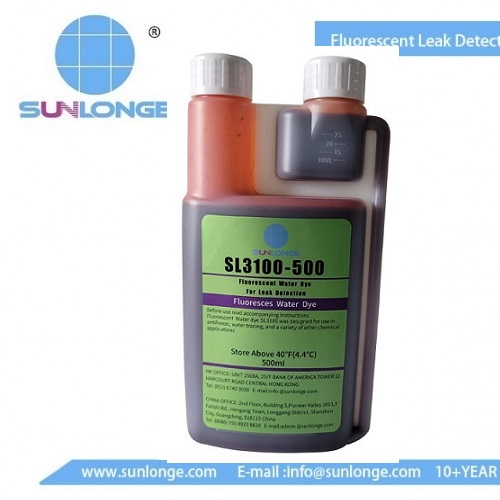
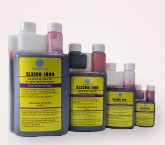
Fluorescein’s brightness depends on pH, so a dye formulated to stay bright in alkaline or high-pH conditions gives more dependable results. Sunlonge’s SL3100 Water Tracing Fluorescent Dye is a concentrated fluorescein disodium salt formula in a water and glycol solvent system. Sunlonge states it keeps excellent fluorescence and light fastness even in a high-pH environment, mixes with water or antifreeze, and is suited to 365 nm inspection.
Component by Component: Where Dye Reveals Cooling System Leaks
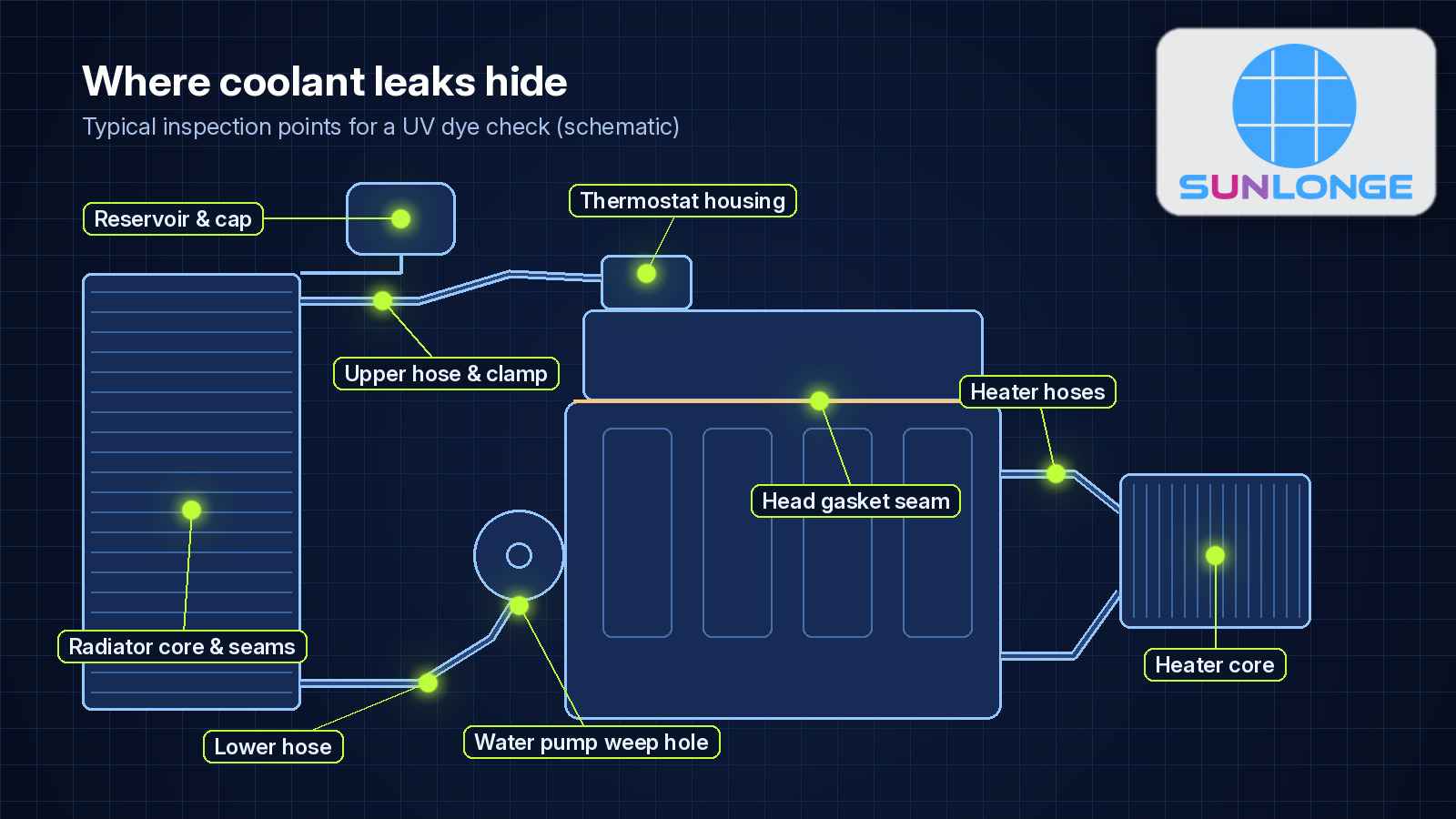
Radiator core, seams and tanks
Check where plastic end tanks meet the aluminium core, the drain cock, and any spots with fin damage. Dye in the core often wicks along the tubes, so follow the glow back to its brightest point.
Hoses, clamps and connections
Upper and lower radiator hoses, bypass hoses and quick-connect fittings are common leak sites. Look for a glowing ring at the clamp or a film along the underside of the hose where coolant has run.
Water pump
Many pumps have a weep hole that shows seal wear. A dye trace from the weep hole or down the timing cover points to the pump rather than a nearby hose. Sunlonge’s guide on water pump leaks covers common causes.
Thermostat housing and intake gasket
Housings and coolant-carrying intake gaskets can seep at the joint face. A thin glowing line along the seam is the tell-tale sign.
Heater core and heater hoses
Heater core leaks often show up as damp footwell carpet, a sweet smell, or a misted windscreen. Scan the heater hoses at the firewall, then check the cabin floor and the HVAC drain area with the lamp. Glowing residue confirms coolant rather than A/C condensate.
Head gasket: what dye can and cannot show
Dye shows external head gasket seeps clearly as a glowing line along the head-to-block joint. If the system keeps losing coolant with no external evidence, the leak may be internal, into a cylinder or the oil. In that case, follow up with a cooling system pressure test or a combustion leak (block) test. Dye shows where coolant escapes outside the engine, not inside it.
A Technician’s Workflow for Dye-Based Coolant Leak Detection
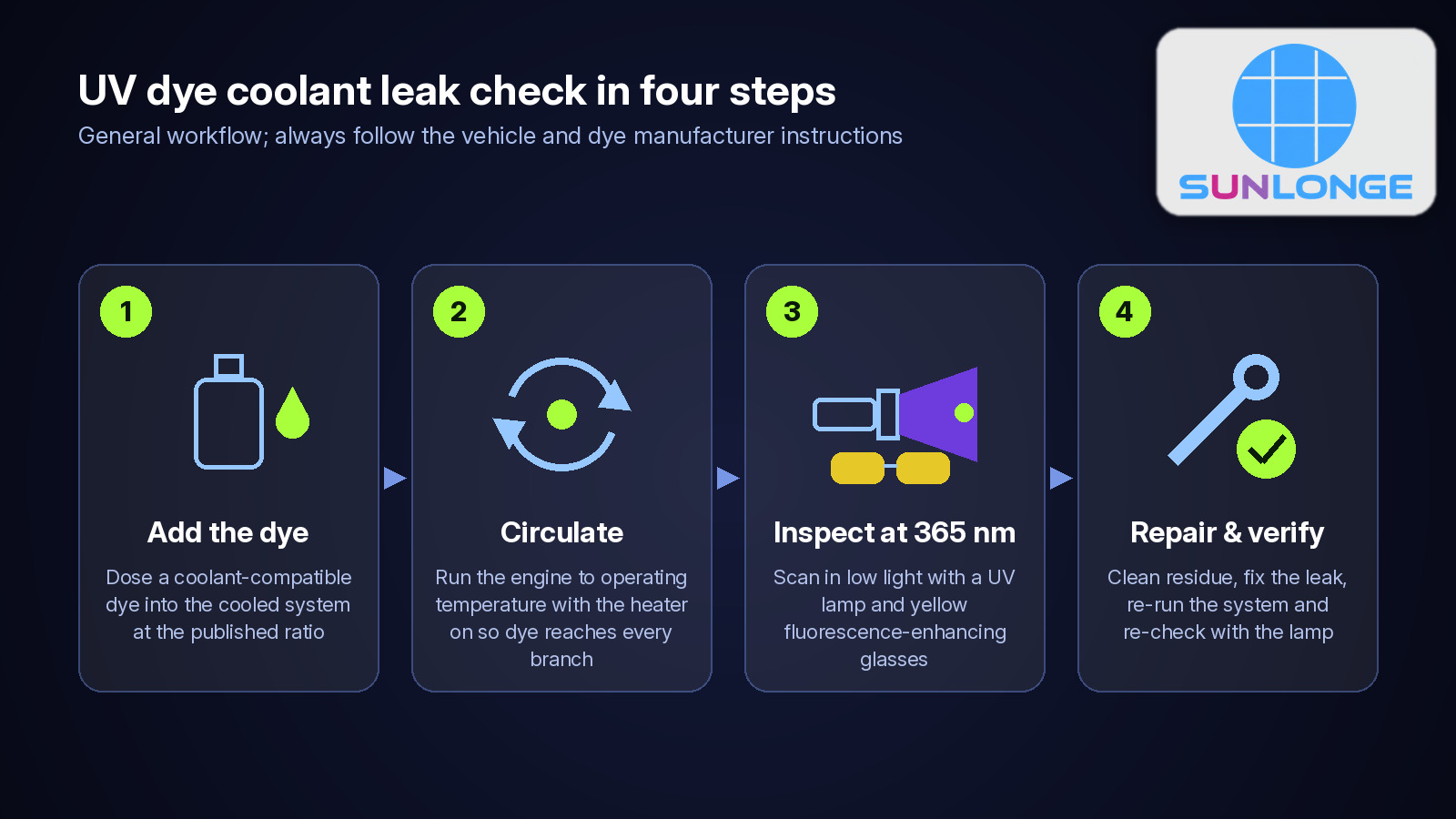
- Prepare safely. Let the engine cool completely. Never open a hot, pressurized cooling system. Clean old residue from suspect areas so new traces are easy to tell apart.
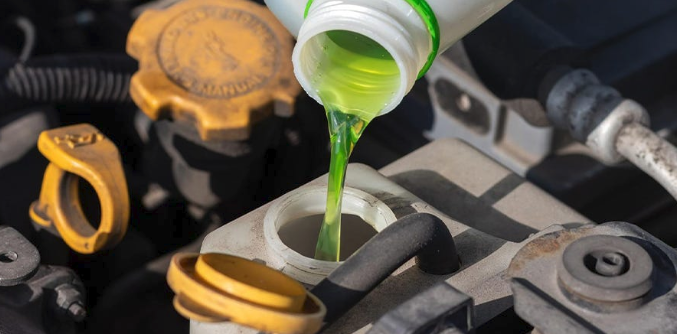
- Dose the dye. Add a coolant-compatible dye through the reservoir or radiator neck. Sunlonge lists a typical usage ratio of 0–1.5 : 3,000 for SL3100, meaning 1 L can treat about 3,000 L of antifreeze. For example, a system holding 10 L would need roughly 3–5 mL as a starting point. Actual dosage depends on coolant colour, the UV lamp and ambient light.
- Run the engine to operating temperature with the cabin heater on so dye reaches the heater core and every branch. A pressure tester can help bring out leaks that only open under pressure.
- Inspect at 365 nm. In shade or low light, wear yellow fluorescence-enhancing glasses and scan systematically: radiator, hoses, pump, housing, gasket seams, heater hoses, then the cabin.
- Repair and verify. Clean the glowing residue, carry out the repair, run the system again and re-inspect. No glow means the leak is fixed. The dye can stay in the coolant for future checks.
Choosing the Right UV Lamp and Accessories
Dye is only half the system. The lamp decides how bright the glow looks and how quickly you can scan:
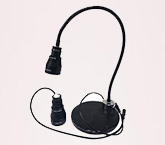
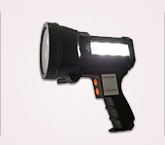
- High-output 365 nm lamps such as the SL8803 Super UV LED Leak Detection Lamp (3 × 5 W 365 nm LEDs with lens, rated at 21,000 µW/cm²) make faint seeps visible even in a bright workshop.
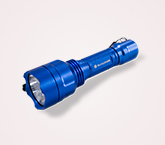
- Adjustable-beam flashlights like the SL6300, whose focus can be adjusted from 20 to 100 mm, let you switch between a wide sweep and a tight spot in cramped engine bays.
- Complete kits such as the AT063-K Water Tracing Dyes and Blue Start Kit combine an AT063 rechargeable leak detection flashlight, 500 mL of SL3100 dye, UVG-103Y fluorescence-enhancing glasses and a carrying case, so a technician has everything in one place.
Why Sunlonge Fluorescent Leak Detection Dye Outperforms Typical Alternatives
Generic coolant dyes often come with little information beyond “add one bottle”. For professional diagnostics, published data and a matched dye-and-lamp system make the difference:
| Factor | Sunlonge SL3100 + Sunlonge UV lamps | Typical generic coolant dye |
| Chemistry disclosed | Fluorescein disodium salt in water/glycol solvent | Often undisclosed |
| Concentration | Typical ratio 1.0–1.5 : 3,000; 1 L treats about 3,000 L of antifreeze | Dosage ratio often not published |
| Performance in coolant | Excellent fluorescence and light fastness, even at high pH | Rarely specified |
| Material compatibility | Listed as compatible with all rubber, plastic and metal parts (concentrated and diluted) | Frequently undocumented |
| Safety data | Flash point above 100 °C (212 °F) | Not always stated |
| Inspection wavelength | Specified for 365 nm; matched Sunlonge 365 nm lamps and yellow glasses | Lamp sold separately, wavelength unspecified |
| Range for other water systems | SL3300 green, SL3400 yellow, SL3500 magenta and SL3000 colourless tracers | Usually one colour |
| Manufacturer | Founded in 1999, own R&D team, factories in mainland China, worldwide delivery | Varies; technical support often limited |
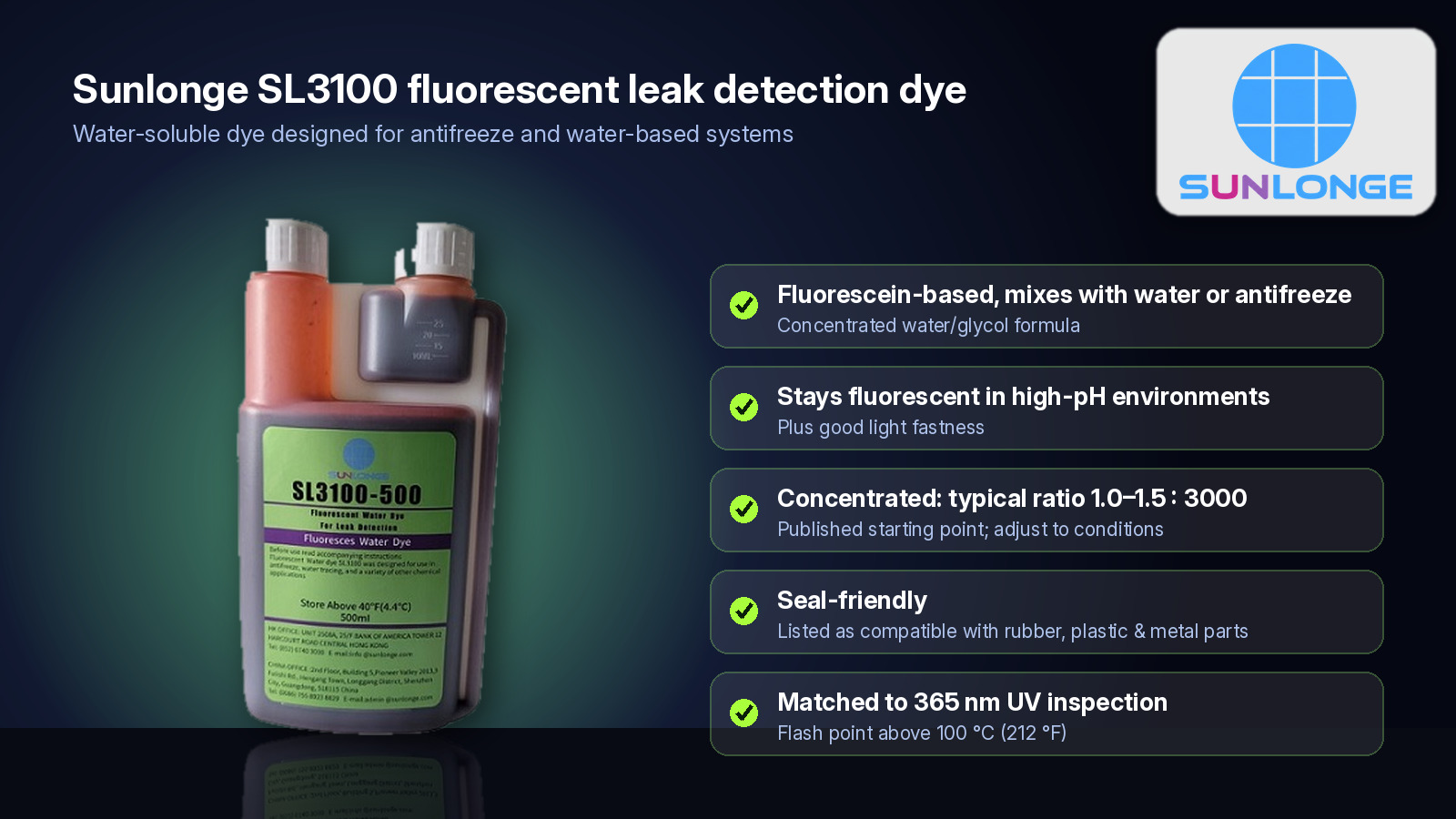
Because Sunlonge makes both the dyes and the 365 nm lamps, the chemistry and optics are designed to work together. You get a bright, high-contrast indication from a small, economical dose, backed by a supplier that also builds UV inspection lamps for NDT and laboratories.
FAQ
Is fluorescent leak detection dye safe for my cooling system?
Use a dye made for water/glycol coolant at the recommended ratio. Sunlonge lists SL3100 as compatible with all rubber, plastic and metal parts in both concentrated and diluted form. Always follow the vehicle maker’s coolant guidance.
What UV light do I need to see coolant dye?
A 365 nm UV-A lamp is the standard choice. Wear yellow fluorescence-enhancing glasses to boost contrast and protect your eyes. Higher-output lamps make small leaks easier to see in normal shop lighting.
How much dye should I add to a car’s cooling system?
Follow the product ratio. For SL3100, Sunlonge’s typical ratio is 1.0–1.5 : 3,000, or roughly 3–5 mL for a 10 L system as a starting point. Adjust for coolant colour and lighting.
Can dye find a blown head gasket?
It shows external head gasket seeps along the joint. Internal leaks into the cylinders or oil need a pressure test or a combustion leak test to confirm.
Can I leave the dye in the coolant after the repair?
Yes. Re-inspect after the repair to confirm the leak is fixed. Leftover dye in the coolant makes future leak checks quicker.
Conclusion: See the Leak, Fix It Once
Cooling system leaks are a common cause of breakdowns, and the hardest part of the job is finding the true source. A fluorescent leak detection dye, paired with a strong 365 nm lamp and yellow glasses, marks every leak point on radiators, hoses, water pumps, housings, heater cores and external gasket seams. That means fewer comebacks and faster, evidence-based repairs. With published chemistry, a concentrated dosing ratio, high-pH stability, seal compatibility, and matched lamps and kits, Sunlonge gives workshops a more complete system than typical generic dyes.
Equip your bay today: browse Sunlonge fluorescent dyes, choose a UV LED leak detection lamp, or pick a ready-to-use leak detection kit. For distributor or bulk pricing, contact Sunlonge.