CN
CN

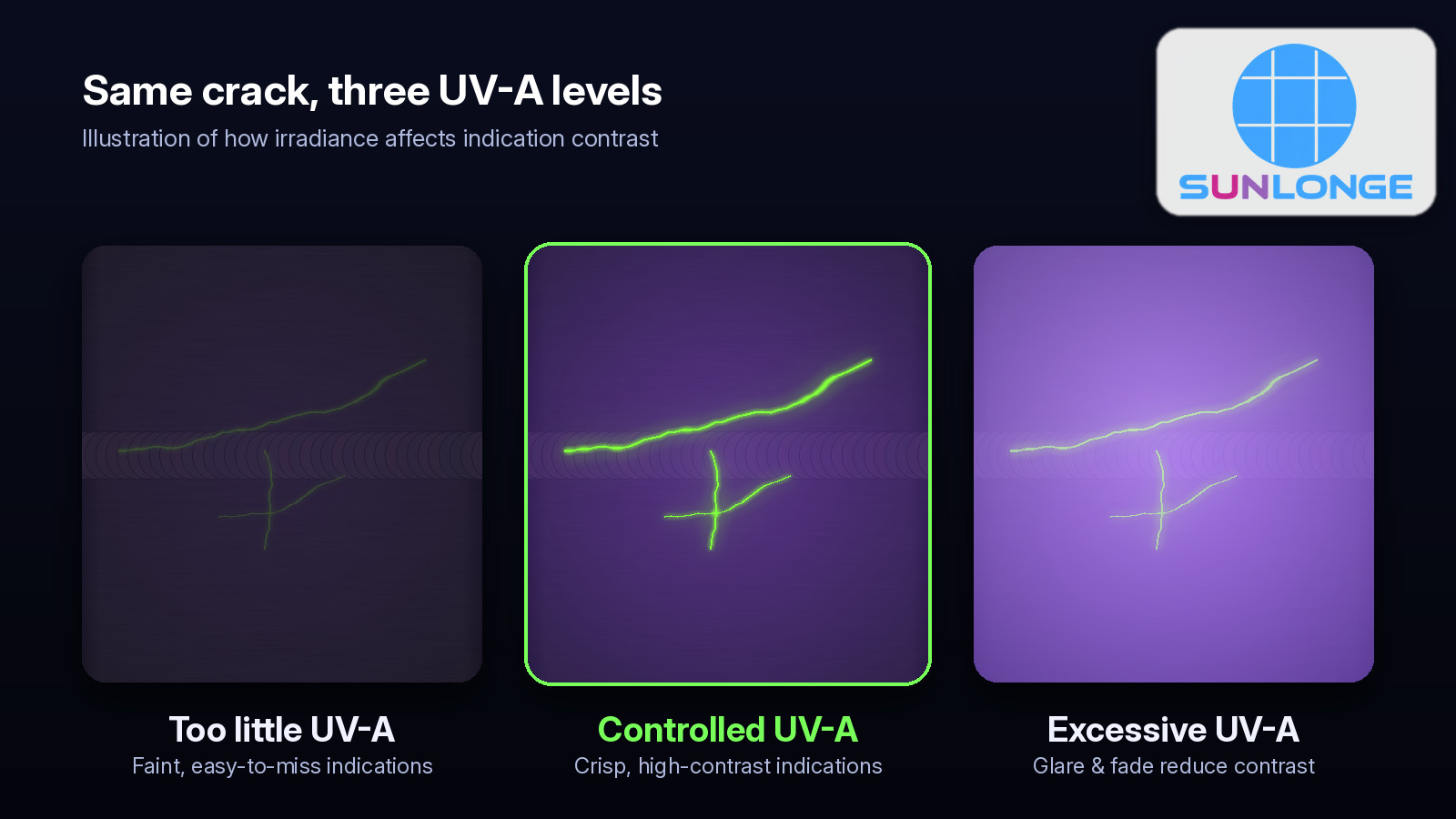
A UV NDT lamp is the light source that turns a microscopic crack into a visible indication. In fluorescent penetrant inspection (FPI) and fluorescent magnetic particle inspection (MPI), the penetrant or particles only glow when they get enough UV-A energy. That makes UV intensity, more precisely the UV-A irradiance arriving at the part surface, one of the most important variables in the whole process, and one of the easiest to get wrong. Too little and real defects fade into the background. Too much and glare and dye fade start to hide them again.
This guide explains how intensity links to indication quality, which figures the main standards set, how distance and lamp stability change what reaches the part, and why Sunlonge UV NDT lamps give inspectors a documented, repeatable intensity window that typical low-cost UV lights do not.
Why UV Intensity Is the Hidden Variable in Fluorescent Inspection
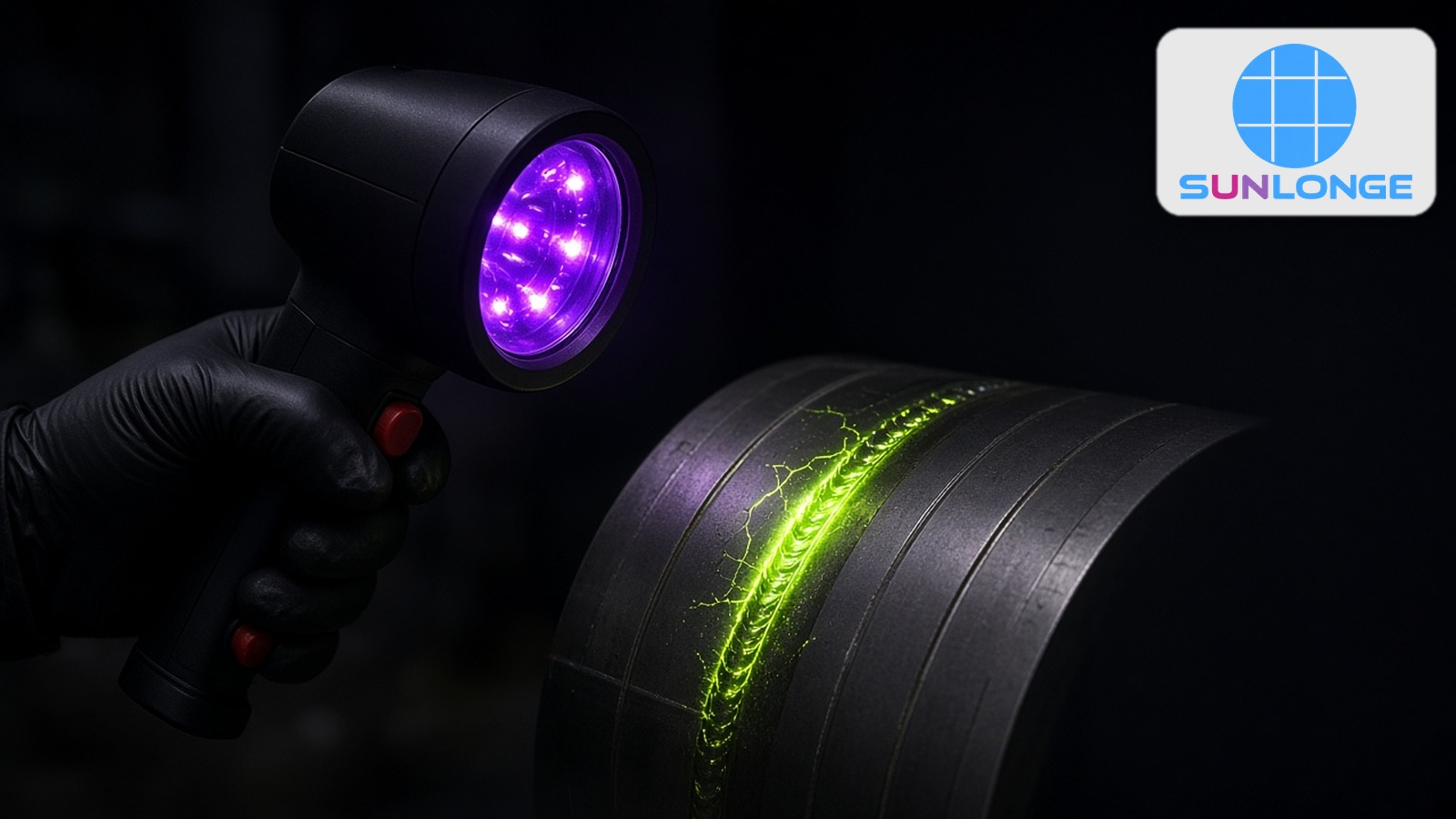
Fluorescent inspection works on contrast. The inspector looks for a bright yellow-green line against a dark, low-fluorescence background. Lamp intensity affects both sides of that ratio:
- Indication brightness. More UV-A on the surface generally means more fluorescence from the penetrant or particles trapped in a discontinuity.
- Background brightness. Stray visible light from the lamp, ambient light in the booth, and fluorescence from leftover surface penetrant all rise with poor lighting control.
- The inspector’s eye. Human vision in a darkened booth needs time to adapt, and very intense sources can cause glare that reduces perceived contrast.
So the goal is not maximum power. It is controlled, verified irradiance at the inspection surface, kept inside the limits your procedure allows.
The Numbers That Define the Intensity Window
Most FPI and MPI specifications agree on a minimum and a set of controls. Some add a maximum.
| Requirement | Figure | Source |
| Minimum UV-A at the examination surface | 1,000 µW/cm² (10 W/m²) | ASTM E1417/E1417M-21; ISO 3059:2012 |
| Minimum UV-A for aerospace MPI lamps | 1,000 µW/cm² at 15 in (38.1 cm) from the filter | ASTM E1444/E1444M-21 |
| Maximum ambient visible light (fluorescent methods) | 2 fc (21.5 lx) / 20 lx | ASTM E1417; ISO 3059 |
| Dark adaptation before evaluation | At least 1 minute | ASTM E1417; ASTM E1444 |
| Source peak wavelength | 365 ± 5 nm | ISO 3059; ASTM E3022 / RRES 90061 (LED lamps) |
| Upper guidance for penetrant testing | Generally not more than 5,000 µW/cm² (50 W/m²) | ISO 3059:2012 |
| Maximum steady-state irradiance (LED lamps) | 5,000 µW/cm² at 15 in | Rolls-Royce RRES 90061 |
The floor: 1,000 µW/cm² at the part
Below roughly 1,000 µW/cm², fine indications can lack the brightness to stand out from the background. That’s why ASTM E1417 and ISO 3059 both use this figure as the minimum at the examination surface. ASTM E1417 also says that when special lighting such as pencil lamps or light guides is used, intensity must be measured at the expected working distance, not just at a reference distance.
The ceiling: glare and fluorescent fade
More is not always better. ASTM E3022 warns that some high-intensity UV-A lamps can exceed 10,000 µW/cm² at 15 in, and that such sources can cause fluorescent dye fade and expose the inspector’s unprotected eyes and skin to higher levels of radiation. ISO 3059 advises that, for penetrant testing, high levels and long durations of UV-A exposure should be avoided, generally not more than 5,000 µW/cm². In aerospace, RRES 90061 caps LED lamp output at 5,000 µW/cm² at 15 in.
Ambient light and dark adaptation
Even a perfect UV NDT lamp can’t make up for a bright room. Keep ambient visible light at or below 2 fc (about 20 lux) and give inspectors at least one minute of dark adaptation before they evaluate parts. Lamps with low visible-light emission help keep the background dark.
Distance: Why Rated Intensity Is Not What Reaches the Part
Lamp datasheets usually state intensity at 15 in (38.1 cm), the reference distance used in ASTM E1444 and ASTM E3022 measurements. Real inspections rarely happen at exactly that distance.
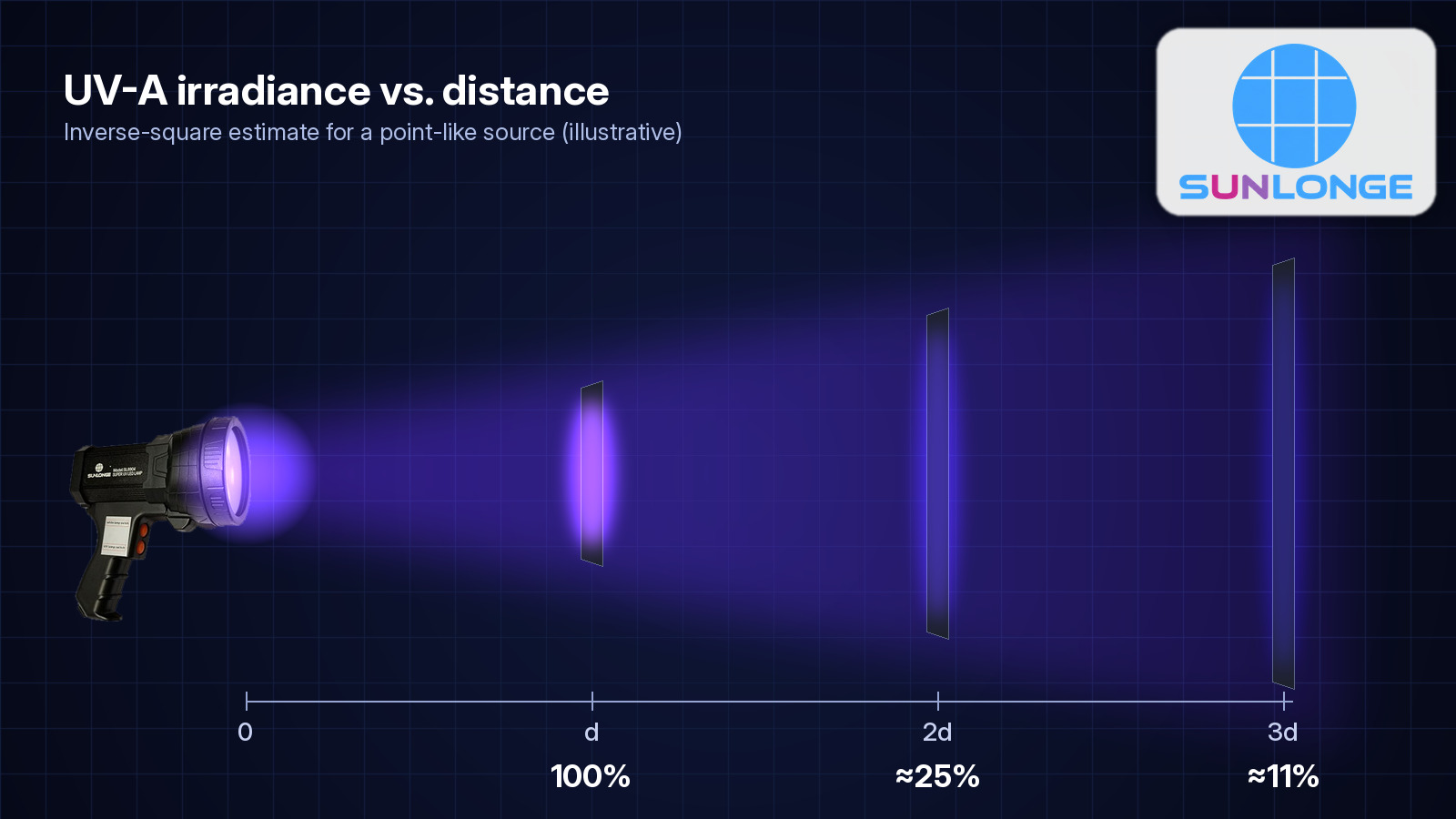
For a point-like source, irradiance follows the inverse-square law: double the distance and the irradiance drops to about one quarter. Triple it and only about one ninth remains. Lensed LED lamps don’t behave like perfect point sources, so the real fall-off depends on the optics. The practical lessons stay the same:
- A lamp that just passes 1,000 µW/cm² at 38 cm may fall below the minimum if the inspector stands further back.
- A lamp that is comfortable at 38 cm may go over a maximum limit when held close to the part.
- The only reliable number is the one you measure with a calibrated UV-A radiometer at the working distance you actually use.
Stability Over a Shift: Warm-Up, Stabilization and Battery Life
Intensity also changes over time:
- Mercury-vapor black lights need several minutes to reach full output. Industry guidance commonly cites 10 to 15 minutes, which adds waiting time and makes output vary early in a shift.
- LED UV lamps are at full output almost instantly, but output can drift slightly as the LEDs heat up until temperature stabilizes. ASTM E3022 requires manufacturers to characterize this behaviour.
- Battery-powered lamps can lose output as the battery drains. ASTM E1417 calls for battery lamps to be measured before and at the end of each use, and ASTM E1444 requires the 1,000 µW/cm² minimum to be maintained throughout the examination.
Good thermal design, regulated drive electronics and published stability figures all help a lamp deliver the same result at 4 p.m. as at 8 a.m.
Matching Intensity to the Job: The SL8904 Series as an Example
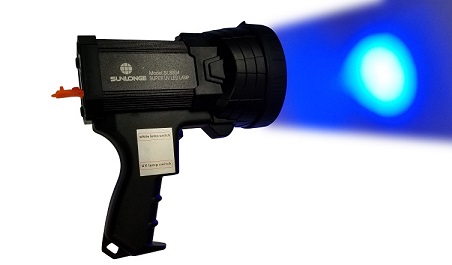
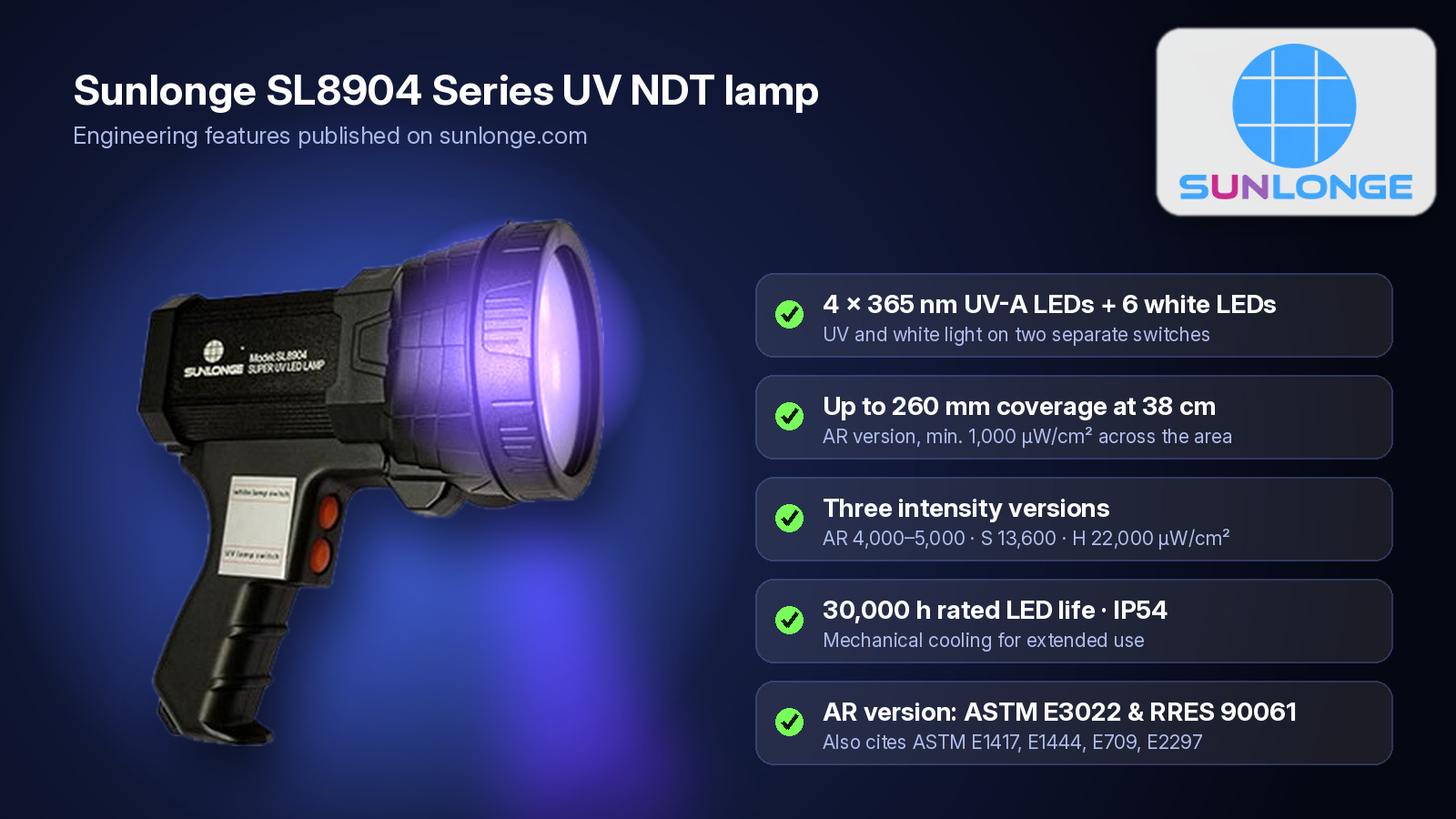
The Sunlonge SL8904 Series UV NDT lamp shows how one platform can serve different intensity needs. All versions use four 5 W, 365 nm UV-A LEDs (peak 365–370 nm) plus six white LEDs on a separate switch. According to Sunlonge’s published table:
- SL8904-AR (Aerospace RRES 90061): 4,000–5,000 µW/cm² at 38 cm, visible light below 0.5 fc (5 lux) with white-light filters, an irradiated area of 186 × 260 mm, rated for all aeronautics NDT, and compliant with ASTM E3022 and RRES 90061.
- SL8904-S (Standard): 13,600 µW/cm² at 38 cm, for industrial (non-aeronautics) NDT.
- SL8904-H (High): 22,000 µW/cm² at 38 cm, for non-aeronautics work where longer stand-off distances or larger parts call for more output.
Whatever version you choose, check irradiance at your real working distance and keep it within the maximum your procedure allows.
Why Sunlonge UV NDT Lamps Outperform Typical Alternatives
Many inexpensive “UV flashlights” are sold for general use with little more than a wattage figure. For NDT, what matters is documented and repeatable performance. Here’s how a Sunlonge UV NDT lamp compares with a typical low-cost UV light:
| Factor | Sunlonge SL8904 Series UV NDT lamp | Typical low-cost UV flashlight |
| Wavelength | 365 nm UV-A LEDs, 365–370 nm peak | Peak wavelength often not documented |
| Intensity data | Stated per version at 38 cm (AR 4,000–5,000; S 13,600; H 22,000 µW/cm²) | Rarely stated at a standard distance |
| Coverage | Up to 260 mm with at least 1,000 µW/cm² (AR) and a homogeneous beam with no dark spots | Beam profile seldom published |
| Visible light control | Below 0.5 fc (5 lux) with filters on AR; below 2 fc on S/H | Often no visible-light filter |
| Standards | AR version: ASTM E3022 and RRES 90061; meets ASTM UV-A intensity and wavelength specifications for FPI and MPI | No NDT compliance claim |
| Output stability | Stability of UV intensity above 90%; mechanical cooling for extended use | Not specified |
| Use near magnetizing equipment | 100% solid-state circuit designed to work in strong magnetic fields | Not addressed |
| Service life and protection | 30,000 h rated LED life; IP54 | Usually unstated |
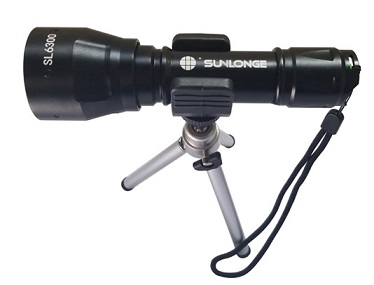
| Versatility | UV and white light used separately or together; tripod mount; battery operation | Typically UV only |
| Manufacturer support | Founded in 1999 with its own R&D team; UV intensity can be adjusted to customer requirements | Usually off-the-shelf only |
The difference isn’t only brightness. A Sunlonge lamp comes with the documentation an auditor expects, intensity options matched to the job, and optics designed to light the inspection area evenly. Those are what turn a light source into a dependable inspection tool.
A Simple Intensity Verification Routine
- At the start of each shift, measure UV-A at 38 cm and at your working distance with a calibrated radiometer.
- Measure ambient light in the booth and confirm it is 2 fc (about 20 lux) or less.
- Let LED lamps reach their stated stabilization time before taking reference readings.
- For battery lamps, measure again at the end of the inspection period.
- Record the readings so trends such as aging LEDs or a dirty filter show up early.
FAQ
What is the minimum UV-A intensity for fluorescent penetrant inspection?
ASTM E1417 and ISO 3059 both require at least 1,000 µW/cm² (10 W/m²) at the examination surface, with ambient visible light at or below about 20 lux.
Is a more powerful UV NDT lamp always better?
No. Very high irradiance can cause veiling glare and fluorescent fade. ISO 3059 advises generally staying at or below 5,000 µW/cm² for penetrant testing, and RRES 90061 caps LED lamps at 5,000 µW/cm² at 15 in. Pick the output that keeps your working distance inside your procedure’s window.
Why is UV intensity measured at 15 inches (38.1 cm)?
It’s the reference distance used in ASTM E1444 and ASTM E3022, so lamps can be compared fairly. Always confirm intensity at your actual working distance too.
How often should I check my UV NDT lamp?
ASTM E1417 and E1444 require regular checks as set in their tables and your written procedure, typically daily. Battery lamps also need readings before and after use or must keep the minimum throughout the examination.
Which Sunlonge SL8904 version should I choose?
Choose SL8904-AR for aerospace work under ASTM E3022 and RRES 90061. For general industrial NDT, SL8904-S or SL8904-H give more output for longer distances or larger areas. Sunlonge can also adjust UV intensity to your requirements.
Conclusion: Control the Light, Control the Result
UV intensity decides whether a crack reads as a crisp indication or disappears into the background. The best results come from a UV NDT lamp that delivers verified irradiance at the part: above the 1,000 µW/cm² minimum, below glare and fade limits, stable over a shift, and backed by real documentation. With 365 nm LEDs, published intensity for each version, wide even coverage, and ASTM E3022 and RRES 90061 compliance on the AR model, Sunlonge UV NDT lamps are built for that job.
Ready to tighten your inspection window? Explore the SL8904 Series UV NDT lamp, compare models in the UV NDT lamp range, or contact Sunlonge for a recommendation or a customized intensity version.