CN
CN

Finding fluorescent traces of engine oil, hydraulic fluid, compressor lubricant, and gear oil on excavators, haul trucks, pumps, and plant machinery

Oil on a machine is not a cosmetic problem. On an excavator, a haul truck, a diesel compressor, or a pipeline pump skid, oil on the housing is often the only external evidence of a seal that is about to fail, a cracked housing that is already failing, or a fitting that has been weeping into soil for weeks. The difficulty is that heavy equipment is dirty by design. Dust, old seepage, rain, diesel mist, and previous repairs paint every surface the same dark colour. A technician who wipes a stain and waits for it to return can spend a shift chasing the wrong joint.
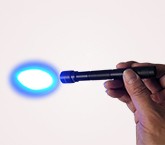
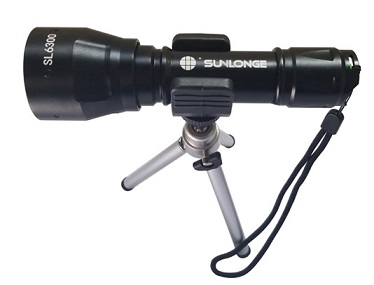
A UV Leak Detection Flashlight changes that search. Fluorescent tracer dye is added to the lubricant. The machine is run. Escaping oil carries the dye to the exact exit point. Under a true 365 nm UV-A beam the wet path lights up yellow-green against grease, rust, and mud. This article explains why oil leaks on heavy equipment are expensive, how the flashlight-and-dye method works on engines, hydraulics, compressors, and gearboxes, which lamp specifications actually matter in a muddy yard, and why Sunlonge’s SL3300-H is built as a field instrument rather than a novelty torch.
1. Why Oil Leaks on Heavy Equipment Are a Reliability Problem, Not a Housekeeping Problem
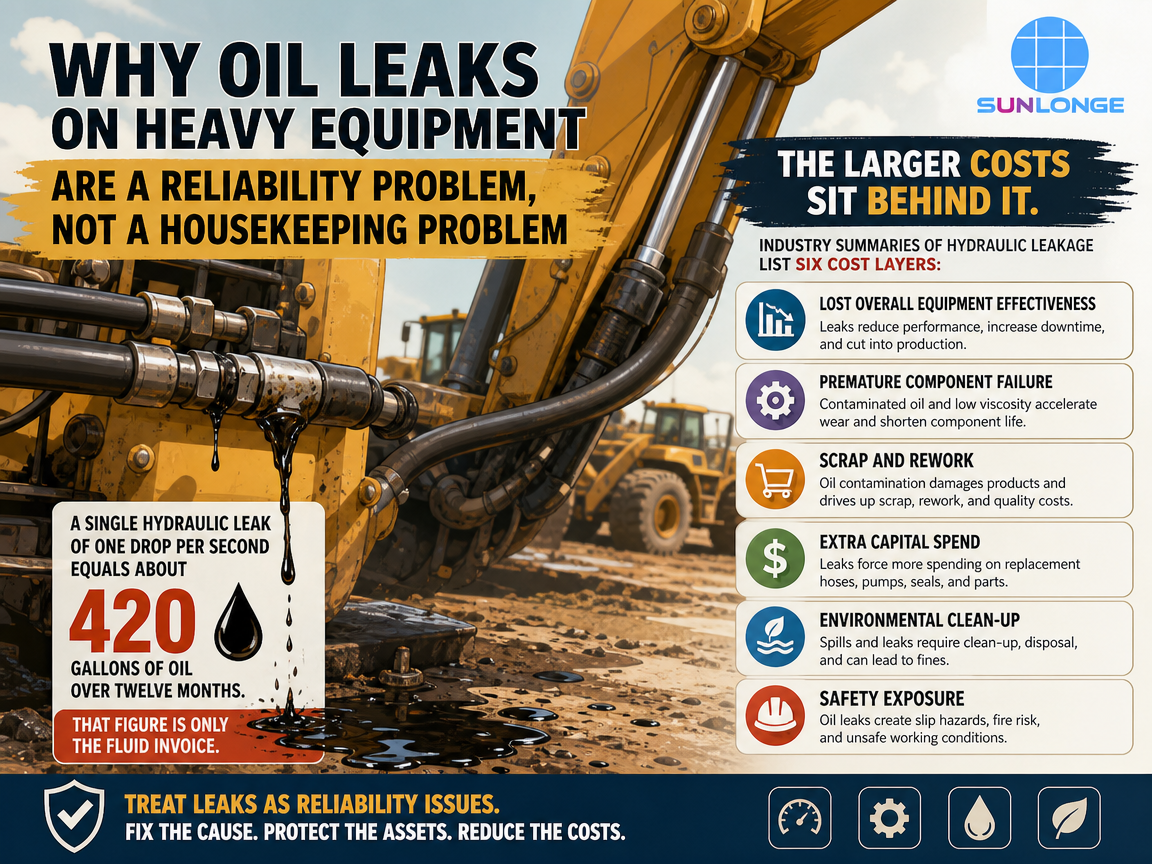
A single hydraulic leak of one drop per second equals about 420 gallons of oil over twelve months. That figure is only the fluid invoice. The larger costs sit behind it.
Industry summaries of hydraulic leakage list six cost layers: lost overall equipment effectiveness, premature component failure, scrap and rework, extra capital spend on hoses and pumps, environmental clean-up, and safety exposure. Contaminated lubricants are associated with roughly 80% of equipment stoppages and component failures, because a leak is also an inlet. Dust, water, and process chemicals enter through the same gap that oil leaves. Hydraulic failures account for about 45% of major excavator breakdowns. Construction-sector analyses put the average hydraulic system failure—parts, labour, and downtime combined—near 95,000 US dollars, with emergency repairs carrying a 150–200% premium over planned work. About 78% of those failures show detectable warning signs two to six weeks earlier. A slow weep is often that warning.
Downtime rates make the arithmetic worse. Construction fleets commonly see 20–30% unplanned downtime per asset. A mining truck can cost more than 1,000 dollars per idle hour. Crushers have been costed at up to 100,000 dollars per hour at some sites. Heavy-industry plants in recent downtime studies have been associated with average annual losses on the order of 128 million dollars per plant as unplanned hours and hourly rates both rose. Fortune Global 500 industrial companies as a group have been estimated to lose on the order of 1.5 trillion dollars a year to unplanned downtime. None of those numbers is caused only by oil leaks. All of them get larger when leaks are found late.
Environmental and regulatory exposure is the third layer. Oil that leaves a machine does not stay on the machine. It reaches soil, wash-down pits, storm drains, and, on pipeline and oilfield sites, reportable discharge thresholds. Finding the source in one pass is cheaper than repeating a clean-up because the wrong gasket was changed.
1.1 Why visual inspection fails on real machines
Heavy equipment hides leaks. Engine oil runs along a block and drips from the lowest bolt, not from the failed rear main seal. Hydraulic oil follows a hose to a clamp and drips there. Compressor lubricant mists and condenses two metres from the rod seal. Gear oil on a final drive is thrown by rotation onto an adjacent guard. The stain the operator sees is a drainage map, not a failure map.
Pressure decay and soap-bubble tests struggle for the same geometric reasons. Many circuits cannot be isolated without taking the machine out of the production plan. Intermittent leaks appear only at operating temperature and load. A UV Leak Detection Flashlight works while the machine is dirty, warm, and in place, which is the only condition that matters on a quarry bench or a plant night shift.
2. How a UV Leak Detection Flashlight Reveals Oil
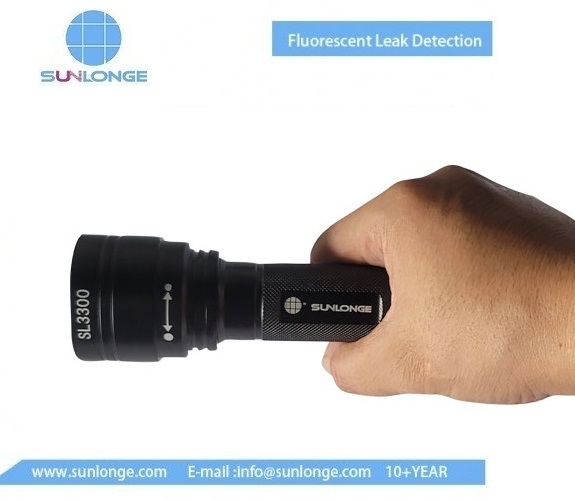
The method has three parts: a dye that dissolves in the host oil, time for that oil to circulate and escape, and a UV Leak Detection Flashlight that excites the dye at the leak face.
2.1 The dye travels with the oil
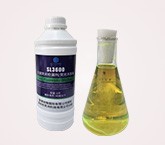
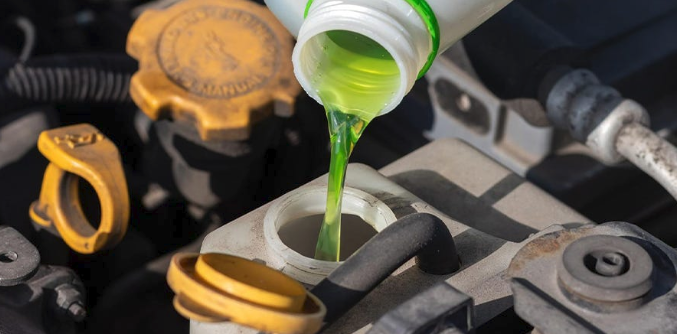
Oil-soluble fluorescent dyes are organic tracers formulated for mineral oils, synthetic PAO oils, engine oils, gear oils, compressor oils, and hydraulic fluids. They are dosed in parts per million, typically in the 500–2,000 ppm range depending on fluid darkness and system volume. Sunlonge’s SL3200 oil-soluble dye, used across automotive and industrial programs, is commonly referenced at about 500 ppm for engine oil and 500–2,000 ppm for hydraulic and transmission fluids—on the order of one litre of dye treating 1,000–2,000 litres of host fluid. Correctly specified dyes are filtered, seal-compatible, and intended to remain in the system after the inspection so the next survey does not require a fresh fill.
Once circulating, every active leak carries dye to the exterior. Old dry stains without dye are history. Fresh fluorescent trails are the current path. That distinction is what visual inspection cannot provide on a greasy excavator boom.
2.2 Why the flashlight must be 365 nm, not “UV-looking”
Professional oil dyes are tuned to absorb in the UV-A band around 365 nm and emit bright yellow-green visible light. A true 365–370 nm peak produces strong fluorescence with little visible violet glare. Consumer 395 nm “UV” torches look bright to the eye because they leak violet and blue. That visible component washes out yellow-green emission and performs poorly on dark engine and hydraulic oils. Workshop practice and dye manufacturers have repeated the same rule for years: 365 nm is the working wavelength for oil, fuel, and hydraulic tracers; 395–400 nm lamps sold for some refrigerant dyes are the wrong tool for black sump oil.
Intensity matters as much as peak. Two lamps can both say “365 nm” and produce very different glow on a thin seep in daylight. Sunlonge’s own leak-lamp guidance has long contrasted professional outputs in the 45,000–80,000 µW/cm² class at 15 inches against generic torches around 25,000 µW/cm². The SL3300-H is specified at 60,000 µW/cm² at 15 inches (38 cm), with an adjustable irradiated area of 50–80 mm at that distance. That combination is what lets a technician see a hairline weep on a valve block without crawling the machine into a dark bay.
2.3 The field sequence on heavy equipment
- Confirm fluid type and choose an oil-soluble dye compatible with engine oil, hydraulic oil, gear oil, or compressor lubricant. Do not put a water dye in a sump.
- Dose by system volume. For a dark engine oil, use the higher end of the recommended ppm range. For a light hydraulic oil, the lower end is often enough.
- Run the machine under normal load and temperature long enough for the circuit to turn over. Large hydraulic tanks and cold gearboxes need more time than a small engine sump. Half a shift is a common industrial window; follow the dye maker’s guidance.
- Wipe obvious fresh drips so you are looking at active paths, not puddles.
- Dim shop lights if you can. Outdoors, work the shadow side of the machine or wait for lower sun. Yellow or amber UV glasses raise contrast and protect eyes.
- Scan with the UV Leak Detection Flashlight at a working distance of roughly 15–40 cm. Start wide, then tighten the beam on any glow.
- Mark every fluorescent site before you wipe. Multiple leaks on one machine are normal. Repairing only the lowest drip wastes the inspection.
- After the repair, run and scan again. Residual dye in the system makes the verification step free.
3. Where the Method Pays Off on Real Assets
3.1 Diesel engines and power packs
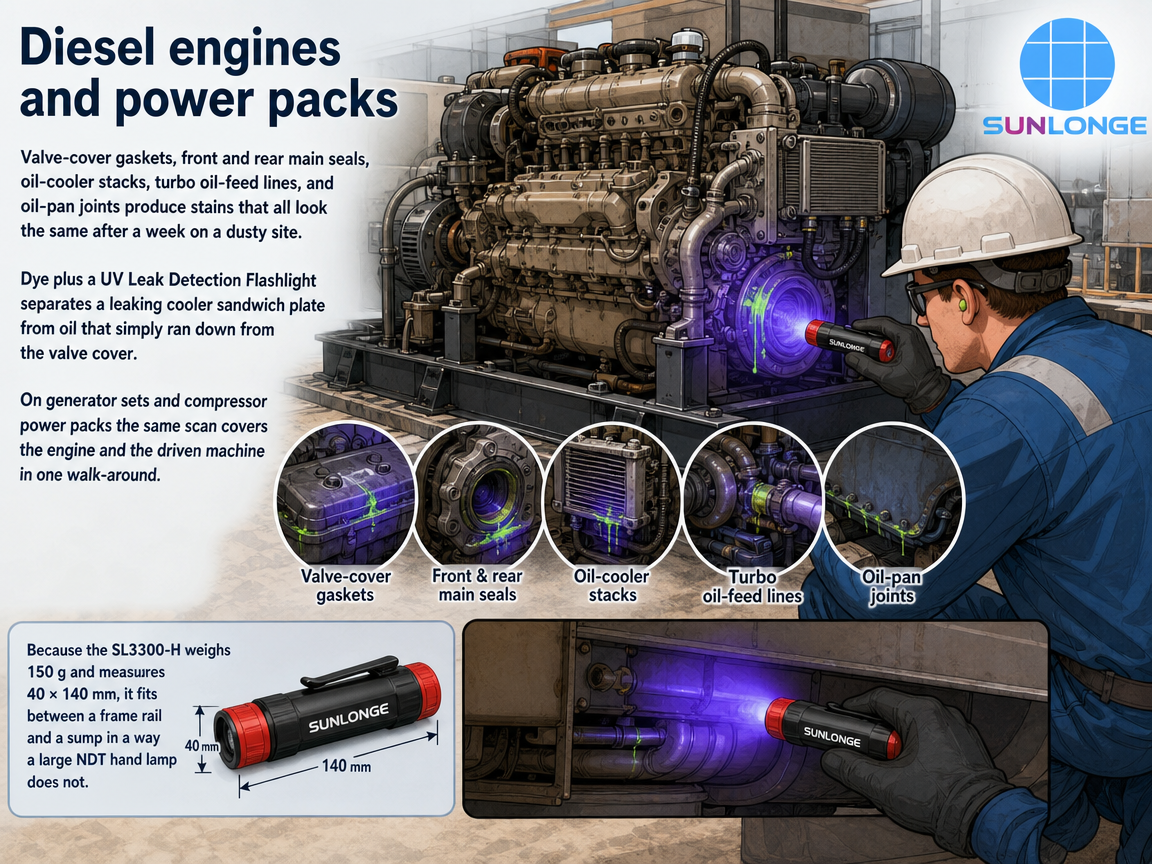
Valve-cover gaskets, front and rear main seals, oil-cooler stacks, turbo oil-feed lines, and oil-pan joints produce stains that all look the same after a week on a dusty site. Dye plus a UV Leak Detection Flashlight separates a leaking cooler sandwich plate from oil that simply ran down from the valve cover. On generator sets and compressor power packs the same scan covers the engine and the driven machine in one walk-around. Because the SL3300-H weighs 150 g and measures 40 × 140 mm, it fits between a frame rail and a sump in a way a large NDT hand lamp does not.
3.2 Hydraulic systems on excavators, loaders, and presses
Cylinders, pump cases, control-valve banks, quick couplers, and hose crimps are the usual suspects. Hydraulic oil is often lighter in colour than engine oil, so fluorescence is vivid once the dye is in the circuit. The operational gain is isolation without breaking the circuit. A machine that must keep moving dirt or holding a press tool can be scanned at the next stop rather than torn down on a guess. Given that hydraulic events dominate excavator failure statistics and that contamination through leak paths drives a large share of those events, finding the weep before the pump ingests dirt is the reliability use case, not the neatness use case.
3.3 Compressors and circulating oil systems
Reciprocating and screw compressors throw lubricant as mist. The leak origin is frequently a rod seal, shaft seal, or oil-separator gasket; the wet zone is a panel two feet away. Fluorescent dye follows the oil film. A tight, high-intensity beam from a UV Leak Detection Flashlight can be walked along the crankcase, cooler bundle, and piping until the glow starts. Plant air and process-gas compressors in manufacturing and oil and gas service are poor candidates for “clean it and watch,” because access windows are short and housings are hot.
3.4 Gearboxes, finals, and circulating lube skids
Final drives, swing gearboxes, crusher pinions, and pipeline pump gearboxes leak at input seals, output seals, and inspection covers. Gear oil is sticky and dark. A 365 nm flashlight with enough irradiance still pulls a yellow-green edge on a fresh path. On circulating lube skids the same method finds cooler tube leaks and filter-head weeps that oil analysis will later describe only as “consumption.” Combining a flashlight survey with routine oil analysis is how a reliability team turns a consumption trend into a work order with a location.
3.5 Pipeline, HVAC plant, and oilfield auxiliaries
Sunlonge’s target markets—pipeline maintenance, HVAC, industrial manufacturing, and oil and gas—are full of oil-wetted auxiliaries: engine-driven pumps, hydraulic power units for valve actuators, compressor packages, and gearbox-driven fans. These assets sit outdoors, often coated in previous product. A pocket UV Leak Detection Flashlight is the practical tool because the work is walking, climbing, and reaching, not standing at a bench.
4. What Separates a Working UV Leak Detection Flashlight from a Cheap Torch
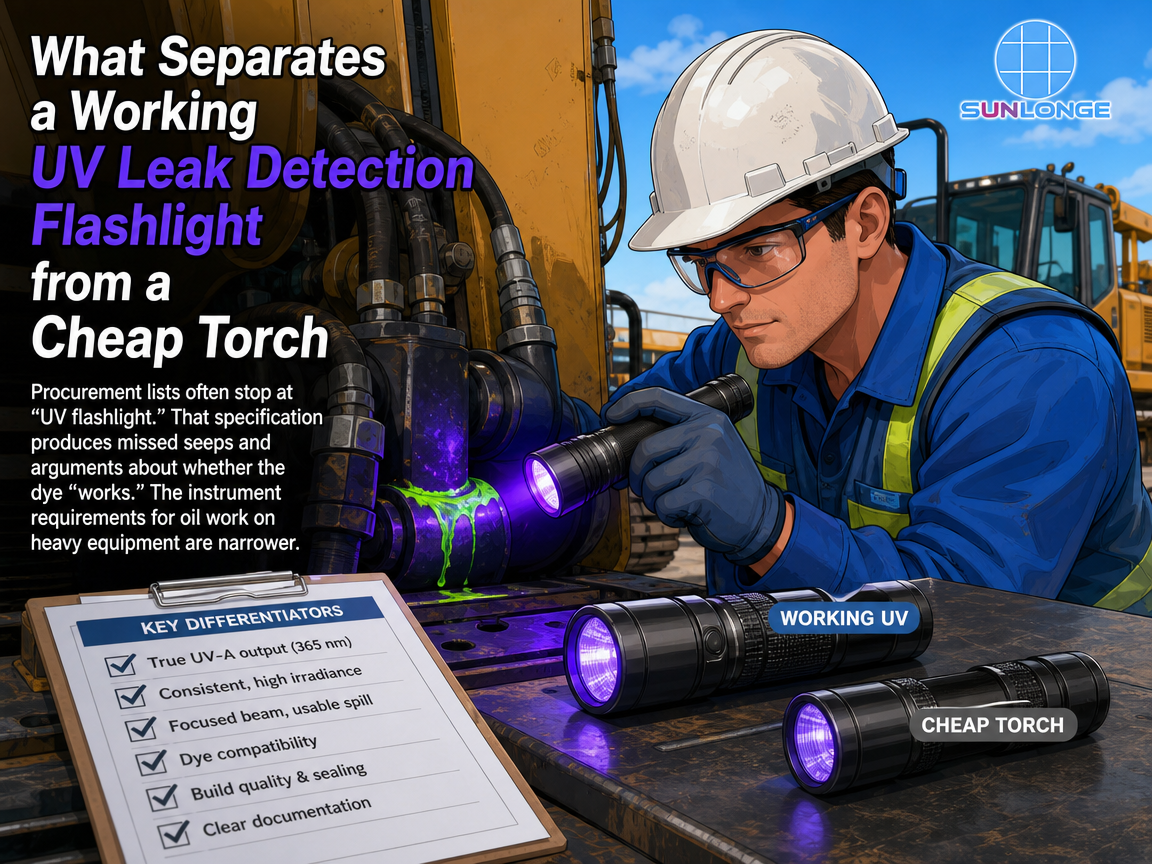
Procurement lists often stop at “UV flashlight.” That specification produces missed seeps and arguments about whether the dye “works.” The instrument requirements for oil work on heavy equipment are narrower.
4.1 Peak wavelength locked at 365–370 nm
If the LED peaks at 395 nm, oil dyes underperform. Sunlonge keeps SL3300-H at 365–370 nm with a 3 W SVC 365 nm UV LED and lens. That is the same UV-A philosophy the company uses across its NDT and leak-detection lines: excite the tracer, do not flood the scene with visible violet.
4.2 Irradiance high enough for dirty, partly lit yards
Laboratory photos of glowing dye are taken in the dark. Mine workshops and construction yards are not dark. 60,000 µW/cm² at 15 inches is the SL3300-H answer to that environment. Related Sunlonge leak flashlights in other families reach 21,000–38,600 µW/cm² on compact multi-LED bodies or higher still on dedicated high-output models. The point is documented irradiance at a stated distance, not a lumen claim meant for white light.
4.3 Constant-current drive when the battery falls
A leak survey on a haul truck is a 20–40 minute crawl. If output sags as the cell voltage drops, the last fittings on the list are inspected with a weaker lamp than the first. SL3300-H uses a constant-current driver and specifies UV intensity stability greater than 80% as the battery fades. That is a field specification, not a bench specification.
4.4 Adjustable spot for scan-then-confirm
A 50–80 mm field at 38 cm lets the technician sweep a valve bank, then close the beam on a single fitting. Fixed wide beams waste irradiance. Fixed pin spots miss the neighbouring leak. Adjustable optics are how one 150 g torch covers both jobs.
4.5 Power that matches the site
AAA cells are available at any depot. An 18650 lithium cell covers a longer shift. SL3300-H accepts both. LED life is specified up to 30,000 hours. The body is 40 × 140 mm. Those details decide whether the lamp lives in a toolbox on the machine or stays in the shop because it is awkward to carry.
5. Why Sunlonge’s UV Leak Detection Flashlight Is the Better Industrial Choice
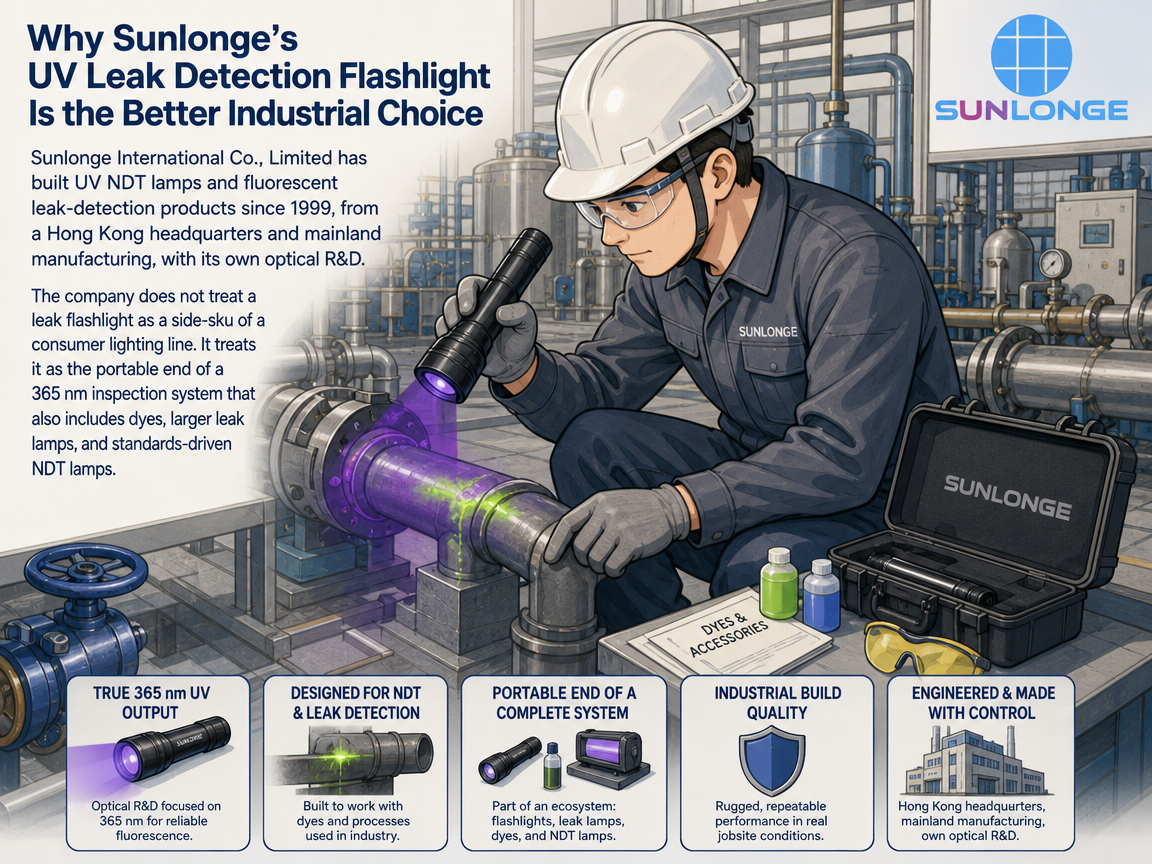
Sunlonge International Co., Limited has built UV NDT lamps and fluorescent leak-detection products since 1999, from a Hong Kong headquarters and mainland manufacturing, with its own optical R&D. The company does not treat a leak flashlight as a side-sku of a consumer lighting line. It treats it as the portable end of a 365 nm inspection system that also includes dyes, larger leak lamps, and standards-driven NDT lamps.
5.1 365 nm technology instead of violet marketing
Sunlonge’s published leak-lamp doctrine is consistent: dyes used on oils fluoresce best under 365 nm UV-A; generic 395 nm torches are the wrong spectral tool. SL3300-H is a 365–370 nm instrument. That single choice is the largest performance gap versus the products maintenance buyers find on general marketplaces.
5.2 Intensity class built for oil, not for novelty glow
60,000 µW/cm² at 15 inches puts SL3300-H in the professional leak-flashlight band Sunlonge has argued for against ~25,000 µW/cm² generics. Higher irradiance is what makes a thin hydraulic weep visible on a grey valve block in a brightly lit bay. Optical lenses over the LED, a design theme across Sunlonge flashlights, concentrate energy into a usable spot instead of wasting it in a wide, dim cone.
5.3 Stability and thermal honesty
Greater than 80% intensity stability with a constant-current driver is the difference between a lamp that is comparable at 07:30 and at 09:00. On NDT-oriented cousins such as the SL8803 / SL8803T leak and inspection lamps, Sunlonge publishes even tighter stability figures (greater than 90%) and, where required, ASTM E3022 and Rolls-Royce RRES 90061 documentation. The same engineering culture—measure the beam, regulate the current, sink the heat—sits behind the pocket SL3300-H.
5.4 A dye-plus-lamp system, not an orphan torch
A flashlight without a compatible dye is a conversation piece. Sunlonge supplies SL3200 oil-soluble fluorescent dye alongside the lamps, with published ppm guidance for engine and hydraulic volumes, and water-soluble tracers (SL3100 / SL3400 class) when the circuit is coolant rather than oil. Technicians can source lamp, glasses, and dye from one industrial vendor instead of mixing a consumer torch with an unknown tracer.
5.5 Field geometry and kit
Standard packaging for SL3300-H includes the lamp, charger, and toolbox. UV filter glasses and a spare battery are optional and should be treated as required for oil work. At 150 g the lamp can be worn, pocketed, or clipped into a bag that already holds a sample bottle and a rag. Customers in more than 30 countries have approved Sunlonge UV lights for leak and inspection duty. That distribution footprint matters when a mine or a pipeline contractor needs repeatable spares, not a one-off internet purchase.
5.6 Total cost against the leak, not against another torch
The purchase comparison that matters is not SL3300-H versus a 15-dollar violet key-ring. It is one missed hydraulic failure at ~95,000 dollars, one mining-truck hour above 1,000 dollars, or 420 gallons a year from a one-drop-per-second fitting, versus a 30,000-hour LED lamp that finds the fitting on the first survey. Sunlonge has long positioned well-specified 365 nm LED inspection tools as delivering on the order of 40% lower total illumination and inspection cost through life, energy, and avoided rework. On heavy equipment the avoided rework is a second rebuild that was scheduled because the first leak was never isolated.
5.7 A wider toolbox when the pocket lamp is not enough
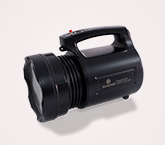
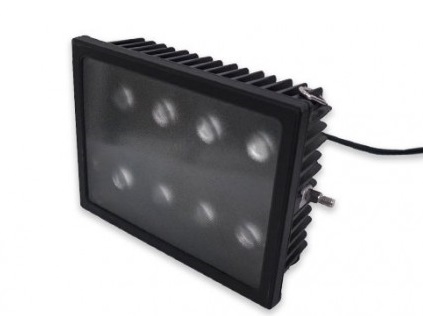
Some surveys need a larger irradiated field—undercarriage walks, skid packages, or night work on a pipe rack. Sunlonge’s SL8803T portable UV leak lamps offer 160 mm-class fields, 21,000–38,600 µW/cm² class outputs, greater than 90% stability, and multi-hour battery packs. Desktop and surface-inspection lamps in the company’s catalogue reach very high lux levels (examples in the 210,000–400,000 lux range at 30 cm) for a different job: seeing scratches and particles, not exciting oil dye. The honest specification is to use SL3300-H for confined oil traces and a larger 365 nm lamp when the geometry demands area. One vendor can supply both.
6. Comparison Tables
Table 1 places common ways of finding oil leaks on heavy equipment next to a UV Leak Detection Flashlight survey. Table 2 is the specification sheet a buyer should demand, filled in for Sunlonge SL3300-H.
| Method | What it actually finds | Works on a dirty, loaded machine? | Typical weakness on heavy equipment |
| Wipe and watch | New wetness after a delay | Poor — needs a clean baseline | Hours of delay; drip point ≠ leak origin |
| Soap / bubble on a fitting | Pressurised gas escape at that fitting | Only if the joint is accessible and isolated | Cannot scan a whole boom or crankcase |
| Pressure / level loss | That the system is leaking | Yes, but no location | Does not say which of twelve hoses failed |
| Electronic sniffers (some fluids) | Vapour near a sensor tip | Limited on heavy oils | Poor on non-volatile gear and engine oils |
| Oil analysis only | Consumption, dilution, wear metals | Yes, as a trend tool | No geographic location of the leak |
| UV Leak Detection Flashlight + dye | The live oil path, including multiple sites | Yes — designed for in-place surveys | Needs correct 365 nm lamp, dye dose, and time to circulate |
Table 1. Leak-finding methods against the constraints of heavy equipment.
| Specification | Why it matters on oil leaks | Sunlonge SL3300-H |
| Peak wavelength | Oil dyes absorb near 365 nm; 395 nm wastes contrast | 365–370 nm |
| UV LED | Source quality and optical control | 1 × 3 W SVC 365 nm LED with lens |
| UV intensity @ 15 in / 38 cm | Sees thin seeps in real lighting | 60,000 µW/cm² |
| Irradiated area @ 38 cm | Scan wide, then confirm tight | Ø 50–80 mm, adjustable |
| Intensity stability | Last fitting inspected as well as the first | >80%, constant-current driver |
| LED life | Toolbox tool, not a disposable | Up to 30,000 hours |
| Power | Depot batteries vs long shift | AAA or 18650 lithium |
| Mass / size | Fits engine bays and undercarriages | 150 g; 40 × 140 mm |
| Kit | Contrast and uptime | Lamp, charger, toolbox; glasses and spare cell optional |
| System partners | Dye must match the oil | SL3200 oil-soluble dye; other Sunlonge 365 nm lamps |
| Field proof | Spares and repeat orders | UV lights used by customers in 30+ countries |
Table 2. Buyer checklist for a UV Leak Detection Flashlight used on heavy-equipment oil systems.
7. Figures to Put in a Maintenance Briefing
| Figure | Value | Use in the argument |
| One drop per second, annual volume | ~420 gallons / year | A “small” hydraulic drip is not small |
| Stoppages linked to contaminated lubricant | ~80% | A leak is also a dirt inlet |
| Share of major excavator failures that are hydraulic | ~45% | Hydraulics are the dominant breakdown family |
| Failures with earlier warning signs | ~78%, often 2–6 weeks | Weeps are usable leading indicators |
| Average hydraulic failure cost (parts, labour, downtime) | ~USD 95,000 | Cost of missing the leak |
| Emergency vs planned repair premium | 150–200% | Why find it on a survey, not on a wrecker |
| Construction unplanned downtime (typical range) | 20–30% per asset | Fleet-level exposure |
| Mining truck idle order of magnitude | > USD 1,000 / hour | Value of a same-shift diagnosis |
| Crusher downtime (site examples) | Up to USD 100,000 / hour | Why process plant leaks get executive attention |
| Detectable leak scale cited for UV + dye methods | < 1/8 oz per year class | Sensitivity versus wipe-and-watch |
| SL3300-H irradiance | 60,000 µW/cm² @ 15 in | Professional vs ~25,000 µW/cm² generics |
| SL3300-H stability / life / mass | >80% / 30,000 h / 150 g | Shift-long, pocketable instrument |
| SL3200-class oil dye treat rate (order) | 1 L dye : ~1,000–2,000 L oil | Cost of the tracer is not the barrier |
| Sunlonge framed TCO advantage for specified LED inspection | Up to ~40% | Life and avoided rework, not purchase price |
Table 3. Statistics and product figures used in this guide. Industry cost figures are published ranges and examples, not a promise of savings at every site.
8. Implementation Discipline That Keeps Results Honest
A UV Leak Detection Flashlight does not forgive a sloppy procedure. Dose the dye from a written chart, not from habit. Record the time the machine went back to work so the circulation window is known. Do not declare “no leak” after a two-minute idle on a 400-litre hydraulic tank. Clean only after you have marked every glow; wiping first erases the map. Replace yellow glasses when they scratch; scratched lenses scatter UV and flatten contrast. Recheck after the repair with the same lamp and the dye still in the oil. If two technicians disagree, they should disagree about a marked fluorescent spot, not about a brown stain.
Safety is ordinary industrial practice: UV-A is not a toy. Use the glasses. Do not stare into the beam. Keep the lamp away from eyes and from unintended skin exposure during long crawls under a machine. Follow the dye supplier on compatibility with seals and on any site rule for tracers in environmentally sensitive catchments.
9. Questions and Answers
Q1. What is a UV Leak Detection Flashlight in this context?
It is a handheld UV-A lamp, peaking at 365–370 nm, used with oil-soluble fluorescent dye to make escaping engine oil, hydraulic fluid, compressor lubricant, or gear oil glow at the leak so a technician can see the path on heavy equipment.
Q2. Can I find oil leaks with the flashlight alone, without dye?
Some fresh oils show weak autofluorescence, but it is unreliable on dark, used, or additive-heavy lubricants. For a defensible survey, add a compatible oil-soluble dye, circulate, then scan. The flashlight is the reader; the dye is the ink.
Q3. Why not use the same 395 nm torch we use for some refrigerant dyes?
Oil tracers are built for 365 nm UV-A. A 395 nm lamp dumps visible violet onto the scene and couples poorly to dark oils. On an engine or a hydraulic block that extra glare hides the seep you came to find.
Q4. How is this different from Sunlonge’s automotive AC leak-flashlight article?
Automotive AC work hunts refrigerant-lubricant leaks on passenger vehicles in a workshop. This procedure hunts bulk oil on engines, hydraulics, compressors, and gearboxes of construction, mining, plant, and oilfield machines, usually outdoors or in a bay that cannot be fully darkened. The lamp family can overlap; the failure mode, dirt load, and cost of being wrong are different.
Q5. Will the dye hurt bearings, pumps, or seals?
Specified industrial oil dyes are formulated to stay in the host fluid without changing viscosity or lubricity when dosed correctly. Use the ppm chart for that fluid. Do not over-treat a small sump with a bulk-tank dose. Follow OEM rules where a warranty is in force.
Q6. How small a leak can the method show?
Published UV-and-dye practice describes leaks below the level that wipe-and-watch can time—down to the fraction-of-an-ounce-per-year class under good contrast. On heavy equipment the practical win is usually not a laboratory-scale pinhole. It is the difference between “the whole left-hand pump is wet” and “the case drain fitting at the twelve-o’clock port is the source.”
Q7. How long must the machine run after dyeing?
Until the circuit has turned over and any leak has had time to carry dye outside. A passenger-car engine may show traces in tens of minutes. A large hydraulic reservoir or a cold planetary gearbox may need hours of loaded work. If in doubt, scan once early and again at the end of the shift.
Q8. Why is Sunlonge SL3300-H better than a generic UV flashlight?
Documented 365–370 nm peak, 60,000 µW/cm² at 15 inches, adjustable 50–80 mm spot, constant-current drive with greater than 80% stability as the battery falls, 30,000-hour LED life, 150 g body, AAA or 18650 power, and a matching oil dye from the same industrial manufacturer. Generics usually omit the stability number, the true 365 nm peak, and the irradiance-at-distance claim.
Q9. Do I need the larger SL8803-style lamp instead?
Use SL3300-H when you must put a beam between a frame and a sump or walk a machine with one hand free. Use a larger 365 nm leak lamp when you need a 130–160 mm field or multi-hour runtime on a pipe rack. Many sites hold both.
Q10. Does this replace oil analysis?
No. Oil analysis tells you that consumption, dilution, or dirt is rising. The UV Leak Detection Flashlight tells you where the oil is leaving. Together they turn a lab trend into a wrench hour.
Q11. What about water, coolant, or fuel leaks?
Use the matching tracer. Water and glycol circuits take water-soluble dyes (Sunlonge SL3100 / SL3400 class). Fuel has its own compatible tracers. The same 365 nm flashlight generally reads them; the chemistry in the tank must match the fluid.
Q12. Where is the product specification?
The SL3300-H UV flashlight leak detection lamp is published at https://www.sunlonge.com/product/1379.html. For dye selection and larger 365 nm lamps, contact Sunlonge International Co., Limited with the fluid type, system volume, and whether the work is workshop or outdoor.
10. Conclusion
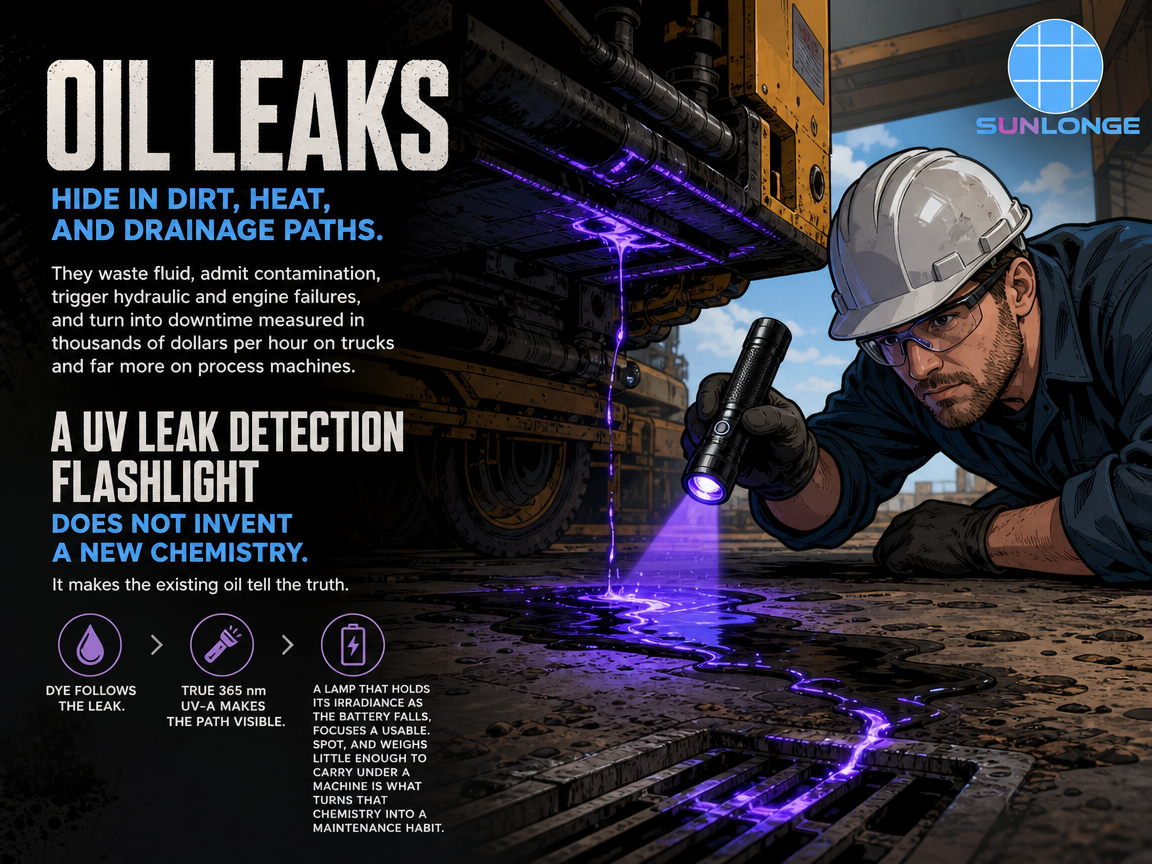
Oil leaks on heavy equipment hide in dirt, heat, and drainage paths. They waste fluid, admit contamination, trigger hydraulic and engine failures, and turn into downtime measured in thousands of dollars per hour on trucks and far more on process machines. A UV Leak Detection Flashlight does not invent a new chemistry. It makes the existing oil tell the truth. Dye follows the leak. True 365 nm UV-A makes the path visible. A lamp that holds its irradiance as the battery falls, focuses a usable spot, and weighs little enough to carry under a machine is what turns that chemistry into a maintenance habit.
Sunlonge’s SL3300-H is specified for that habit: 365–370 nm, 60,000 µW/cm² at 15 inches, adjustable 50–80 mm field, greater than 80% intensity stability on a constant-current driver, 30,000-hour LED life, AAA or 18650 power, and a 150 g body, backed by oil-soluble dyes and a wider 365 nm lamp family when the job grows. Specify the flashlight with the same seriousness used for the oil analysis contract. The leak is already on the machine. The question is whether the next person to look at it can see it.
About Sunlonge International Co., Limited
Sunlonge International Co., Limited, established in 1999 and headquartered in Hong Kong with manufacturing in mainland China, designs UV NDT lamps, fluorescent leak-detection lamps and flashlights, excitation sources, inspection lamps, and tracer dyes for pipeline maintenance, HVAC, industrial manufacturing, oil and gas, and laboratory work. SL3300-H product page: https://www.sunlonge.com/product/1379.html. Enquiries: info@sunlonge.com · www.sunlonge.com.