CN
CN

Why a stable excitation light source is the first control point for consistent fluorescence measurements in laboratory imaging and industrial inspection
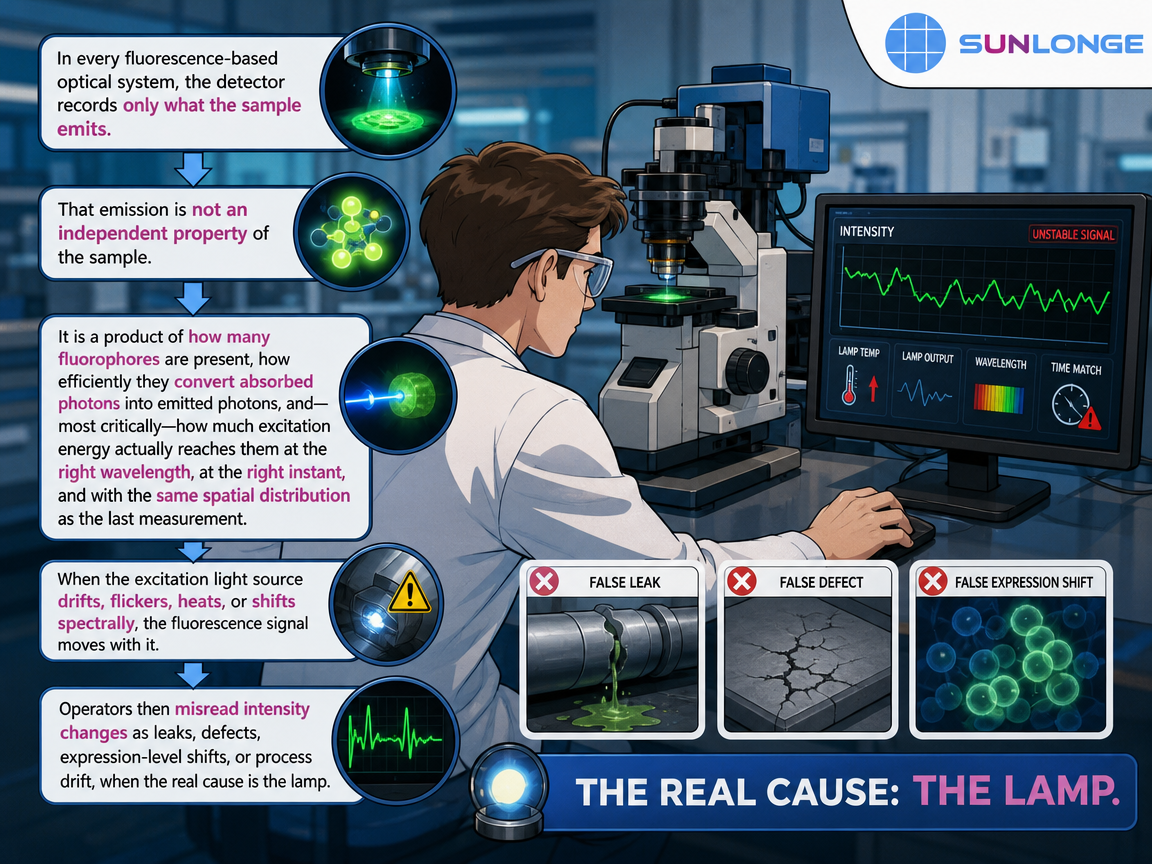
In every fluorescence-based optical system, the detector records only what the sample emits. That emission is not an independent property of the sample. It is a product of how many fluorophores are present, how efficiently they convert absorbed photons into emitted photons, and—most critically—how much excitation energy actually reaches them at the right wavelength, at the right instant, and with the same spatial distribution as the last measurement. When the excitation light source drifts, flickers, heats, or shifts spectrally, the fluorescence signal moves with it. Operators then misread intensity changes as leaks, defects, expression-level shifts, or process drift, when the real cause is the lamp.
This article explains the physical coupling between excitation and emission, the main instability mechanisms in industrial and laboratory sources, the quantitative effect of those instabilities on signal-to-noise ratio and measurement reliability, and how a purpose-built excitation light source—specifically Sunlonge’s SL8803 series—addresses those failure modes. The discussion is written for optical engineers, NDT supervisors, HVAC and pipeline reliability teams, and laboratory managers who need fluorescence data they can defend.
1. What an Excitation Light Source Actually Does
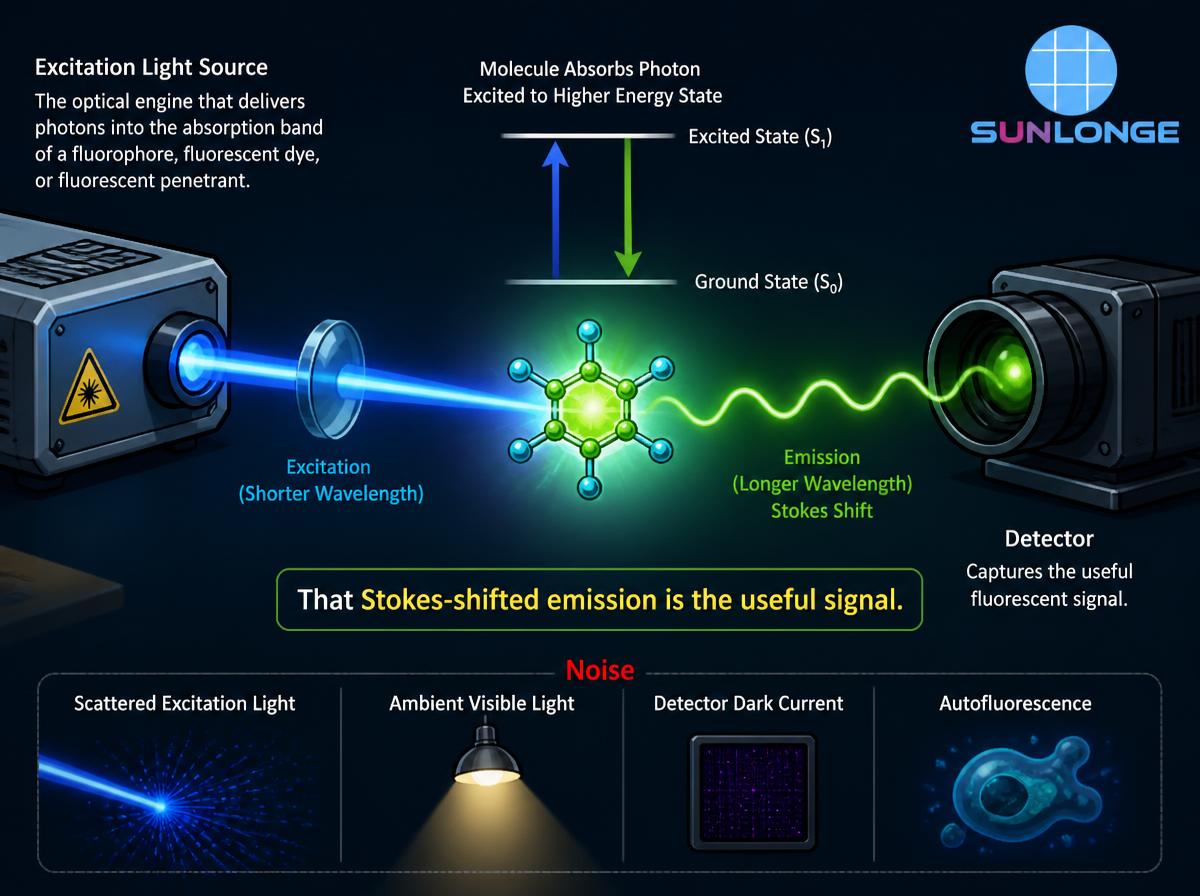
An excitation light source is the optical engine that delivers photons into the absorption band of a fluorophore, fluorescent dye, or fluorescent penetrant. The molecule absorbs those photons, is promoted to an excited electronic state, and then returns to the ground state by emitting a longer-wavelength photon. That Stokes-shifted emission is the useful signal. Everything else—scattered excitation light, ambient visible light, detector dark current, and autofluorescence—is noise.
In the optically thin limit used for most dyes, leak-detection traces, and GFP/DsRed screening, fluorescence intensity follows a linear relationship:
IF ≈ I0 × QY × 2.303 × ε × c × L × k
where IF is emitted fluorescence intensity, I0 is excitation intensity at the sample, QY is fluorescence quantum yield, ε is the molar extinction coefficient at the excitation wavelength, c is fluorophore concentration, L is path length, and k collects geometric and collection-efficiency factors. The equation is simple, and that is the problem: IF scales directly with I0. A 8% drop in excitation intensity produces an 8% drop in measured fluorescence even if the sample has not changed.
That linear coupling is why a generic LED torch, a mercury arc lamp with an aging bulb, or an unregulated laser diode is not an excitation light source in the engineering sense. An excitation light source is specified for wavelength match, spatial uniformity, intensity stability over time and temperature, low visible leakage, and a documented lifetime. Sunlonge designs the SL8803 series around those specifications rather than around raw brightness alone.
1.1 Wavelength match is not optional
Fluorophores do not absorb equally at every wavelength. GFP is efficiently excited near 455–488 nm. DsRed and many red industrial dyes respond near 525–560 nm. Fluorescent penetrants and leak-detection dyes used in oil and gas, HVAC, and pipeline work are typically excited at true 365 nm UV-A. If the source peak sits on the shoulder of the absorption curve, two things happen at once: emission falls, and any small spectral drift of the source produces a large change in effective excitation efficiency. Recent laboratory work on LED excitation has shown that spectral drift, not only power decay, is a major source of fluorescence instability. A temperature–current–spectral model of LED emission can reduce peak-to-valley fluorescence variation from the 2.18–9.41% range down to 0.44–1.25% when drive power is compensated in real time. That result is a reminder: wavelength control and thermal control are stability tools, not marketing extras.
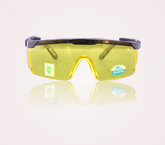
Sunlonge therefore offers discrete, application-matched peaks rather than a single “UV-ish” or “blue-ish” lamp: SL8803-H at 365 nm with a UV observation filter, SL8803-B at 455 nm with an orange filter for GFP-class emitters, and SL8803-G at 525 nm with a red filter for DsRed-class emitters. Additional 395 nm and 625 nm combinations can be built to customer demand. Matching the peak to the dye is the first step in keeping the fluorescence signal stable, because it places the source on the flattest, most efficient part of the absorption curve.
2. Why Fluorescence Signals Become Unstable
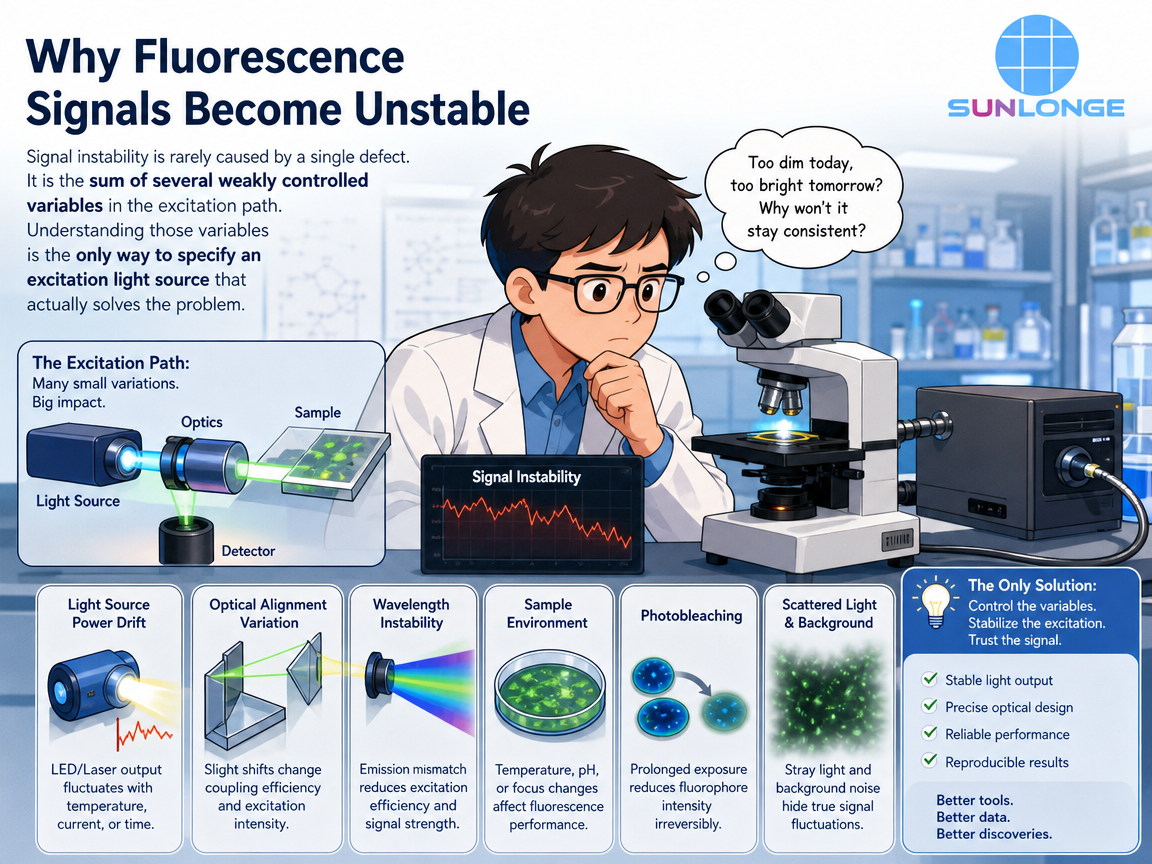
Signal instability is rarely caused by a single defect. It is the sum of several weakly controlled variables in the excitation path. Understanding those variables is the only way to specify an excitation light source that actually solves the problem.
2.1 Intensity flicker and long-term drift
Mercury and xenon arc lamps remain common in older fluorescence microscopes and some industrial booths. Short-term intensity variation of 5–10% from arc wander is typical. Medium-pressure mercury bulbs used in NDT often last only 500–2,000 hours and can lose around 20% of output after a few hundred hours, with non-uniform spatial fade. Every ignition cycle also shortens remaining life. Those sources impose a warm-up of 5–15 minutes before the plasma is usable, so “quick checks” are either delayed or performed on an unstabilized lamp.
Solid-state sources remove arc wander, but they are not automatically stable. An LED junction heats. As junction temperature rises, both radiometric power and peak wavelength move. Unregulated current supplies add ripple. ASTM E3022, the manufacturer practice for LED UV-A lamps used in fluorescent penetrant and magnetic particle testing, therefore limits LED drive-current ripple to 5% or less and requires temperature-stability and stabilization-time data for each lamp model. Aerospace specifications such as Rolls-Royce RRES 90061 and user checks under Airbus AITM 6-1001 treat output stability as a compliance item, not a preference. Stabilization under AITM-style checks is commonly defined as three readings at 30-minute intervals that stay within ±3%.
Sunlonge specifies stability of UV intensity greater than 90% for the SL8803 family and drives the LEDs with constant-current electronics rather than cheap pulse-width schemes that ASTM E3022 does not accept for NDT lamps. That specification is the industrial translation of “the fluorescence number you write down at 09:00 should still be comparable at 16:00.”
2.2 Spectral drift changes effective excitation efficiency
Even if a radiometer reports constant power, a few-nanometre red-shift of an LED peak can change the overlap integral with the fluorophore absorption spectrum. The sample then receives a different effective excitation dose. In quantitative imaging, that looks like a change in expression, dye concentration, or leak size. In NDT, it looks like a change in indication brightness. Spectrum-guided compensation research published in 2026 confirmed that LED spectral drift must be modelled together with power decay if fluorescence emission is to be held inside a 1% band.
True 365 nm UV-A LEDs with optical filtering, of the type Sunlonge uses in NDT-oriented SL8803 variants (including Nichia-class 365 nm emitters on related SL8803 UV configurations), keep the peak inside the 360–370 nm window required by ASTM E3022 and RRES 90061. That is a different design problem from a 395 nm “UV” flashlight sold for consumer leak detection. The 395 nm devices look bright to the eye because they leak visible violet; they are a poor excitation light source for professional fluorescent dyes whose absorption is centred near 365 nm.
2.3 Photobleaching is excitation-dose dependent
Photobleaching is the irreversible loss of a fluorophore’s ability to emit. The bleaching rate is proportional to the time-integrated excitation intensity and to the photobleaching quantum yield of the dye. Fluorescein, a classical reference dye, emits on the order of 30,000 photons before bleaching under typical conditions. Raise the excitation intensity without improving collection efficiency and you spend that photon budget faster. Worse, unstable sources create a moving bleaching rate: the same inspection protocol produces different remaining dye concentrations depending on whether the lamp was cold, hot, fully charged, or near the end of a battery cycle.
A stable excitation light source does not eliminate photobleaching. It makes bleaching predictable. Predictable bleaching can be managed with shorter dwell times, lower but sufficient irradiance, matched observation filters, and consistent working distance. Unpredictable bleaching cannot be calibrated out. For industrial leak detection in HVAC loops, hydraulic systems, and pipelines, that distinction decides whether a follow-up inspection is comparable to the baseline.
2.4 Spatial non-uniformity masquerades as sample variation
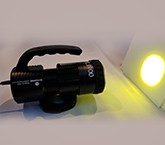
If the irradiated field is peaked in the centre and weak at the edge, two identical indications at different positions in the field produce different fluorescence. Operators then “scan” by waving the lamp, which adds another time-varying excitation function. A usable excitation light source therefore specifies not only peak intensity but irradiated area and spot uniformity. SL8803-B delivers a circular field of about 160 mm diameter at 30 cm with 15,000 lux (455 nm). SL8803-G delivers about 130 mm at 40,000 lux (525 nm). Related UV-A SL8803 configurations cover 130–160 mm at 38 cm with intensities from a few thousand to more than 20,000 µW/cm² depending on the version. The lamp head is compact (73 × 193 mm, 400 g) so the field can be placed where a large flood lamp cannot go, without sacrificing a usable, even spot.
2.5 Visible-light leakage and ambient contamination
Fluorescence contrast is IF divided by everything else the detector or the eye sees. Visible leakage from a poorly filtered source raises the floor. ASTM E3022 and RRES 90061 therefore constrain filter transmission in the visible and, for aerospace lamps, visible emission at the work surface. Sunlonge’s SL8803-AR class lamps are built to those constraints (visible emission below 0.5 foot-candles / 5 lux on the aerospace version) and are documented against ASTM E3022, ASTM E1417, ASTM E1444, ASTM E709, ASTM E2297, and Rolls-Royce RRES 90061. That filtering is as important to signal stability as the LED driver, because an unstable visible component changes background from hour to hour.
3. How a Stable Excitation Light Source Protects Measurement Reliability
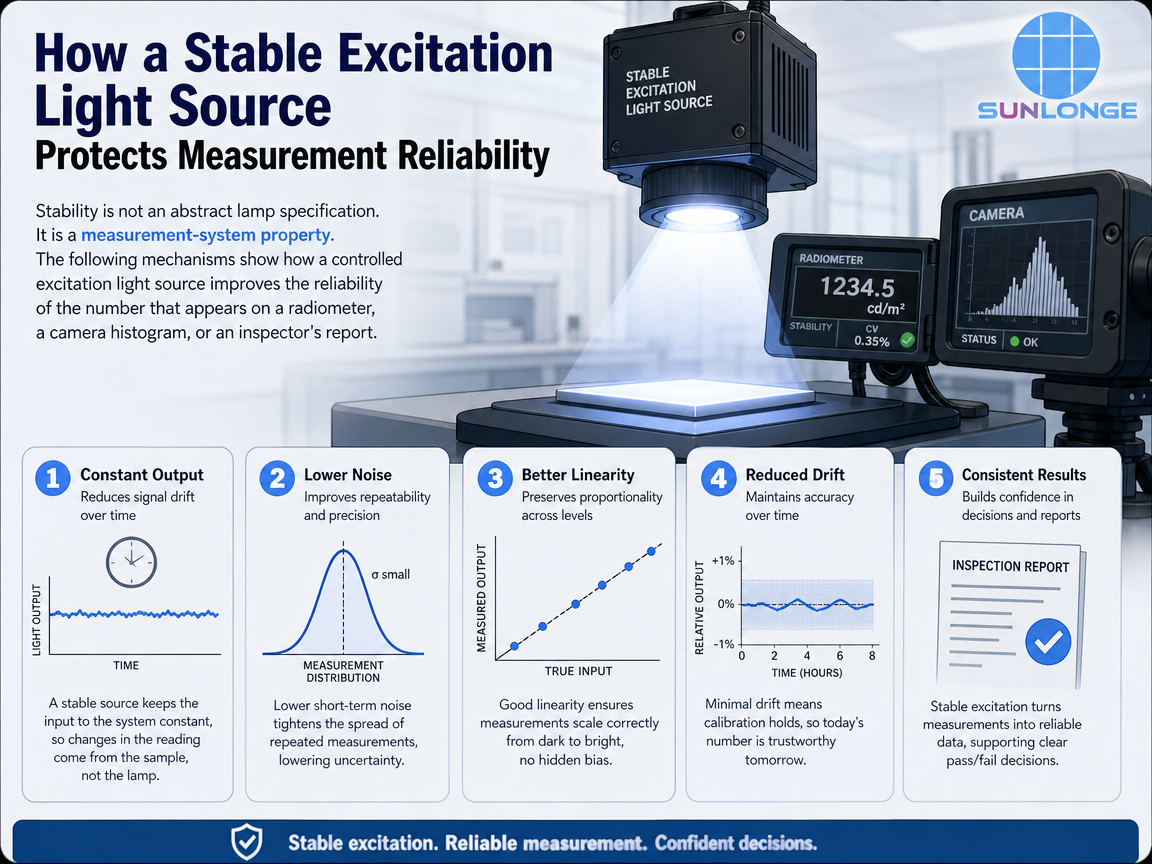
Stability is not an abstract lamp specification. It is a measurement-system property. The following mechanisms show how a controlled excitation light source improves the reliability of the number that appears on a radiometer, a camera histogram, or an inspector’s report.
3.1 Signal-to-noise ratio tracks excitation quality
In photon-limited fluorescence, signal quality improves when excitation intensity rises, fluorescence yield rises, non-fluorescence background falls, and collection efficiency rises. Increasing I0 helps only while the source itself is quiet. If the source contributes a 5% intensity noise term, that term appears directly in IF. Hardware-level reviews of biological imaging list light-source fluctuation as a primary device-related noise source and identify regulated LEDs and solid-state lasers as the practical remedy over arc lamps. For industrial work the same physics applies: a leak-detection dye that produces a 20% contrast indication cannot be graded reliably if the lamp itself wanders by 8%.
Sunlonge’s constant-current LED architecture, >90% intensity stability specification, and 30,000-hour LED life remove the two largest historical noise sources in the field: arc flicker and frequent bulb replacement. Instant-on behaviour further removes the “I measured before the lamp was ready” error that mercury systems invite.
3.2 Repeatability across shifts, sites, and seasons
Laboratory time-lapse experiments and industrial baseline-versus-retest programs both assume that Tuesday’s excitation dose equals Thursday’s. Temperature-dependent LED drift breaks that assumption unless the fixture is thermally designed and current-regulated. Sunlonge builds the SL8803 body in aluminium alloy specifically to sink LED heat, and ships a polymer battery pack with a battery-display tail switch so operators know they are not comparing a full-charge field to a depleted field. Runtime is approximately 3 hours on the main inspection beam and more than 8 hours on the side light. Those numbers matter because a mid-inspection battery sag is an excitation transient.
3.3 Quantitative comparison becomes possible
Once I0 is stable and spectrally matched, differences in IF can be attributed to concentration, path, or quantum yield—the quantities the user actually cares about. That is the difference between “the indication looks brighter today” and “the indication is 1.4× the baseline intensity at the same working distance.” Process plants, semiconductor lines, and gene-expression screening groups all need the second statement. A 2026 LED compensation study reduced fluorescence peak-to-valley variation by roughly a factor of four to seven by treating the excitation light source as a controlled, modelable subsystem. Sunlonge’s product philosophy is the industrial version of that idea: specify the source tightly enough that software compensation is a refinement, not a rescue.
3.4 Photobleaching and phototoxicity become manageable
Because bleaching rate scales with excitation dose, a source that can be run at a known, repeatable irradiance lets the user sit just above the detection threshold instead of flooding the sample. Matched observation glasses (UV, orange, or red depending on the SL8803 variant) raise collection contrast so the operator does not compensate for a poor filter by turning the lamp up. Lower, stable dose extends dye life in closed-loop HVAC and hydraulic systems and reduces phototoxic stress in live GFP/DsRed work on plants, mice, and microorganisms—the exact application set listed for the SL8803 series.
4. Laboratory and Industrial Optical Systems That Depend on This Stability
4.1 Laboratory fluorescence and reporter-gene work
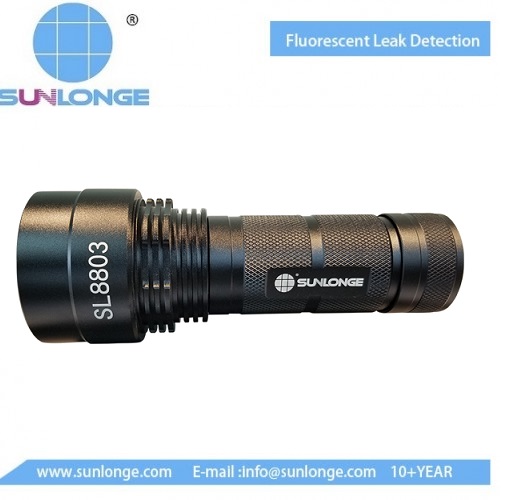
The SL8803 series is specified for GFP and DsRed observation in gene plants (rice, wheat, corn, soybean, cotton, Arabidopsis), genetic animals (mice, monkeys), and genetic microorganisms (bacteria, fungi, yeast). These are wide-field, often in-situ observations, not confocal point-scanning. The requirement is a portable, even, wavelength-matched field that does not drift while a tray of seedlings or a cage of animals is screened. A 400 g handheld excitation light source with a tripod mount and 15 cm-class side irradiation lets the same instrument move from bench to greenhouse to animal room without a new calibration story at each door.
4.2 Fluorescent leak detection in HVAC, hydraulics, and pipelines
Closed-loop systems hide leaks behind insulation, under floors, and inside plants that cannot be shut down for a dye-free inspection. Fluorescent leak-detection dyes convert those leaks into emission sites under the correct excitation light source. If the lamp intensity sags, a small leak falls below visual threshold and is recorded as “no indication.” If the lamp is too spectrally dirty, background fluorescence from oils, rust inhibitors, and house lighting swamps the indication. Sunlonge’s industrial positioning—pipeline maintenance, HVAC, manufacturing, and oil and gas—is built on that contrast problem. Related SL8803 UV-A versions deliver 21,000 µW/cm² class output at 15 inches on standard models, with high-output cousins in the broader SL8803T family reaching much higher irradiance when the inspection geometry demands it.
4.3 Fluorescent penetrant and magnetic particle inspection
NDT indications are fluorescence. Indication brightness is therefore only as stable as the excitation light source. Standards exist because the cost of a missed crack in a weld, blade, pressure vessel, or landing-gear component is not a laboratory inconvenience. ASTM E3022 defines how manufacturers must measure LED UV-A lamps. ISO 3059 defines viewing conditions. RRES 90061 adds aerospace constraints on peak wavelength, visible light, and intensity envelope. Sunlonge’s SL8803-AR configuration is built to live inside that envelope: peak 365–370 nm, controlled visible emission, documented intensity at 15 inches / 38 cm, and a certificate of conformance with the lamp. Current ripple control and thermal design are not optional extras in this market; they are the difference between a lamp that can be written into a procedure and a lamp that cannot.
4.4 Machine-vision and hybrid optical benches
Many modern inspection cells combine a fluorescence channel with a broadband surface-inspection channel. Sunlonge’s wider portfolio includes high-lux desktop and wafer inspection lamps (examples in the range of 210,000 to 400,000 lux at 30 cm on dedicated surface-inspection models). Those products solve a different problem—scatter and topography. The excitation light source problem remains spectral and radiometric stability. Plants that already use Sunlonge inspection lighting can keep the same vendor, the same filter discipline, and the same documentation style when they add a fluorescence channel, which reduces integration risk.
5. Why Sunlonge’s Excitation Light Source Outperforms Generic Alternatives
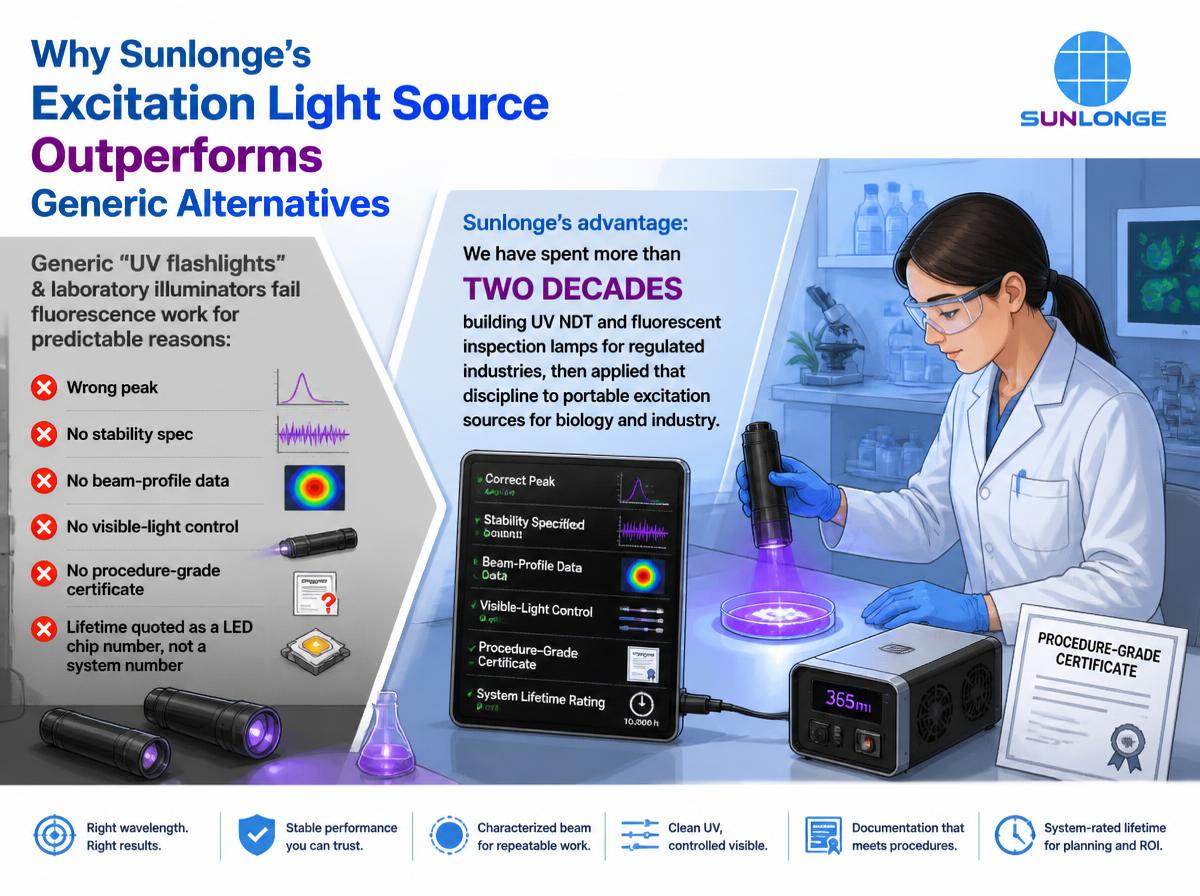
Generic “UV flashlights” and laboratory illuminators fail fluorescence work for predictable reasons: wrong peak, no stability spec, no beam-profile data, no visible-light control, no procedure-grade certificate, and a lifetime that is quoted as a LED chip number rather than a system number. Sunlonge’s advantage is that the company has spent more than two decades building UV NDT and fluorescent inspection lamps for regulated industries, then applied that discipline to portable excitation sources for biology and industry.
5.1 Application-matched wavelengths instead of a single compromise peak
One lamp cannot optimally excite GFP, DsRed, and fluorescent penetrant. Sunlonge ships SL8803-H (365 nm), SL8803-B (455 nm), and SL8803-G (525 nm) with the correct observation filter for each, and will combine 365 / 395 / 455 / 525 / 625 nm on request. That portfolio is the practical answer to spectral mismatch, which is one of the two dominant excitation-side instability terms.
5.2 Documented intensity, field size, and stability
SL8803-B: 15,000 lux at 30 cm, 160 mm field. SL8803-G: 40,000 lux at 30 cm, 130 mm field. Stability of intensity: greater than 90%. LED life: 30,000 hours. Body: aluminium alloy, 73 × 193 mm, 400 g. Power: 100–240 V charger plus polymer battery, about 3 hours on the inspection beam. These are not catalogue ornaments. They are the numbers a quality engineer puts into a work instruction. Generic products rarely publish a stability figure at all.
5.3 Standards pedigree from the NDT side of the house
Sunlonge was established in 1999, is headquartered in Hong Kong, manufactures in mainland China, and maintains its own R&D team for special lamps. The same SL8803 platform exists in NDT configurations that comply with ASTM E3022 and Rolls-Royce RRES 90061, with supporting references to ASTM E1417, E1444, E709, and E2297. Each relevant lamp ships with measurement documentation. That pedigree matters even when the customer is a plant-science laboratory rather than an aerospace NDT shop, because the thermal, ripple, filter, and beam-profile work required by those standards is exactly the work that keeps a fluorescence signal still.
5.4 Total cost of ownership, not purchase price
Mercury booths consume bulbs every few months in multi-shift use, require hazardous disposal, and waste 5–15 minutes per start. Unregulated LED torches are cheap on day one and expensive when indications are missed or experiments are repeated. Sunlonge’s LED architecture is consistent with the 10,000–30,000+ hour class of industrial UV-A LEDs, and the company has long positioned well-specified LED inspection lighting as delivering on the order of 40% lower total illumination cost through energy, replacement, and downtime reduction. Instant full output, unlimited on/off cycling, and mercury-free construction are part of that arithmetic.
5.5 Field geometry that industrial work actually needs
Pipeline galleries, rooftop HVAC plant, engine bays, and greenhouse benches do not look like a fluorescence microscope. They need a handheld excitation light source with a wide, even spot, a tripod option, protective glasses, and a toolbox kit. SL8803 includes those accessories as standard or specified options. The 15 cm-class side irradiation and compact head are deliberate: they put photons on surfaces that a bench illuminator cannot reach, without breaking the uniformity that quantitative comparison requires.
5.6 Custom non-standard sources
Sunlonge states as a company capability that it masters core optical technology for parallel and special light sources and will build non-standard wavelengths and intensities to customer demand. For an optical system that uses an unusual dye, a dual-band protocol, or a fixed working distance inside a machine, that custom path is often faster than forcing a catalogue laser into an application that did not need coherence in the first place.
6. Key Technical Comparison
The table below condenses the stability-relevant differences between the source classes most often proposed for fluorescence work, and places Sunlonge’s SL8803-class excitation light source in that landscape. Values are typical of the class; always confirm the certificate that ships with a specific serial number.
| Attribute | Mercury / xenon arc | Generic LED torch | Sunlonge SL8803 excitation light source |
| Peak wavelength control | Discrete mercury lines; aging shifts output | Often 395 nm “UV” or unstated blue | Specified 365 / 455 / 525 nm (also 395 / 625 nm custom) |
| Short-term intensity noise | 5–10% class from arc wander | Unspecified; often unregulated | Designed for >90% intensity stability |
| Warm-up to usable output | 5–15 minutes | Instant, but thermally drifting | Milliseconds to full LED output |
| Typical service life | 500–2,000 h (medium-pressure) | Chip-rated, system unproven | 30,000-hour LED life |
| Drive / ripple discipline | Ballast dependent | Rarely specified | Constant-current; NDT variants aligned with ASTM E3022 ripple limits |
| Visible leakage control | Filter dependent, degrades | Usually poor | Matched observation filters; AR versions <0.5 FC visible |
| Field uniformity | Reflector dependent | Hot-spot beam common | Even spot; 130–160 mm class at 30–38 cm |
| Documented compliance | Older UV-A practices | None | ASTM E3022, RRES 90061 on AR/NDT configurations |
| Portable mass | Booth or heavy hand lamp | Light but uncontrolled | 400 g handheld, aluminium body, tripod kit |
| Best use | Legacy booths only | Non-quantitative spotting | Quantitative fluorescence, leak detection, FPI/MPI, GFP/DsRed |
7. Recommended Specification Checklist for a Stable Excitation Light Source
Use the following checklist when comparing vendors. If a supplier cannot answer these items in writing, the fluorescence signal will answer them later—usually during a disputed inspection or a failed replicate.
- Peak wavelength stated in nanometres, not as “UV” or “blue,” and matched to the dye absorption maximum.
- Intensity at a defined distance (30 cm or 15 in / 38 cm), in lux or µW/cm², with a beam diameter.
- Stability figure over time and temperature (Sunlonge: >90% intensity stability on SL8803).
- LED or laser lifetime as a system rating, not a bare-die rating (Sunlonge: 30,000 hours).
- Current regulation method and, for UV-A NDT, ripple within ASTM E3022 limits (≤5%).
- Visible-light emission and filter set, including operator glasses matched to the emission band.
- Stabilization behaviour after switch-on, consistent with the idea behind AITM-style ±3% checks.
- Thermal design of the housing (metal heat path, not a sealed plastic tube).
- Certificate of wavelength and output with the individual unit when the work is regulated.
- Accessories that freeze geometry: tripod, defined working distance, and a battery-state display.
8. Implementation Notes for Optical-System Integrators
A stable excitation light source still fails if the rest of the optical system re-introduces variability. Lock working distance; the inverse-square law turns a 5 cm change at close range into a large intensity error. Use the supplied observation filter or a matched emission filter on the camera. Keep the lens and filter clean; scatter from dust is a background term that changes daily. Record lamp serial number, battery state, and ambient temperature with each quantitative run. For NDT, verify irradiance with a calibrated UV-A radiometer at the same distance used in the procedure. For laboratory work, include a fluorescent reference slide or a sealed dye cuvette at the start and end of a session so any residual source drift is visible.
Where the protocol is ratiometric (two excitation bands, or excitation versus a reference scatter channel), stability requirements tighten further, because each band can drift differently. Dual-wavelength SL8803 configurations and Sunlonge microscope fluorescence adapters exist for that case. Do not mix an unregulated 455 nm torch with a regulated 525 nm module and call the ratio a biological result.
9. Figures Worth Remembering
The following figures are the ones that should sit in a specification sheet or a management presentation. They are drawn from Sunlonge product data and from the broader technical literature on excitation and fluorescence stability.
| Metric | Figure | Why it matters for fluorescence stability |
| SL8803 intensity stability | >90% | Caps the excitation term that maps 1:1 into IF |
| SL8803 LED lifetime | 30,000 hours | Removes year-scale source replacement as a drift event |
| SL8803-B illuminance @ 30 cm | 15,000 lux (455 nm) | GFP-class excitation with a defined dose |
| SL8803-G illuminance @ 30 cm | 40,000 lux (525 nm) | DsRed-class excitation with a defined dose |
| Irradiated field @ 30 cm | 130–160 mm class | Keeps two indications in the same dose envelope |
| Handheld mass | 400 g | Geometry stays repeatable in the field |
| Inspection-beam runtime | ~3 hours | Avoids mid-survey battery sag |
| LED vs mercury life (typical) | 30,000 h vs 500–2,000 h | Fewer spectral and intensity discontinuities |
| Arc-lamp short-term noise (typical) | 5–10% | Directly inherited by IF if used as excitation |
| ASTM E3022 current ripple limit | ≤5% | Bounds electronic contribution to flicker |
| AITM-style stability check | ±3% over three 30-min readings | Field definition of “the lamp has settled” |
| LED spectral-compensation study | 2.18–9.41% → 0.44–1.25% p–v | Shows how much spectrum+power drift can move IF |
| Fluorescein photons before bleach (order) | ~30,000 | Reminder that excess, unstable dose spends dye life |
| TCO reduction claimed for specified LED lighting | Up to ~40% | Stability and life are cost variables, not only quality variables |
| Company operating history | Since 1999 | Process knowledge behind the lamp, not only the chip |
10. Questions and Answers
Q1. What is an excitation light source, in one sentence?
An excitation light source is a wavelength-controlled illuminator designed to raise fluorophores into their excited state with a stable, uniform, and documented photon dose so the resulting emission can be compared across time and instruments.
Q2. Why does fluorescence intensity follow the excitation light source so closely?
In the linear (optically thin) regime used for most dyes and penetrants, emitted intensity is proportional to excitation intensity, quantum yield, and concentration. If quantum yield and concentration are constant, any change in the excitation light source appears as a change in the measured signal.
Q3. Is a brighter excitation light source always better?
No. Excess intensity accelerates photobleaching and can saturate the fluorophore or the detector. The correct source is bright enough for the indication or image to clear the noise floor, spectrally matched to the dye, and stable enough that today’s dose equals tomorrow’s dose. SL8803 variants offer different lux and µW/cm² levels so the dose can be chosen rather than maximised.
Q4. How is Sunlonge’s SL8803 different from a consumer UV or blue flashlight?
SL8803 publishes peak wavelength, illuminance or irradiance at a stated distance, irradiated area, intensity stability greater than 90%, 30,000-hour LED life, matched observation filters, and—on NDT configurations—compliance with ASTM E3022 and RRES 90061. A consumer light publishes almost none of that and often peaks at 395 nm, which is the wrong band for professional 365 nm dyes.
Q5. What stability number should I write into a procedure?
Write the manufacturer’s stated stability (for SL8803, >90% intensity stability) plus a user verification rule. For aerospace-influenced work, adopt an AITM-style check: three readings 30 minutes apart inside ±3% before the lamp is released for quantitative use that shift.
Q6. Does LED spectral drift still matter if power looks constant on a radiometer?
Yes. A radiometer integrates power in its sensor band. If the LED peak slides along the dye’s absorption curve, effective excitation efficiency changes even when the radiometer reading does not. That is why peak-wavelength control and thermal design belong in the excitation light source specification.
Q7. Can I use the same excitation light source for GFP plants and for pipeline leak detection?
Not the same wavelength. Use SL8803-B (455 nm) or a custom blue for GFP, SL8803-G (525 nm) for DsRed-class emitters, and a 365 nm SL8803-H or NDT UV-A configuration for fluorescent leak dyes and penetrants. The mechanical platform can be the same family; the peak must follow the molecule.
Q8. How do certifications change the stability argument?
ASTM E3022 forces the manufacturer to measure spectrum at ambient and at maximum operating temperature, beam profile, stabilization time, housing temperature, and current ripple. RRES 90061 adds aerospace limits on peak wavelength and visible light. A lamp that has passed those tests has already been treated as a measurement instrument. A lamp that has not is a flashlight.
Q9. What about lasers—are they more stable than an LED excitation light source?
A well-stabilized, temperature-controlled laser can be extremely quiet and is the right tool when the optical system needs coherence, a single-mode fibre, or a sub-nanometre line (confocal, Raman, interferometry). For wide-field fluorescence, leak detection, and NDT, that coherence is unused cost and unused safety burden. A regulated LED excitation light source such as SL8803 is the more stable practical choice in those geometries, with longer typical system life and simpler integration.
Q10. How does Sunlonge reduce lifetime cost while improving stability?
By replacing short-lived, slow-start mercury sources and unregulated torches with 30,000-hour LEDs, instant output, constant-current drive, and procedure-grade documentation. Fewer replacements, less downtime, lower energy, and fewer repeated inspections are the cost side of the same stability design. Sunlonge has long framed that package as delivering on the order of 40% cost advantage against poorly specified illumination.
Q11. What accessories actually affect signal stability?
A tripod freezes working distance and angle. Matched observation glasses or emission filters raise contrast so operators do not over-drive the source. A battery display prevents a depleting pack from becoming a hidden intensity ramp. The SL8803 standard kit is built around those items for a reason.
Q12. Where should I go next if I need a configured excitation light source?
Review the SL8803 series page at https://www.sunlonge.com/product/1349.html and contact Sunlonge International Co., Limited with your fluorophore or dye, working distance, duty cycle, and any standard you must meet (ASTM E3022, RRES 90061, internal quality procedure). Custom wavelength combinations are available when a catalogue peak is not the right overlap.
11. Conclusion
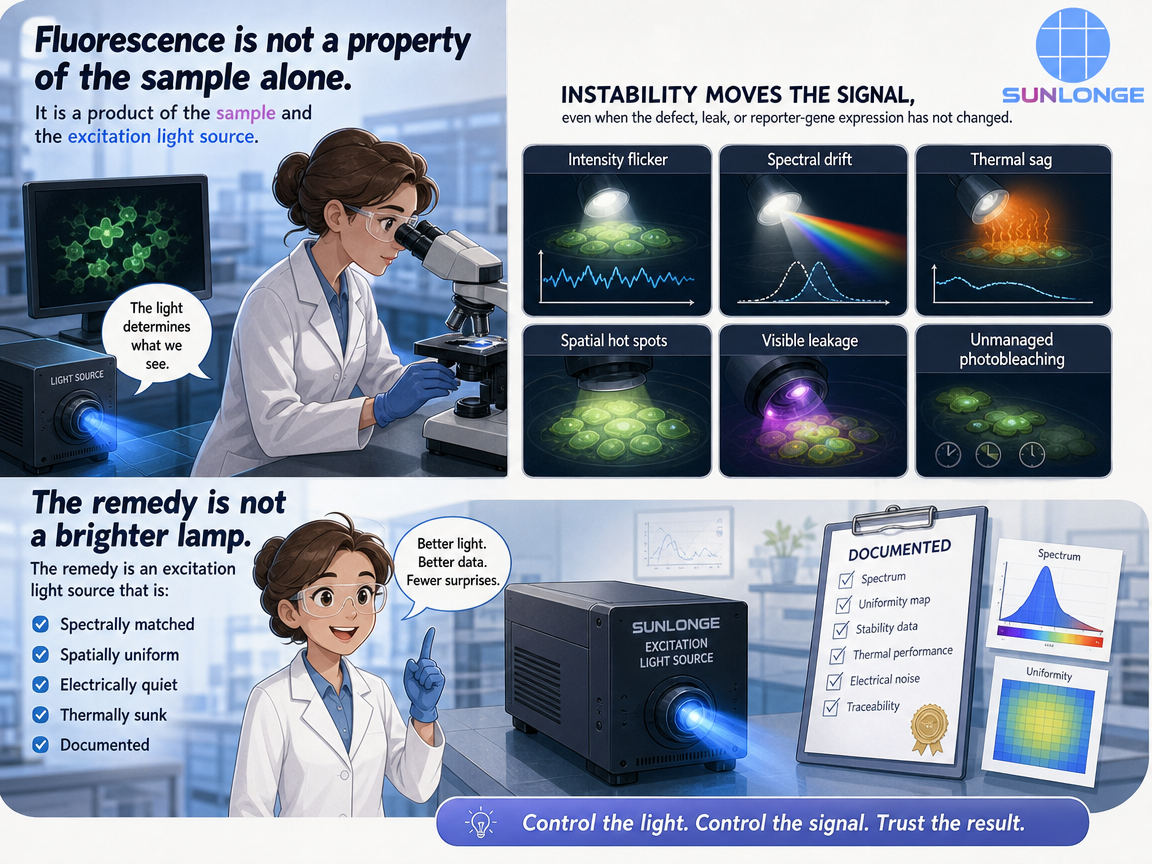
Fluorescence is not a property of the sample alone. It is a product of the sample and the excitation light source. Intensity flicker, spectral drift, thermal sag, spatial hot spots, visible leakage, and unmanaged photobleaching all move the recorded signal even when the defect, leak, or reporter-gene expression has not changed. The remedy is not a brighter lamp. The remedy is an excitation light source that is spectrally matched, spatially uniform, electrically quiet, thermally sunk, and documented.
Sunlonge’s SL8803 series is built to that definition. It offers discrete 365 nm, 455 nm, and 525 nm peaks (with further custom bands), 15,000–40,000 lux class output at 30 cm depending on colour, a 130–160 mm usable field, greater than 90% intensity stability, 30,000-hour LED life, a 400 g handheld aluminium body, and—on NDT configurations—the ASTM E3022 and Rolls-Royce RRES 90061 pedigree that regulated inspection already requires. Those attributes are why the same platform can serve a greenhouse GFP screen at 09:00 and a pipeline fluorescent-dye survey at 14:00 without a different stability story.
If measurement reliability is the requirement, specify the excitation light source with the same seriousness used for the camera, the radiometer, and the dye. Then specify Sunlonge when the work has to be repeatable.
About Sunlonge International Co., Limited
Sunlonge International Co., Limited, established in 1999 and headquartered in Hong Kong with manufacturing in mainland China, designs and builds UV NDT lamps, fluorescent leak-detection lamps, excitation light sources, wafer and surface inspection lamps, and related dyes and adapters. Core markets include pipeline maintenance, HVAC, industrial manufacturing, oil and gas, aerospace NDT, and laboratory fluorescence. Product information for the SL8803 portable excitation LED light source is published at https://www.sunlonge.com/product/1349.html. General enquiries: info@sunlonge.com · www.sunlonge.com.